
Hashimoto's Disease: Symptoms, Diagnosis and Treatment

Forbes Health Advisory Board · Naturopathic Doctor
Hashimoto's disease is an autoimmune disorder in which the immune system makes antibodies that attack the thyroid gland, and in the United States it is the most common cause of hypothyroidism, or an underactive thyroid. Cleveland Clinic lists three blood tests used to diagnose it: TSH, free T4 and an antithyroid antibody test. When it causes hypothyroidism, the treatment is thyroid hormone replacement with levothyroxine. It's a lifelong condition, and with lifelong monitoring and treatment, Cleveland Clinic calls the outlook excellent.
One limit is worth knowing up front. According to MedlinePlus, a TSH test shows how well your thyroid is working, but it can't show what is causing a thyroid problem. This guide covers what Hashimoto's is, the symptoms, why it can go unnoticed, how it's diagnosed and treated, and what to ask for at your next appointment. It's general information, and it isn't a substitute for advice from your own clinician.
What Is Hashimoto's Disease?
Hashimoto's disease is an autoimmune disorder that can cause hypothyroidism, and rarely hyperthyroidism, according to the National Institute of Diabetes and Digestive and Kidney Diseases (NIDDK). The thyroid is a small, butterfly-shaped gland in the front of your neck. In Hashimoto's, three things happen to it:
- The immune system makes antibodies that attack the thyroid gland.
- Large numbers of white blood cells build up in the thyroid.
- The thyroid becomes damaged and can't make enough thyroid hormones.
That matters well beyond the neck, because thyroid hormones control how your body uses energy and affect nearly every organ. The condition has other names too: Hashimoto's thyroiditis, chronic lymphocytic thyroiditis and autoimmune thyroiditis.
Gabriel Rocha, PA-C, MMSc, IFMCP, a functional medicine provider at Med Matrix, separated the two terms this way on our podcast episode on Hashimoto's and thyroid antibodies: "hypothyroidism tells me the factory isn't producing enough product. Hashimoto's tells me one reason the factory may be getting damaged."
Who gets Hashimoto's
The number of people with Hashimoto's disease in the United States is unknown, NIDDK says. It adds that most cases of hypothyroidism, for which Hashimoto's is the most common cause, are mild or have few obvious symptoms. Your chances go up with:
- Being a woman. It's 4 to 10 times more common in women than men, and it more often develops in women ages 30 to 50 (NIDDK). It can also affect men, and it can occur at any age, including in children (American Thyroid Association, or ATA).
- Family history, if other family members have the disease.
- Other autoimmune disorders. NIDDK names celiac disease, lupus, rheumatoid arthritis, Sjögren's syndrome and type 1 diabetes, and Cleveland Clinic adds Addison's disease and pernicious anemia.
If you already live with one autoimmune condition, our page on autoimmune diseases and the article on the root cause of autoimmune disease are related reading.
Where Hashimoto's fits among thyroid conditions
- Hypothyroidism: the thyroid doesn't make enough thyroid hormones to meet your body's needs. Hashimoto's is its most common cause.
- Hyperthyroidism, also called overactive thyroid. Having more thyroid hormone than you need speeds up body functions.
- Graves' disease, an autoimmune thyroid disorder and the most common cause of hyperthyroidism (MedlinePlus).
- Other types of thyroiditis. Subacute thyroiditis involves a painfully inflamed and enlarged thyroid, postpartum thyroiditis develops after a woman gives birth, and silent thyroiditis is painless. NIDDK says all three can cause a phase of too much thyroid hormone followed by hypothyroidism.
- Thyroid nodules, small lumps in the thyroid gland. Cleveland Clinic advises seeing a provider if you notice a change in your thyroid.
Symptoms of Hashimoto's Disease
Many people with Hashimoto's disease have no symptoms at first. ATA says it often progresses very slowly over many years, and you may not have any symptoms early on, even if thyroid antibodies show up in your blood tests. Cleveland Clinic calls an enlarged thyroid, or goiter, a common first sign. A goiter can make the front of the neck look swollen and may create a feeling of fullness in your throat, though it's usually not painful (NIDDK). ATA adds that it may cause neck discomfort, pressure or difficulty swallowing. As the disease progresses, you may develop one or more symptoms of hypothyroidism. Between them, NIDDK and Cleveland Clinic list these:
- Fatigue
- Weight gain
- Trouble tolerating cold
- Constipation
- Dry skin, and dry, thinning or brittle hair, or hair loss
- Joint and muscle pain
- A slower-than-normal heart rate
- Low or depressed mood
- Puffy eyes and face
- Memory problems or difficulty concentrating
- Heavy or irregular periods, or fertility problems
- Decreased sex drive
Cleveland Clinic describes how hypothyroidism can make you feel "off." You may feel tired, sluggish or have trouble thinking clearly. For the weight question in particular, see thyroid and weight gain, and for tiredness that won't lift, our page on fatigue.
Symptoms that concern women
MedlinePlus lists two symptoms for women in particular: heavy or irregular menstrual periods, and fertility problems in women. NIDDK notes that because hypothyroidism can cause fertility problems, women who have trouble getting pregnant often get tested for thyroid problems. Left untreated, hypothyroidism can also cause problems during pregnancy, and Cleveland Clinic says it can increase the risk of miscarriage, preterm birth and preeclampsia. NIDDK says thyroid medicines can help prevent problems and are safe to take during pregnancy, though ATA says animal thyroid extract shouldn't be used and T3 isn't recommended in pregnancy. ATA lists planning a pregnancy, or already being pregnant, as a reason to call your doctor.
A rare early phase that feels the opposite
Rarely, early in the course of the disease, thyroid damage may release too much thyroid hormone into your blood and cause symptoms of hyperthyroidism (NIDDK). MedlinePlus lists those as including a rapid or irregular heartbeat, feeling nervous or irritable, and trouble sleeping. Still, NIDDK says most people with Hashimoto's disease develop hypothyroidism. Cleveland Clinic adds that not everyone with Hashimoto's develops it.
When it's an emergency
Without treatment, hypothyroidism can lead to high cholesterol, heart disease and heart failure, and high blood pressure. In rare cases it leads to myxedema coma, which happens when the body's functions slow down to dangerous levels. Cleveland Clinic says to call 911 or get to the emergency room as soon as possible for its symptoms: a body temperature below 95 degrees Fahrenheit, swelling especially in the face, tongue and lower legs, a slow heart rate and faint pulse, slow or difficult breathing, and confusion or loss of consciousness.
Why Hashimoto's Gets Missed
Hashimoto's can go unnoticed for a long time because its early stage may cause no symptoms and its later symptoms overlap with many other conditions. ATA says it often progresses very slowly over many years. NIDDK says many hypothyroid symptoms, especially fatigue and weight gain, are common and don't necessarily mean you have a thyroid problem. It adds that a hypothyroidism diagnosis can't be based on symptoms alone, because many of its symptoms are the same as those of other diseases. And because hypothyroidism develops slowly, you may not notice symptoms for months or even years.
What each test can show matters too. A TSH test finds out how well your thyroid is working, and it can tell whether you have too much or too little thyroid hormone. MedlinePlus is direct about the limit: "a TSH test can't show what is causing a thyroid problem." ATA, meanwhile, says Hashimoto's can be diagnosed when thyroid antibody levels are high but thyroid hormone levels are normal. Put those together and a normal TSH usually means the thyroid is keeping up for now, though pituitary problems and biotin supplements can affect how the test reads. It can't tell you whether antibodies are present. MedlinePlus says your provider will probably order other thyroid blood tests if your TSH results aren't normal. Finding antibodies while TSH and free T4 are normal doesn't start thyroid hormone treatment (ATA). What it changes is that you know to keep checking TSH.
None of that makes TSH a bad test. Rocha put it fairly: "TSH may be an excellent screening test, but a screening test is not the same thing as a complete explanation." Our article on a normal TSH with ongoing symptoms goes further into that.
Two Med Matrix patients describe their own experience of asking for more testing. Laura learned she had Hashimoto's during her first lab review with Dr. Sasha Rose, ND, LAc, MSOM: "There were things on there that I hadn't known. For example, Hashimoto's disease. I had asked my physician to test me for that and they didn't. And that did come up on there."
Maureen, who has Hashimoto's and hypothyroidism, said of her primary care office: "I couldn't get them to do the full thyroid panel that they did here for me."
Individual experiences aren't treatment advice, so don't stop or replace thyroid medicine without your prescriber.
How Hashimoto's Is Diagnosed
Doctors diagnose Hashimoto's with a medical history, a physical exam and blood tests. NIDDK says the doctor will start with your history and an exam, checking your neck for a goiter, and then order one or more blood tests to check for hypothyroidism and its causes. These are the core tests:
- TSH (thyroid-stimulating hormone). Your pituitary gland makes TSH to tell your thyroid how much hormone to make. When the thyroid hormone level in your blood is too low, the pituitary makes larger amounts of TSH to tell the thyroid to work harder (MedlinePlus).
- Free T4. It checks the amount of thyroid hormone in your blood that your body can actually use (ATA).
- TPO antibodies. Thyroid peroxidase antibodies are present in most people with Hashimoto's disease (NIDDK).
- Thyroglobulin (Tg) antibodies. ATA names TPO and/or thyroglobulin antibodies as the ones that damage the thyroid in Hashimoto's.
You probably won't need other tests to confirm it. If your doctor suspects Hashimoto's but you don't have antithyroid antibodies in your blood, NIDDK says you may have an ultrasound of your thyroid. ATA notes that an ultrasound can show signs of inflammation even in early stages, when thyroid hormone levels are still normal.
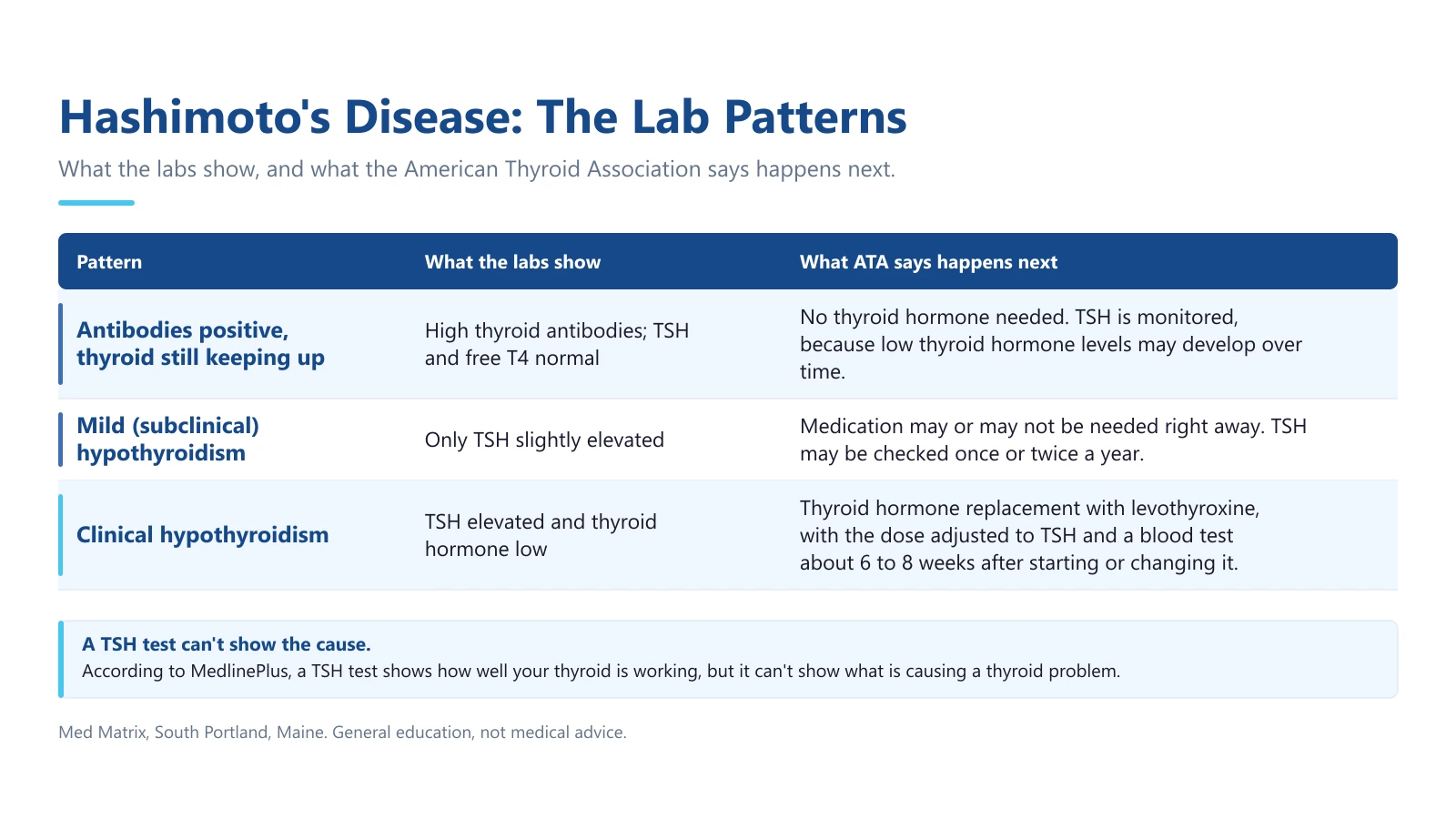
| Pattern | What the labs show | What ATA says happens next |
|---|---|---|
| Antibodies positive, thyroid still keeping up | High thyroid antibodies; TSH and free T4 normal | No thyroid hormone needed. TSH is monitored, because low thyroid hormone levels may develop over time. |
| Mild (subclinical) hypothyroidism | Only TSH slightly elevated | Medication may or may not be needed right away. TSH may be checked once or twice a year. |
| Clinical hypothyroidism | TSH elevated and thyroid hormone low | Thyroid hormone replacement with levothyroxine, with the dose adjusted to TSH and a blood test about 6 to 8 weeks after starting or changing it. |
Sources: American Thyroid Association, Hashimoto's Thyroiditis; American Thyroid Association, Hypothyroidism; NIDDK, Hashimoto's Disease. Accessed November 6, 2026.
A positive antibody result raises its own questions, including what the number means and how common positives are. Our guide to thyroid antibodies covers that. If you're pregnant or planning to be, tell your doctor about positive antibodies or a raised TSH, because monitoring can differ in pregnancy.
How Hashimoto's Is Treated
Treatment usually depends on whether the thyroid is damaged enough to cause hypothyroidism. If it isn't, NIDDK says your doctor may choose to simply check your symptoms and thyroid hormone levels regularly, and ATA says high antibody levels with normal TSH and free T4 don't require treatment with thyroid hormone. ATA's treatment brochure adds that there has been no proven benefit in taking T4 to improve symptoms when thyroid hormone levels are normal. It also says that if thyroid lab values are normal, symptoms are not likely to be due to a thyroid problem, and that you should discuss other potential causes or treatment with your physician.
Once hypothyroidism develops, the recommended treatment is levothyroxine, a medicine identical to the natural thyroid hormone thyroxine (T4). It comes as a pill, a liquid or a soft gel capsule, and the newer forms may help people with digestive problems that affect how the pill is absorbed. Your dose is adjusted based on your TSH level (ATA). NIDDK says you'll have a blood test about 6 to 8 weeks after you start, another each time the dose changes, and then one at 6 months and once a year after you reach a dose that's working. If you're pregnant, you may need more frequent checks (ATA). Most people with hypothyroidism due to Hashimoto's need lifelong treatment (ATA), and NIDDK says it can be well controlled as long as you take the medicine as instructed and have regular follow-up blood tests.
T4, T3 and thyroid extract
A 2014 American Thyroid Association guideline reviewed the sources of dissatisfaction with levothyroxine therapy and the evidence on treatment alternatives. It concluded that levothyroxine should remain the standard of care, and it found no consistently strong evidence that combination T4 and T3 therapy, thyroid extract or other alternatives improve health outcomes more than levothyroxine alone. It listed long-term outcome trials of combination therapy and thyroid extracts among future research needs. ATA's patient page on hypothyroidism also says some people may need a second medicine, liothyronine (T3), if they don't feel better with T4 alone. ATA's treatment brochure adds cautions: T3 has a very short life span in the body, high T3 levels can cause a rapid heartbeat, insomnia and anxiety and may harm the heart and bones, and there is no indication for T3 alone. ATA's summary of its 2017 pregnancy guideline says the recommended treatment in pregnancy is oral levothyroxine, and that T3 or desiccated thyroid isn't recommended. ATA published new pregnancy guidelines in 2026, so ask your doctor what applies to you.
Natural desiccated thyroid (NDT) is dried and powdered thyroid extract from pigs or cows, and it contains both T4 and T3. ATA's brochure is cautious about it: the amounts of T4 and T3 can vary in every batch, which makes blood levels harder to keep stable through the day, the pills contain binders and so aren't completely natural, and animal thyroid extract shouldn't be used in pregnancy. FDA says animal-derived thyroid medications are not FDA approved, and it has concerns about their safety and effectiveness: tablets may not always provide the same thyroid hormone levels, they carry an increased risk of impurities that can lead to infections and other health concerns, and FDA has received complaints and adverse event reports. ATA's 2025 statement says it doesn't recommend them as first-line therapy, though it recognizes them as the treatment of choice for some patients. As of its August 2026 page, FDA says it is applying a risk-based enforcement approach while manufacturers work toward approval, and that it may take action. It recommends that patients taking them talk to their doctor.
Med Matrix providers treat thyroid conditions with T4 and T3/NDT, and also use nutrient repletion. Offering an option is not evidence that it works better: levothyroxine remains the standard of care, and NIDDK's 2021 page says no specific guidance is available on supplements such as vitamin D and selenium. Nutrient repletion doesn't replace thyroid hormone when hypothyroidism needs treatment, so tell whoever prescribes your thyroid medicine about anything you take.
Hashimoto's is a lifelong (chronic) condition, and there's no known way to prevent it, Cleveland Clinic says. With the right treatment, most people can manage it and live healthy, active lives.
When Symptoms Come Back or Get Worse
If your symptoms come back or get worse, ATA lists that as a reason to call your doctor. People taking thyroid hormone have regular TSH tests to check they're on the right dose, according to MedlinePlus, so a recheck is a reasonable thing to ask for. Before that appointment, run through this list:
- New or worsening symptoms. Cleveland Clinic says to see your provider.
- Missed doses. Be honest about them. ATA says a dose that's too low, or frequent missed doses, can keep hypothyroid symptoms going and keep TSH elevated.
- Feeling wired. A dose that's too high can cause symptoms of hyperthyroidism, and ATA lists feeling nervous, a fast heartbeat, feeling hot and losing weight. Early in Hashimoto's, thyroid damage can rarely do the same (NIDDK).
- What you take with your pill. Grapefruit juice, espresso coffee, soy, and multivitamins that contain iron or calcium can affect how well levothyroxine is absorbed. Taking it on an empty stomach helps, and your doctor may ask you to take it 30 to 60 minutes before your first meal (NIDDK). Ask your doctor or pharmacist how far apart to take iron, calcium, antacids and other medicines.
- A new medicine, or a stopped one. ATA lists starting or stopping a medicine that affects thyroid pills as a reason to call, along with gaining or losing 10 pounds or more.
- A new brand or manufacturer. ATA says to tell your doctor so your levels can be rechecked.
- Pregnancy. Many women taking thyroid hormone medicine need a higher dose during pregnancy, so NIDDK says to contact your doctor right away.
- Your dose itself. Never stop the medicine or take more without talking with your doctor first. NIDDK says too much thyroid hormone can cause serious problems, such as atrial fibrillation or osteoporosis.
Related reading: how to lower cortisol.
Does Diet Matter With Hashimoto's?
There's no special diet for Hashimoto's disease, according to Cleveland Clinic, but some foods, medicines or supplements can affect how your body absorbs levothyroxine. NIDDK's diet guidance for Hashimoto's centers on iodine. If you have Hashimoto's, you may be sensitive to iodine's harmful side effects, and foods with large amounts of iodine, such as kelp, dulse or other kinds of seaweed, may cause hypothyroidism or make it worse. Iodine supplements and certain iodine-rich medicines can have the same effect, so ask about any cough syrups you take that may contain iodine. If you're pregnant, you do need enough iodine, because the baby gets iodine from your diet, but NIDDK notes that too much can also cause problems, such as a goiter in the baby, so ask your doctor how much you need.
Researchers are looking at how diet and supplements such as vitamin D and selenium may affect Hashimoto's, but NIDDK's page, last reviewed in 2021, says no specific guidance is available. Celiac disease is on NIDDK's list of autoimmune disorders that make Hashimoto's more likely. Our Hashimoto's diet guide covers gluten and the rest in detail.
What to Ask Your Clinician For
Take these questions with you:
- Was my TSH run with free T4, or on its own?
- Were thyroid antibodies checked, and which ones? ATA names TPO and/or thyroglobulin antibodies.
- What range was each result compared against, and where did my numbers fall?
- I'm on thyroid hormone and still have symptoms. Have my dose, timing and absorption been reviewed, and is adding T3 worth discussing?
- How often will my TSH be rechecked? For mild (subclinical) hypothyroidism, ATA mentions once or twice a year.
- Should I stop biotin before my blood test? ATA says biotin supplements can interfere with thyroid blood tests.
- Bring a written list of your symptoms, medicines and supplements.
- Has anything changed in my neck? Cleveland Clinic says a thyroid ultrasound may be used to check the size of the thyroid and look for nodules.
How Med Matrix Looks at Hashimoto's
Every Med Matrix patient's labs include TSH, Free T3, Free T4, Total T4, T-Uptake, Reverse T3, TPO antibodies and thyroglobulin antibodies, as part of our 80+ biomarker test. Both antibodies run alongside thyroid function on every patient, so nobody has to ask for them. We interpret results against optimal ranges set per patient, and when we retest, we compare your thyroid function results with your own previous numbers. ATA's stated treatment goal is a TSH in the normal range. We read each number together with your symptoms rather than as a verdict on its own. ATA says antibody levels don't need repeating to monitor Hashimoto's; TSH does. Your own clinician can order TSH, free T4 and antibody tests. ATA says T3 testing is rarely helpful in hypothyroidism, that free T3 is often not reliable, and that reverse T3 is not clinically useful for diagnosing it; we include them as part of our broader panel. Learn more on our thyroid and adrenal page and our advanced testing page.
Labs can be drawn in our office, or at a partner lab near you. We have one office, at 198 Maine Mall Road in South Portland, Maine, and we see patients in Maine and New Hampshire. The first step is a Free Discovery Call with our patient coordinator, followed by the 80+ Biomarker Test & Full Body Scan. Med Matrix has served 3,000+ patients and holds 4.8 stars across 190+ reviews. Our functional medicine page explains the wider approach, and the Hashimoto's episode with Gabriel Rocha is the place to listen next.
Frequently Asked Questions
Can Hashimoto's disease be cured or reversed?
Cleveland Clinic describes Hashimoto's as a lifelong (chronic) condition, and ATA says most people with hypothyroidism due to Hashimoto's will need lifelong thyroid hormone replacement. What you can aim for is control. NIDDK says hypothyroidism can be well controlled with thyroid hormone medicine when you take it as instructed and keep up with follow-up blood tests, and Cleveland Clinic calls the outlook excellent with lifelong monitoring and treatment.
Can a Hashimoto's flare-up cause anxiety?
Feeling anxious or on edge can have a thyroid explanation. Early in Hashimoto's, thyroid damage can rarely release too much hormone and cause hyperthyroid symptoms, NIDDK says, including feeling nervous or irritable and trouble sleeping (MedlinePlus). A thyroid medicine dose that's too high can do the same, ATA says. If you take thyroid medicine and feel nervous or notice a fast heartbeat, tell your doctor. Genetics, stress and your environment may also play a role (MedlinePlus), so raise new anxiety with your clinician, who can check TSH and free T4.
What are the symptoms of Hashimoto's disease in women?
The general list applies: fatigue, weight gain, feeling cold and constipation. Between them, NIDDK and Cleveland Clinic also list heavy or irregular periods, fertility problems and decreased sex drive. Hashimoto's is 4 to 10 times more common in women than men and more often develops in women ages 30 to 50 (NIDDK). Without treatment, hypothyroidism can increase the risk of miscarriage, preterm birth and preeclampsia, Cleveland Clinic says. NIDDK says thyroid medicines can help prevent problems and are safe in pregnancy, though ATA advises against animal thyroid extract and T3.
What is subclinical hypothyroidism?
ATA uses the term for a TSH that is only slightly elevated, also called mild hypothyroidism. You may or may not need medication right away, and ATA says your TSH may be checked once or twice a year to see if you're developing clinical hypothyroidism. NIDDK notes that most cases of hypothyroidism are mild or have few obvious symptoms.
What are hypothyroid legs?
Aching or stiff legs most closely match joint and muscle pain (NIDDK, Cleveland Clinic). Cleveland Clinic lists swelling in the face, tongue and lower legs among myxedema coma signs, with a body temperature below 95 degrees Fahrenheit, a slow heart rate and faint pulse, slow or difficult breathing, and confusion or loss of consciousness. Call 911 for those signs. Breathing problems or confusion are emergency warning signs on their own (MedlinePlus), and new or worsened swelling in only one leg needs a call to your provider right away.
Do I need treatment if my antibodies are positive but my TSH is normal?
Not with thyroid hormone, according to ATA: high thyroid antibody levels with normal TSH and free T4 don't require it. ATA says repeating and monitoring antibody levels isn't needed, but your TSH does need monitoring, because low thyroid hormone levels may develop over time. If you're pregnant or planning to be, tell your doctor about positive antibodies or a raised TSH, because monitoring can differ in pregnancy. Our guide to thyroid antibodies explains what a positive result means.
Where can I get thyroid function and both antibodies tested in Maine?
Med Matrix runs TSH, Free T3, Free T4, Total T4, T-Uptake, Reverse T3, TPO antibodies and thyroglobulin antibodies on every patient as part of its 80+ biomarker test. The office is at 198 Maine Mall Road in South Portland, and we see patients from Maine and New Hampshire. Labs can be drawn in our office, or at a partner lab near you. The first step is a Free Discovery Call.
Sources
- Hashimoto's Disease. National Institute of Diabetes and Digestive and Kidney Diseases (NIDDK). https://www.niddk.nih.gov/health-information/endocrine-diseases/hashimotos-disease. Accessed November 6, 2026.
- Hypothyroidism (Underactive Thyroid). National Institute of Diabetes and Digestive and Kidney Diseases (NIDDK). https://www.niddk.nih.gov/health-information/endocrine-diseases/hypothyroidism. Accessed November 6, 2026.
- Hashimoto's Thyroiditis. American Thyroid Association. https://www.thyroid.org/hashimotos-thyroiditis/. Accessed November 6, 2026.
- Hypothyroidism. American Thyroid Association. https://www.thyroid.org/hypothyroidism/. Accessed November 6, 2026.
- Thyroid Hormone Treatment. American Thyroid Association. https://www.thyroid.org/thyroid-hormone-treatment/. Accessed November 6, 2026.
- TSH (Thyroid-stimulating hormone) Test. MedlinePlus, US National Library of Medicine. https://medlineplus.gov/lab-tests/tsh-thyroid-stimulating-hormone-test/. Accessed November 6, 2026.
- Hashimoto's Disease. Cleveland Clinic. https://my.clevelandclinic.org/health/diseases/17665-hashimotos-disease. Accessed November 6, 2026.
- Jonklaas J, Bianco AC, Bauer AJ, et al. Guidelines for the Treatment of Hypothyroidism: Prepared by the American Thyroid Association Task Force on Thyroid Hormone Replacement. Thyroid. 2014;24(12):1670-1751. PubMed. https://pubmed.ncbi.nlm.nih.gov/25266247/. Accessed November 6, 2026.
- Heald AH, Taylor P, Premawardhana L, et al. Natural desiccated thyroid for the treatment of hypothyroidism? Front Endocrinol (Lausanne). 2024;14:1309159. PubMed. https://pubmed.ncbi.nlm.nih.gov/38260143/. Accessed November 6, 2026.
- FDA's Actions to Address Unapproved Thyroid Medications. US Food and Drug Administration. https://www.fda.gov/drugs/enforcement-activities-fda/fdas-actions-address-unapproved-thyroid-medications. Accessed November 6, 2026.
- American Thyroid Association Statement on Desiccated Thyroid Extract. American Thyroid Association. September 18, 2025. https://www.thyroid.org/ata-statement-desiccated-thyroid-extract/. Accessed November 6, 2026.
- Thyroid Function Tests. American Thyroid Association. https://www.thyroid.org/thyroid-function-tests/. Accessed November 6, 2026.
- American Thyroid Association task force updates treatment guidelines for the diagnosis and management of thyroid disease during pregnancy and the postpartum. American Thyroid Association, Clinical Thyroidology for Patients. May 2017. https://www.thyroid.org/patient-thyroid-information/ct-for-patients/may-2017/vol-10-issue-5-p-3-7/. Accessed November 6, 2026.
- Anxiety. MedlinePlus, US National Library of Medicine. https://medlineplus.gov/anxiety.html. Accessed November 6, 2026.
- Foot, leg, and ankle swelling. MedlinePlus, US National Library of Medicine. https://medlineplus.gov/ency/article/003104.htm. Accessed November 6, 2026.
- Recognizing medical emergencies. MedlinePlus, US National Library of Medicine. https://medlineplus.gov/ency/article/001927.htm. Accessed November 6, 2026.
Get Your Thyroid Function and Antibodies Checked
If you want your thyroid function and both antibodies checked together, every Med Matrix patient's labs include them. It starts with a Free Discovery Call with our patient coordinator.
Get Your Free Guide + $100 Voucher and take the first step.