
Hashimoto's Diet: What the Trials Show and What They Don't

Forbes Health Advisory Board · Naturopathic Doctor
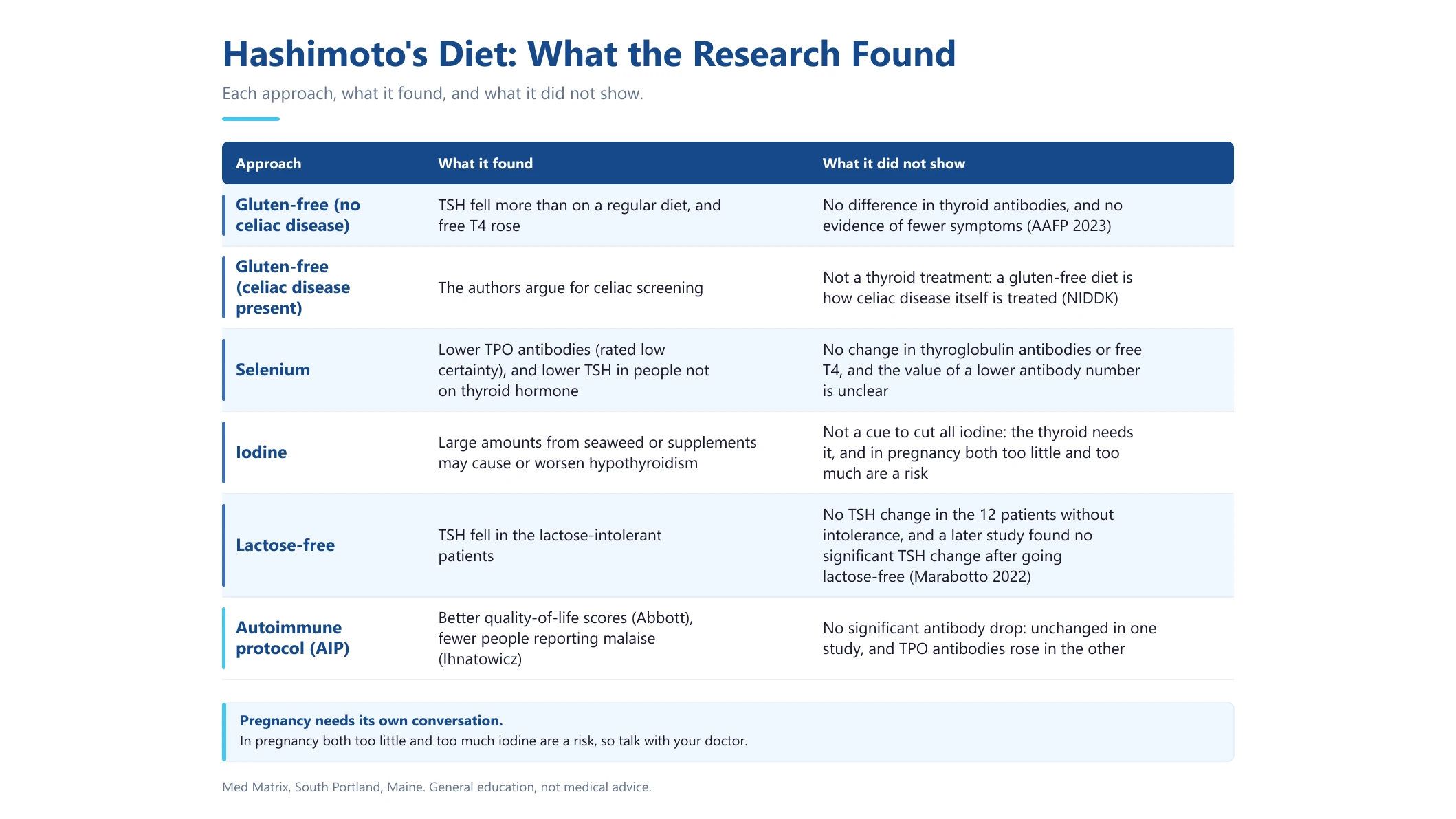
No single diet has been shown to treat Hashimoto's disease, and beyond its iodine caution, the National Institute of Diabetes and Digestive and Kidney Diseases (NIDDK) says no specific diet guidance is currently available. The clearest food rule in the evidence is to avoid large amounts of iodine, such as kelp, dulse, other seaweed and iodine supplements, and the case for going gluten-free is strongest in people who also have celiac disease.
This article grades each common approach against the evidence behind it, with study size and design named where a study exists, so you can see which changes hold up and which are still guesses. For the condition itself, start with our guide to Hashimoto's disease. This is general information, and it isn't a substitute for advice from your own provider.
Hashimoto's Diet Approaches, Side by Side
The table covers six approaches: the evidence behind each one, what it found, and what it didn't show.
| Approach | Evidence | What it found | What it did not show |
|---|---|---|---|
| Gluten-free (no celiac disease) | Randomized trial, 62 women analyzed over 12 months (Pobłocki 2021) | TSH fell more than on a regular diet, and free T4 rose | No difference in thyroid antibodies, and no evidence of fewer symptoms (AAFP 2023) |
| Gluten-free (celiac disease present) | Meta-analysis of 6,024 patients: about 1 in 62 with autoimmune thyroid disease had celiac disease (Roy 2016) | The authors argue for celiac screening | Not a thyroid treatment: a gluten-free diet is how celiac disease itself is treated (NIDDK) |
| Selenium | Meta-analysis of 35 randomized trials (Huwiler 2024) | Lower TPO antibodies (rated low certainty), and lower TSH in people not on thyroid hormone | No change in thyroglobulin antibodies or free T4, and the value of a lower antibody number is unclear |
| Iodine | NIDDK guidance | Large amounts from seaweed or supplements may cause or worsen hypothyroidism | Not a cue to cut all iodine: the thyroid needs it, and in pregnancy both too little and too much are a risk |
| Lactose-free | Before-and-after study, no randomization reported: 83 patients on levothyroxine; 38 with lactose intolerance restricted lactose for 8 weeks (Asik 2014) | TSH fell in the lactose-intolerant patients | No TSH change in the 12 patients without intolerance, and a later study found no significant TSH change after going lactose-free (Marabotto 2022) |
| Autoimmune protocol (AIP) | Two small studies with no control group: 16 women over 10 weeks (Abbott 2019) and 28 people over 12 weeks (Ihnatowicz 2023) | Better quality-of-life scores (Abbott), fewer people reporting malaise (Ihnatowicz) | No significant antibody drop: unchanged in one study, and TPO antibodies rose in the other |
Read the table with two cautions. Most of the gluten and selenium trials measure lab numbers such as TSH and antibodies rather than how people feel. A lower antibody number isn't the same thing as feeling better: the authors of a 2024 review of 35 selenium trials say the clinical relevance of lowering TPO antibodies still needs study. Several of these trials enrolled only women, which fits a disease NIDDK says is 4 to 10 times more common in women than in men.
Gluten-Free: Strongest When Celiac Disease Is in the Picture
Gluten is a protein found in wheat, barley and rye, and NIDDK lists celiac disease among the autoimmune conditions that make Hashimoto's more likely. A 2016 meta-analysis pooled 6,024 people with autoimmune thyroid disease and found biopsy-confirmed celiac disease in 1.6% of them, about 1 in 62. Its authors argue that people with autoimmune thyroid disease should be screened for celiac disease. If you have celiac, a gluten-free diet is the treatment for it, so the question answers itself.
Order matters here. NIDDK says doctors don't recommend starting a gluten-free diet before diagnostic testing, because going gluten-free can affect the results. Celiac disease is usually diagnosed with blood tests and a biopsy of the small intestine. So if you're thinking of cutting gluten, ask your clinician about celiac testing first.
Without celiac disease, the evidence is thinner. A 12-month randomized trial, by Pobłocki and colleagues in 2021, randomized women with Hashimoto's to a gluten-free or regular diet for 12 months. It enrolled 92, but 30 didn't finish, for reasons such as not being able to stick to the diet, so 62 were analyzed. All of them were on levothyroxine. The gluten-free group saw a significant drop in TSH and a rise in free T4, with no difference in TPO or thyroglobulin antibodies. A family-physician evidence review lists a lack of information about levothyroxine treatment among the trial's limitations, along with no intention-to-treat analysis, so the TSH drop can't be tied to the diet alone.
An earlier pilot study by Krysiak and colleagues looked at a different group: 34 women who weren't on levothyroxine and who had incidentally found positive tissue transglutaminase antibodies, the antibody most commonly checked in celiac screening. Of these, 16 went gluten-free for 6 months and 18 didn't change their diet. Antibodies fell in the gluten-free group and rose in the comparison group, but the women weren't randomized.
A 2023 meta-analysis by Piticchio and colleagues pooled 4 studies with 87 patients who had no symptoms or biopsy signs of celiac disease. TSH fell and free T4 rose, while the antibody drops narrowly missed statistical significance. The authors concluded that the evidence isn't yet enough to recommend a gluten-free diet to everyone with Hashimoto's, and they noted that many patients start one on their own. A family-physician evidence review in American Family Physician put it more bluntly: there's no evidence a gluten-free diet reduces the symptoms of autoimmune thyroid disease.
Selenium: What the Antibody Studies Show
Selenium supplements lowered TPO antibodies in pooled trials, but the evidence is messier than that headline suggests. A 2024 systematic review in Thyroid by Huwiler and colleagues included 35 randomized trials. In people who weren't taking thyroid hormone, selenium lowered TSH, and that effect disappeared once people on thyroid hormone were included. TPO antibodies fell across 29 groups with 2,358 participants, in people with and without thyroid hormone. Free T4, free T3 and thyroglobulin antibodies didn't change.
Look closer and the confidence drops. The antibody results varied widely from trial to trial, and of the 31 studies that reported TSH, 19 had a high risk of bias. The authors rated the certainty of the TPO antibody evidence as low, though they rated the review's evidence as moderate overall, and they wrote that the clinical relevance of lowering TPO antibodies warrants further investigation. Side effects were similar in the selenium and control groups, but the same paper warns that excess selenium intake can be harmful. NIDDK lists selenium as something researchers are still studying, with no guidance yet.
Selenium is found in a range of animal and plant foods. Supplements are a different decision. Talk with a clinician before starting one. This article gives no amount on purpose.
Iodine: Where More Can Make It Worse
Iodine is the food caution NIDDK spells out for Hashimoto's. The thyroid uses iodine to make its hormones, but people with Hashimoto's may be sensitive to iodine's harmful side effects. According to NIDDK, eating foods with large amounts of iodine, such as kelp, dulse or other kinds of seaweed, and certain iodine-rich medicines, may cause hypothyroidism or make it worse. Taking iodine supplements can have the same effect.
NIDDK suggests three things to raise with your health care team:
- which foods and drinks to limit or avoid
- any iodine supplements you take
- cough syrups, some of which contain iodine
Pregnancy needs its own conversation. If you're pregnant, you need enough iodine, because the baby gets its iodine from your diet. Too much iodine can also cause problems, such as a goiter in the baby, so talk with your doctor about how much you need rather than changing your iodine on your own.
Dairy and Lactose: A Narrower Case Than the Internet Suggests
The dairy evidence applies to people who are lactose intolerant, not to everyone with Hashimoto's. A 2014 before-and-after study by Asik and colleagues, with no randomization reported, tested 83 Hashimoto's patients on levothyroxine and found lactose intolerance in 75.9% of them. Thirty-eight of the intolerant patients restricted lactose for 8 weeks, and their TSH fell significantly. In the 12 patients without lactose intolerance, TSH didn't change.
The authors suggested that lactose intolerance be considered in people whose TSH is irregular or whose levothyroxine needs keep climbing. That's a reason to ask about testing for lactose intolerance. In the same study, TSH didn't change in the patients who tolerated lactose.
A 2022 study by Marabotto and colleagues points the other way. It tested 58 women with Hashimoto's and found lactose intolerance in 58.6%, which its authors call no different from the global rate. In the intolerant patients on levothyroxine who went lactose-free, in both diet and pill, TSH didn't change significantly at 3 or 6 months. That study was small too, so the evidence conflicts.
Even with lactose intolerance, you may not need to avoid lactose completely, says NIDDK, and cutting all milk products can leave you short on calcium and vitamin D. Calcium also matters for timing, which is the next section.
Food and Your Thyroid Medication
If you take levothyroxine, some foods and supplements can change how much of it you absorb. NIDDK, MedlinePlus and the American Thyroid Association name these:
- Espresso coffee and grapefruit juice
- Soy and soybean foods
- Walnuts
- Dietary fiber
- Multivitamins that contain iron or calcium
- Calcium or iron supplements, and antacids: tell your doctor when you start or stop one
Ask your prescriber how to handle these, and follow the timing they or your pharmacist give you. Tell them before a big diet change, too. Some studies suggest going gluten-free or cutting lactose can move TSH, and your doctor uses blood tests like TSH to adjust your dose. NIDDK is clear that you should never stop your medicine or take a higher dose without talking with your doctor first.
AIP and Elimination Diets: Two Small Studies
The autoimmune protocol, or AIP, has been tested in Hashimoto's in two small uncontrolled studies, and neither can tell you whether the diet itself works. Abbott and colleagues enrolled 17 women in a 10-week online health coaching program built around AIP, a phased elimination diet. Sixteen completed the before-and-after questionnaires. Quality of life improved on all eight subscales of a standard survey, but there was no statistically significant change in any thyroid function test or in thyroid antibodies.
A 2023 study by Ihnatowicz and colleagues put 28 people with Hashimoto's on AIP for 12 weeks and compared their results before and after. Fewer people reported feeling unwell, but TPO antibodies didn't fall: the average rose, a change the paper's results table does not mark as statistically significant.
Neither study had a control group. In the first, the coaching was intensive, so the diet's effect can't be separated from the support around it. Abbott and colleagues say larger randomized trials are needed to validate the findings.
A narrower tool exists for a narrower problem. When a food sensitivity is suspected, our providers can guide a structured elimination and reintroduction, one that brings foods back to see what actually causes trouble. You can read more on our food and environmental sensitivities page.
Anti-Inflammatory and Mediterranean Eating
The evidence for anti-inflammatory and Mediterranean patterns as Hashimoto's treatments is thin. One small randomized trial, by Ülker and colleagues, split 40 people with Hashimoto's into four groups for 12 weeks: Mediterranean, gluten-free, Mediterranean gluten-free, or a control group. Antibodies fell in the diet groups, but the difference between groups wasn't statistically significant. Free T3 rose in all three diet groups, and weight also fell, so the diet's own effect is hard to separate.
A 2022 review of nutrition in Hashimoto's by Danailova and colleagues notes that foods rich in antioxidants are considered healthy and have anti-inflammatory effects. The review itself favors an anti-inflammatory approach, but when its table of diets and inflammation lists the anti-inflammatory diet, the study it cites is a case series in inflammatory bowel disease. Its Mediterranean entry cites a review of fatigue in a different illness.
The case for these patterns rests mainly on general health. The 2021 gluten-free trial ended on a similar note: its authors recommended proper nutrition education combined with a healthy lifestyle. For the everyday side of this, see our pieces on what ultra-processed foods do to your body and thyroid imbalance.
Foods to Avoid: The Short List That Holds Up
The evidence supports a short list:
- Large amounts of iodine. Kelp, dulse and other seaweed, iodine supplements, and iodine-rich medicines.
- Gluten, once celiac disease is confirmed. Get tested before you cut it.
- Lactose, if you're lactose intolerant, and even then maybe not all of it.
- Soy, walnuts, fiber, espresso, grapefruit juice, and calcium or iron supplements, if you take levothyroxine: ask your prescriber how to handle them.
Diet Works Alongside Your Labs
Tracking the same markers before and after a diet change shows whether your numbers moved. In our clinic, the thyroid markers in the 80+ biomarker panel are TSH, Free T3, Free T4, Total T4, T-Uptake, Reverse T3, TPO antibodies and thyroglobulin antibodies. We retest and compare your results against your own previous numbers, so a change shows up as a trend in your data rather than a guess. For more on what the antibody numbers mean, read our guide to thyroid antibodies or listen to the podcast episode on looking beyond TSH.
Sometimes the labs are where Hashimoto's first shows up. Laura put it this way: "There were things on there that I hadn't known. For example, Hashimoto's disease. I had asked my physician to test me for that and they didn't. And that did come up on there." One patient's experience isn't treatment advice, so don't stop or replace thyroid medicine without your prescriber.
Diet is one part of thyroid care. Depending on your results, treatment can include T4, T3 or NDT, and nutrient repletion, decided with your provider. Our thyroid and adrenal page and advanced testing page cover the approach. We see patients from Maine and New Hampshire at one office, 198 Maine Mall Road in South Portland.
Frequently Asked Questions
Can you eat honey with Hashimoto's?
No study found for this article has tested honey in people with Hashimoto's, so there's no evidence that it harms or helps the thyroid. What is settled is that honey counts as an added sugar, alongside syrups and other sweeteners. The CDC notes that too much added sugar can contribute to weight gain, type 2 diabetes and heart disease. Treat honey the way you'd treat any sweetener and keep it occasional.
Do I need to go gluten-free if I have Hashimoto's?
Not automatically. Ask about celiac testing first, since roughly 1 in 62 people with autoimmune thyroid disease have celiac, and going gluten-free before the test can skew it. Without celiac disease, a 12-month randomized trial found a TSH change but no antibody difference, and a family-physician evidence review found no proof that a gluten-free diet eases symptoms. If you try it anyway, tell your prescriber first.
Is there a list of trigger foods for Hashimoto's?
No validated list of seven trigger foods, or any other number, appears in NIDDK guidance or in the trials reviewed here, and beyond its iodine caution, NIDDK says no specific diet guidance is available. The cautions with evidence behind them are narrower: large amounts of iodine from seaweed or supplements, gluten when celiac disease is confirmed, and lactose when you're lactose intolerant.
Do I need to cut dairy if I have Hashimoto's?
Not necessarily. The dairy evidence covers people with lactose intolerance. In a 2014 study with no randomization reported, TSH fell after 8 weeks of lactose restriction in people with intolerance, and it didn't change in 12 people without intolerance. A 2022 study found no significant TSH change after going lactose-free, so the evidence conflicts. If you suspect intolerance, ask about testing. NIDDK notes many people with lactose intolerance don't need to cut it completely, and that dropping all milk products can leave you short on calcium and vitamin D.
Should I take selenium for Hashimoto's?
Talk with a clinician before you do. Pooled trials found selenium lowered TPO antibodies, and lowered TSH in people not on thyroid hormone, with side effects similar to control groups. But the antibody results varied widely between trials, many had a high risk of bias, the authors rated that antibody evidence as low certainty, and they say the benefit of a lower antibody number still needs study. Excess selenium can be harmful, so no amount is given here.
Where can I get thyroid function and antibodies tested in Maine?
Med Matrix, at 198 Maine Mall Road in South Portland, includes TSH, Free T3, Free T4, Total T4, T-Uptake, Reverse T3, TPO antibodies and thyroglobulin antibodies in its 80+ biomarker panel. A provider reviews the results with you in a 60-minute consultation. We see patients from Maine and New Hampshire, and the first step is a Free Discovery Call.
Sources
- Hashimoto's Disease. National Institute of Diabetes and Digestive and Kidney Diseases (NIH). https://www.niddk.nih.gov/health-information/endocrine-diseases/hashimotos-disease. Accessed November 6, 2026.
- Diagnosis of Celiac Disease. National Institute of Diabetes and Digestive and Kidney Diseases (NIH). https://www.niddk.nih.gov/health-information/digestive-diseases/celiac-disease/diagnosis. Accessed November 6, 2026.
- Treatment for Celiac Disease. National Institute of Diabetes and Digestive and Kidney Diseases (NIH). https://www.niddk.nih.gov/health-information/digestive-diseases/celiac-disease/treatment. Accessed November 6, 2026.
- Eating, Diet, and Nutrition for Lactose Intolerance. National Institute of Diabetes and Digestive and Kidney Diseases (NIH). https://www.niddk.nih.gov/health-information/digestive-diseases/lactose-intolerance/eating-diet-nutrition. Accessed November 6, 2026.
- Levothyroxine. MedlinePlus Drug Information, US National Library of Medicine. https://medlineplus.gov/druginfo/meds/a682461.html. Accessed November 6, 2026.
- Hypothyroidism. American Thyroid Association. https://www.thyroid.org/hypothyroidism/. Accessed November 6, 2026.
- Godhwani A, et al. Does a Gluten-Free Diet Reduce Symptoms of Autoimmune Thyroid Disease? American Family Physician, July 2023. American Academy of Family Physicians. https://www.aafp.org/pubs/afp/issues/2023/0700/fpin-hda-gluten-free-diet-thyroid-disease.html. Accessed November 6, 2026.
- Pobłocki J, Pańka T, Szczuko M, Telesiński A, Syrenicz A. Whether a Gluten-Free Diet Should Be Recommended in Chronic Autoimmune Thyroiditis or Not? A 12-Month Follow-Up. J Clin Med. 2021;10(15):3240. PubMed. https://pubmed.ncbi.nlm.nih.gov/34362024/. Accessed November 6, 2026.
- Krysiak R, Szkróbka W, Okopień B. The Effect of Gluten-Free Diet on Thyroid Autoimmunity in Drug-Naïve Women with Hashimoto's Thyroiditis: A Pilot Study. Exp Clin Endocrinol Diabetes. 2019;127(7):417-422. PubMed. https://pubmed.ncbi.nlm.nih.gov/30060266/. Accessed November 6, 2026.
- Piticchio T, Frasca F, Malandrino P, et al. Effect of gluten-free diet on autoimmune thyroiditis progression in patients with no symptoms or histology of celiac disease: a meta-analysis. Front Endocrinol. 2023;14:1200372. PubMed. https://pubmed.ncbi.nlm.nih.gov/37554764/. Accessed November 6, 2026.
- Roy A, Laszkowska M, Sundström J, et al. Prevalence of Celiac Disease in Patients with Autoimmune Thyroid Disease: A Meta-Analysis. Thyroid. 2016;26(7):880-890. PubMed. https://pubmed.ncbi.nlm.nih.gov/27256300/. Accessed November 6, 2026.
- Huwiler VV, Maissen-Abgottspon S, Stanga Z, et al. Selenium Supplementation in Patients with Hashimoto Thyroiditis: A Systematic Review and Meta-Analysis of Randomized Clinical Trials. Thyroid. 2024;34(3):295-313. PubMed Central. https://pmc.ncbi.nlm.nih.gov/articles/PMC10951571/. Accessed November 6, 2026.
- Asik M, Gunes F, Binnetoglu E, et al. Decrease in TSH levels after lactose restriction in Hashimoto's thyroiditis patients with lactose intolerance. Endocrine. 2014;46(2):279-284. PubMed. https://pubmed.ncbi.nlm.nih.gov/24078411/. Accessed November 6, 2026.
- Marabotto E, Ferone D, Sheijani AD, et al. Prevalence of Lactose Intolerance in Patients with Hashimoto Thyroiditis and Impact on LT4 Replacement Dose. Nutrients. 2022;14(15):3017. PubMed Central. https://pmc.ncbi.nlm.nih.gov/articles/PMC9331471/. Accessed November 6, 2026.
- Abbott RD, Sadowski A, Alt AG. Efficacy of the Autoimmune Protocol Diet as Part of a Multi-disciplinary, Supported Lifestyle Intervention for Hashimoto's Thyroiditis. Cureus. 2019;11(4):e4556. PubMed Central. https://pmc.ncbi.nlm.nih.gov/articles/PMC6592837/. Accessed November 6, 2026.
- Ihnatowicz P, Gębski J, Drywień ME. Effects of Autoimmune Protocol (AIP) diet on changes in thyroid parameters in Hashimoto's disease. Ann Agric Environ Med. 2023;30(3):513-521. PubMed. https://pubmed.ncbi.nlm.nih.gov/37772528/. Full text, Table 3: https://www.aaem.pl/pdf-166263-89990?filename=Effects-of-Autoimmune-Pro.pdf. Accessed November 6, 2026.
- Ülker MT, Çolak GA, Baş M, Erdem MG. Evaluation of the effect of gluten-free diet and Mediterranean diet on autoimmune system in patients with Hashimoto's thyroiditis. Food Sci Nutr. 2024;12(2):1180-1188. PubMed. https://pubmed.ncbi.nlm.nih.gov/38370054/. Accessed November 6, 2026.
- Celiac Disease Screening. MedlinePlus Lab Tests, US National Library of Medicine. https://medlineplus.gov/lab-tests/celiac-disease-screening/. Accessed November 6, 2026.
- Danailova Y, Velikova T, Nikolaev G, et al. Nutritional Management of Thyroiditis of Hashimoto. Int J Mol Sci. 2022;23(9):5144. PubMed Central. https://pmc.ncbi.nlm.nih.gov/articles/PMC9101513/. Accessed November 6, 2026.
- Get the Facts: Added Sugars. Centers for Disease Control and Prevention. https://www.cdc.gov/nutrition/php/data-research/added-sugars.html. Accessed November 6, 2026.
Get a Full Thyroid Picture
A diet change is much easier to judge when you can see your numbers before and after. Start with a Free Discovery Call to talk through your goals, symptoms and concerns. We see patients from Maine and New Hampshire at our South Portland office.
Get Your Free Guide + $100 Voucher and take the first step.
Med Matrix is a functional medicine clinic in South Portland, Maine, serving patients from Maine and New Hampshire.