
Thyroid Antibodies: What a Positive TPO or Tg Result Means

Forbes Health Advisory Board · Naturopathic Doctor
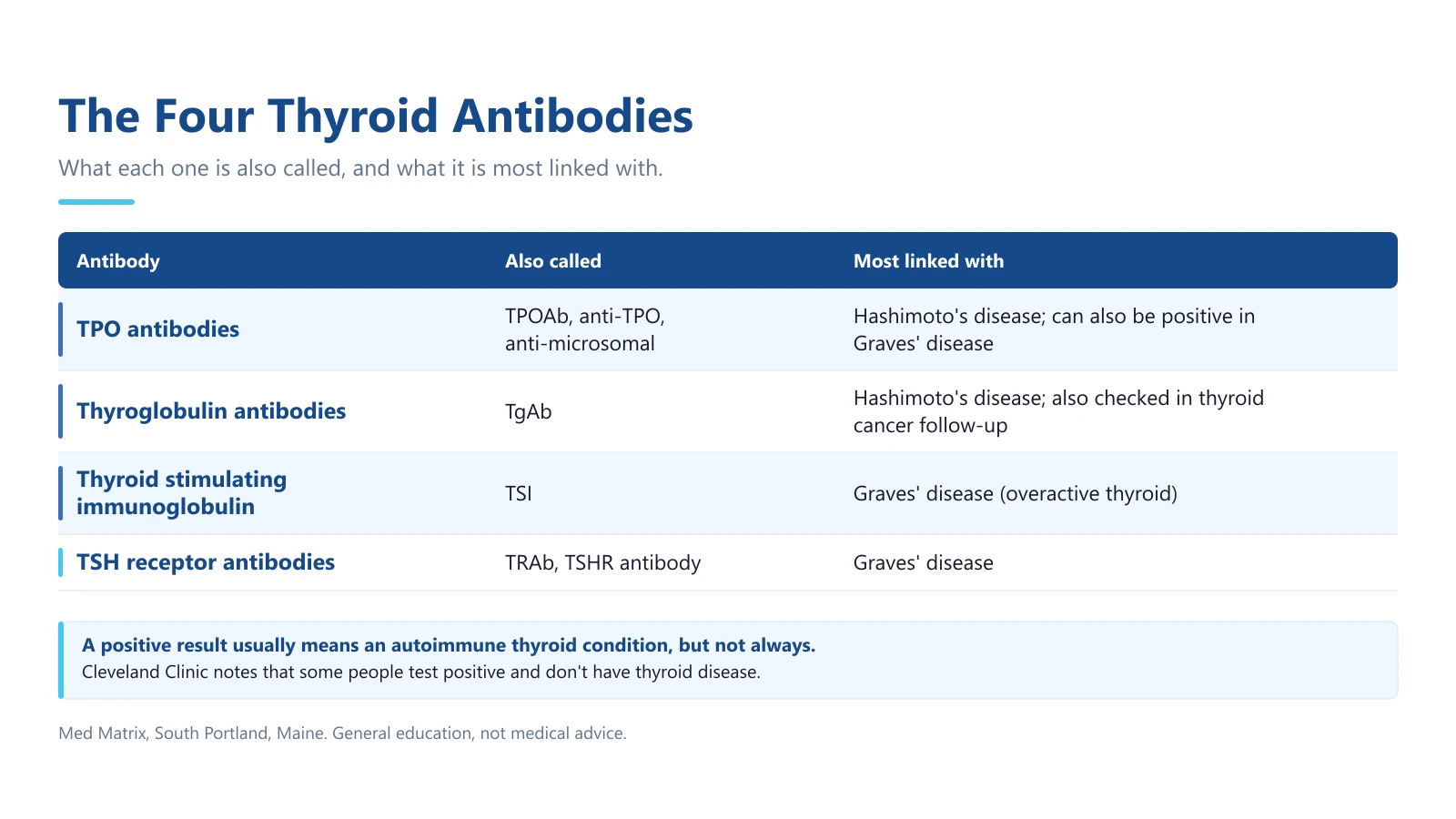
Thyroid antibodies are proteins your immune system makes by mistake against your own thyroid, and a thyroid antibody test checks whether autoimmune thyroid disease is behind a thyroid problem. A positive TPO or thyroglobulin (Tg) antibody result points toward Hashimoto's disease, but a positive TPO result with a normal TSH isn't a diagnosis of an underactive thyroid: it can mean a higher chance of developing hypothyroidism later. Cleveland Clinic says a positive result usually means an autoimmune thyroid condition, but not always: some people test positive and don't have thyroid disease. In a US national survey of people not known to have thyroid disease, 11.3% tested positive for TPO antibodies and 10.4% for thyroglobulin antibodies, roughly 1 in 9 and 1 in 10, though TPO antibodies in that group were linked with an over- or underactive thyroid that hadn't been reported.
For the condition itself, start with our guide to Hashimoto's disease. This is general information, and it isn't a substitute for advice from your own clinician.
What Thyroid Antibodies Are
A thyroid antibody test measures the level of thyroid antibodies in a blood sample to check for an autoimmune thyroid disease, according to MedlinePlus. Antibodies are proteins your immune system makes to fight germs such as viruses and bacteria. Sometimes they attack your own healthy tissue instead. Those are called autoantibodies, and your body makes them by mistake.
Two common thyroid antibodies are TPO antibodies and thyroglobulin antibodies. Each one targets a different protein that helps your thyroid make its hormones. Thyroglobulin itself is a protein produced by normal thyroid cells, and antibodies against it are a marker for autoimmune thyroid disease.
One point is easy to miss. Antibodies measure an immune response. They don't show how well your thyroid is working. The American Thyroid Association (ATA) says it directly: TSH and free T4 are what tell us about the actual thyroid function. That is why an antibody result is read next to TSH and free T4.
The Four Thyroid Antibodies, Side by Side
Four thyroid antibodies are in common use. TPO and thyroglobulin antibodies are the markers for Hashimoto's disease, while TSI and TRAb are the markers for Graves' disease, the most common cause of an overactive thyroid.
| Antibody | Also called | Most linked with | What a positive result alone does not tell you |
|---|---|---|---|
| TPO antibodies | TPOAb, anti-TPO, anti-microsomal | Hashimoto's disease; can also be positive in Graves' disease | Whether your thyroid is underactive now (TSH and free T4 show that) |
| Thyroglobulin antibodies | TgAb | Hashimoto's disease; also checked in thyroid cancer follow-up | On its own, without TPO antibodies, it was not significantly tied to thyroid disease in a US national survey |
| Thyroid stimulating immunoglobulin | TSI | Graves' disease (overactive thyroid) | How overactive the thyroid is (T3 tests help show that) |
| TSH receptor antibodies | TRAb, TSHR antibody | Graves' disease | Whether the antibodies are stimulating or blocking (the test detects both) |
Sources: MedlinePlus, American Thyroid Association, Cleveland Clinic, Hollowell et al. 2002.
Med Matrix runs both TPO antibodies and thyroglobulin antibodies on the standard thyroid panel for every patient. TSI and TRAb aren't part of that standard panel.
Positive Antibodies With a Normal TSH
A positive TPO antibody result with a normal TSH is not a diagnosis of hypothyroidism. It means your immune system is reacting to your thyroid, and Cleveland Clinic notes it may mean you develop hypothyroidism later in life. The National Institute of Diabetes and Digestive and Kidney Diseases (NIDDK) says that if you don't have hypothyroidism, your doctor may choose to simply check your symptoms and thyroid hormone levels regularly. Pregnancy is different: MedlinePlus says thyroid disease can harm both you and your fetus and that it's important to get tested as soon as you know you're pregnant, so tell your clinician about a positive result right away.
| Antibodies | TSH | What the cited sources say it usually points to |
|---|---|---|
| Negative | In range | Thyroid symptoms are probably not caused by an autoimmune disease (MedlinePlus). |
| Negative | Raised | May mean something else is causing hypothyroidism (Cleveland Clinic). Antibody-negative Hashimoto's does occur; an ultrasound can look for it (ATA, NIDDK). |
| Positive TPO | In range | A chance of hypothyroidism later in life (Cleveland Clinic). May be handled by checking symptoms and hormone levels regularly (NIDDK). If you're pregnant, tell your clinician right away. |
| Positive TPO or Tg | Raised | In someone with hypothyroidism, positive antibodies point to Hashimoto's as the cause (ATA). |
| Positive TRAb or TSI | Low | Likely Graves' disease (Cleveland Clinic). |
What a positive result doesn't mean:
- That your thyroid is underactive today. TSH and free T4 answer that.
- That you certainly have thyroid disease. Cleveland Clinic says a positive result usually means an autoimmune thyroid condition, but not always: some people test positive and don't have thyroid disease.
If your TSH is normal and you still feel unwell, that's a separate question, covered in why a normal TSH doesn't rule out a thyroid problem.
Reading the Number on Your Report
There's no single normal range for thyroid antibodies. Each lab sets its own reference limit, prints it next to your result, and calls anything above it positive. As one example, Cleveland Clinic lists a normal TPO antibody level as under 5.6 IU/mL and a normal thyroglobulin antibody level as under 4 IU/mL. It also warns that labs may have different reference ranges, so you shouldn't compare a value from one lab to the normal range from another.
The sources here give no separate reference limit for women. What national data do show is that positive antibodies are more common in women than men and become more common with age.
A TPO result of 100 or 900 next to a single-digit limit looks alarming. A higher number does mean more antibody, and MedlinePlus says the more thyroid antibodies you have, the more likely it is that you have an autoimmune disorder of the thyroid. Tracking that number over time is a separate question. For Hashimoto's, the ATA says that following TPO and thyroglobulin antibody levels over time doesn't help detect the development of hypothyroidism or the response to therapy. Graves' disease and thyroid cancer follow-up are different, and antibody levels can matter there.
Why the Immune System Starts Making Them
Researchers don't know why some people develop Hashimoto's disease, according to NIDDK, though a family history of thyroid disease is common. These factors raise the chance:
- A family history of thyroid disease
- Being a woman: Hashimoto's is 4 to 10 times more common in women than men, and more often develops in women ages 30 to 50
- Getting older, since positive antibodies become more common with age
- Other autoimmune conditions, including celiac disease, lupus, rheumatoid arthritis, Sjögren's syndrome and type 1 diabetes
NIDDK says genes and viruses, such as hepatitis C, may also play a role. Iodine matters once the disease is there. NIDDK says that in people with Hashimoto's, large amounts of iodine, from seaweed such as kelp or from iodine supplements, may cause hypothyroidism or make it worse. More on how these conditions overlap is on our autoimmune diseases page.
Can Thyroid Antibodies Come Down?
TPO antibody levels can fall over time, but in one long-term study few people dropped below its cutoff for a negative result. A German study looked back at 38 people with Hashimoto's taking levothyroxine over an average of 50 months. TPO antibody levels decreased in 35 of them. Only six fell below the study's negative cutoff of 100 IU/mL, which is far higher than the Cleveland Clinic example limit of under 5.6 IU/mL above.
NIDDK's page, last reviewed in 2021, says researchers are looking at how diet and supplements such as vitamin D and selenium may affect Hashimoto's, but gives no specific guidance.
For food, see the Hashimoto's diet; for stress and sleep, how to lower cortisol.
What to Ask Your Clinician For
Questions worth bringing to the appointment:
- Were both TPO and thyroglobulin antibodies run, or only one? The American Thyroid Association puts positive TPO antibodies at about 90% of Hashimoto's patients and positive thyroglobulin antibodies at about 50%.
- Can TSH and free T4 come from the same draw, so the antibodies are read against function?
- What was this lab's reference limit?
- If antibodies are negative but Hashimoto's is still suspected, would a thyroid ultrasound help?
- How often will thyroid function be rechecked?
- Mention biotin. Labcorp asks patients to stop biotin at least 72 hours before the sample is collected, because it can interfere with the test.
Laura, a Med Matrix patient, had asked her own physician to test her for Hashimoto's. In her story, she described what her Med Matrix labs showed: "There were things on there that I hadn't known. For example, Hashimoto's disease. I had asked my physician to test me for that and they didn't. And that did come up on there." One patient's experience isn't treatment advice, so don't stop or replace thyroid medicine without your prescriber.
How Med Matrix Tests Thyroid Antibodies
Both antibodies are standard at Med Matrix. The thyroid portion of our 80+ biomarker test includes TSH, Free T3, Free T4, Total T4, T-Uptake, Reverse T3, TPO antibodies and thyroglobulin antibodies. Providers cross-reference symptoms with biomarker patterns, and when we retest, we compare against your own previous numbers. Labs can be drawn in our office, or at a partner lab near you. See our thyroid and adrenal care and advanced testing pages for more.
On our podcast, Gabriel Rocha, PA-C, MMSc, IFMCP, put the limit of a TSH test this way: "TSH may be an excellent screening test, but a screening test is not the same thing as a complete explanation." Rocha covers antibodies in more depth in the full episode on Hashimoto's beyond TSH.
We have one office, at 198 Maine Mall Road in South Portland, Maine, and see patients from Maine and New Hampshire.
Frequently Asked Questions
What are the four main thyroid tests?
Four common ones are TSH, T4 (total and free), T3 and thyroid antibodies, all on the American Thyroid Association's list of thyroid tests, which names TSH as the initial test. For what a TSH on its own can miss, read why a normal TSH doesn't rule out a thyroid problem.
Do I need to fast for a thyroid antibody test?
No. MedlinePlus says no special preparation is needed, and Cleveland Clinic says you can eat and drink normally unless your provider tells you otherwise. Biotin can cause inaccurate results, and Labcorp asks patients to stop biotin at least 72 hours before the draw. Labcorp lists a usual turnaround of 1 to 3 days for its thyroid antibody test; other labs vary.
My TPO antibodies are over 100 (or 900). How bad is that?
Anything above the limit printed on your report is positive. More antibody is linked with a higher likelihood of autoimmune thyroid disease. For Hashimoto's, the American Thyroid Association says following antibody levels over time doesn't help detect the development of hypothyroidism, and that TSH and free T4 are what tell us about the actual thyroid function.
Can thyroid antibodies go back to normal?
They can fall, but in the one study cited here few dropped below its negative cutoff. In a look back at 38 people with Hashimoto's taking levothyroxine, TPO antibodies fell in 35 over an average of 50 months, and only six fell below the study's cutoff of 100 IU/mL. That cutoff is far higher than the under 5.6 IU/mL limit in the Cleveland Clinic example, so it isn't the same as a normal result on your own report.
Can you have Hashimoto's with negative antibodies?
Yes. The American Thyroid Association notes that some patients diagnosed with Hashimoto's on clinical grounds or by ultrasound have no measurable thyroid antibodies, and one study found those patients had a milder form of hypothyroidism at diagnosis. NIDDK says an ultrasound of the thyroid may be done when Hashimoto's is suspected but antibodies are absent.
Can you have positive thyroid antibodies and no thyroid disease?
Yes. Cleveland Clinic says a positive result usually means an autoimmune thyroid condition, but not always: some people test positive and don't have thyroid disease. In a US national survey of people not known to have thyroid disease, 11.3% were positive for TPO antibodies and 10.4% for thyroglobulin antibodies, though TPO antibodies there were linked with an over- or underactive thyroid that hadn't been reported. Thyroglobulin antibodies alone, without TPO antibodies, were not significantly associated with thyroid disease. Your clinician may choose to keep checking thyroid function.
Does Med Matrix test both thyroid antibodies?
Yes. TPO antibodies and thyroglobulin antibodies are both on our standard thyroid panel, alongside TSH, Free T3, Free T4, Total T4, T-Uptake and Reverse T3, as part of the 80+ biomarker test. We see patients from Maine and New Hampshire at our office in South Portland. Get Your Free Guide + $100 Voucher to start.
Sources
- Thyroid Antibody Tests. MedlinePlus, US National Library of Medicine. https://medlineplus.gov/lab-tests/thyroid-antibody-tests/. Accessed November 6, 2026.
- Hashimoto's Disease. National Institute of Diabetes and Digestive and Kidney Diseases (NIDDK). https://www.niddk.nih.gov/health-information/endocrine-diseases/hashimotos-disease. Accessed November 6, 2026.
- Thyroid Function Tests. American Thyroid Association. https://www.thyroid.org/thyroid-function-tests/. Accessed November 6, 2026.
- Patients with Hashimoto's thyroiditis and negative thyroid antibodies have a milder form of the disease. Clinical Thyroidology for the Public, Vol 7, Issue 9. American Thyroid Association. https://www.thyroid.org/patient-thyroid-information/ct-for-patients/vol-7-issue-9/vol-7-issue-9-p-10-11/. Accessed November 6, 2026.
- Thyroid Antibodies. Cleveland Clinic. https://my.clevelandclinic.org/health/diagnostics/thyroid-antibodies. Accessed November 6, 2026.
- Thyroid Antibodies (test 006684). Labcorp. https://www.labcorp.com/tests/006684/thyroid-antibodies. Accessed November 6, 2026.
- Hollowell JG, Staehling NW, Flanders WD, et al. Serum TSH, T4, and thyroid antibodies in the United States population (1988 to 1994): National Health and Nutrition Examination Survey (NHANES III). J Clin Endocrinol Metab. 2002;87(2):489-499. PubMed. https://pubmed.ncbi.nlm.nih.gov/11836274/. Accessed November 6, 2026.
- Schmidt M, Voell M, Rahlff I, et al. Long-term follow-up of antithyroid peroxidase antibodies in patients with chronic autoimmune thyroiditis (Hashimoto's thyroiditis) treated with levothyroxine. Thyroid. 2008;18(7):755-760. PubMed. https://pubmed.ncbi.nlm.nih.gov/18631004/. Accessed November 6, 2026.
Get Your Antibodies Read Next to Your Thyroid Function
An antibody result makes sense only next to your TSH, your free T4 and your symptoms. Start with a Free Discovery Call, then the 80+ Biomarker Test & Full Body Scan and a 60-Minute Provider Consultation where every result is gone over with you.
Get Your Free Guide + $100 Voucher and take the first step.