
How to Lower Cortisol: What the Evidence Actually Supports

Forbes Health Advisory Board · Naturopathic Doctor
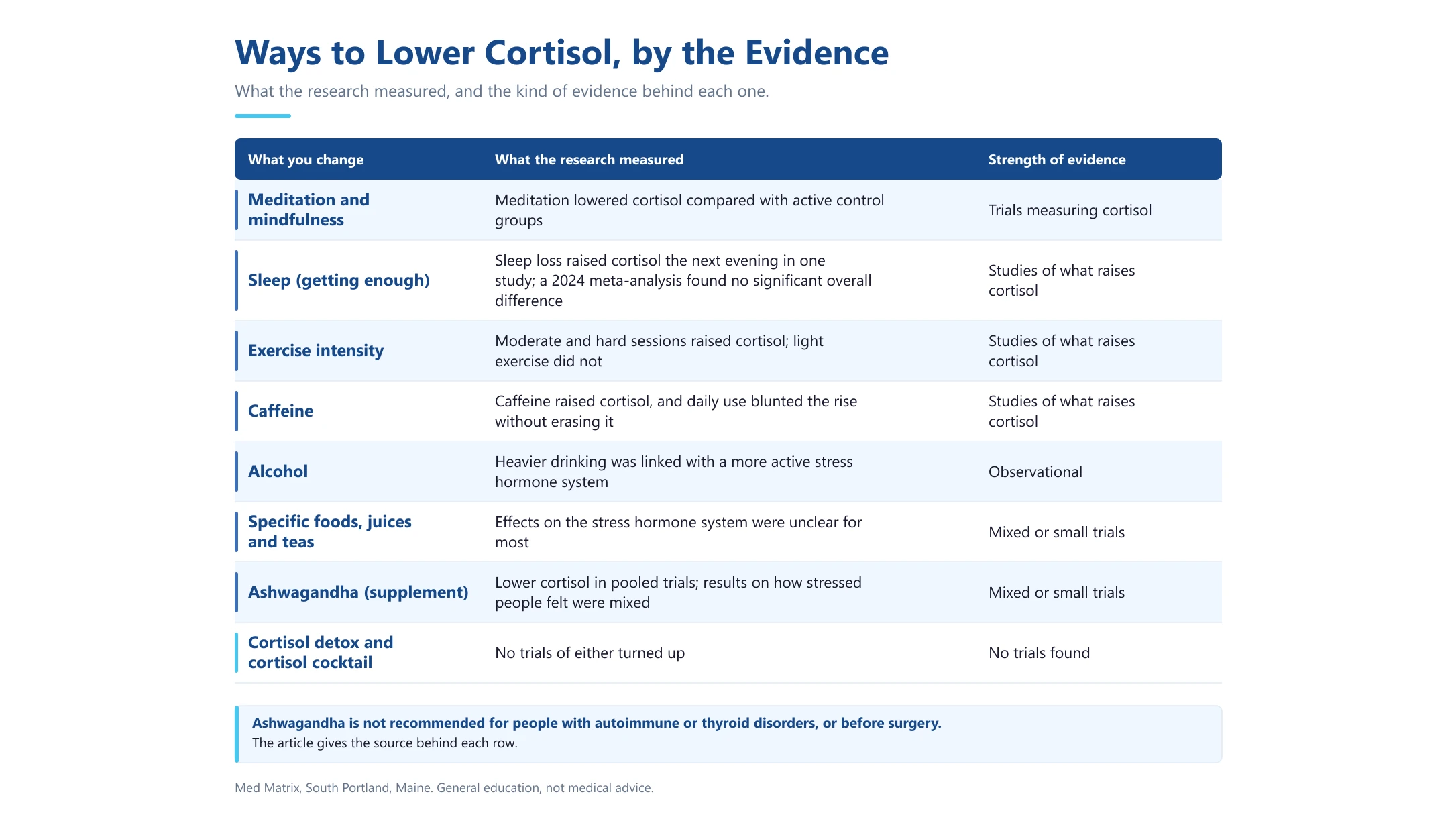
Of the everyday steps covered here, meditation has the strongest trial evidence for lowering cortisol. Sleep loss, hard exercise and caffeine each raised cortisol in a study cited here, so protecting your sleep, mixing easier workouts in with hard ones and keeping coffee to the morning are reasonable steps. Heavier drinking is linked with a more active stress hormone system. Cortisol detoxes and "cortisol cocktails" have no published trials behind them that we could find.
If you're planning to treat high cortisol, for example with a supplement, it's worth checking first whether it is actually high. It rises and falls every day by design, a single number can mislead, and one of our patients who expected high cortisol told us her labs showed it was low. This is general information, and it isn't a substitute for advice from your own provider.
Ways to Lower Cortisol, Sorted by the Kind of Evidence
Meditation, sleep, exercise intensity and caffeine have all been tested in studies that measured cortisol. The alcohol link is observational, so it shows an association rather than cause. Ashwagandha and specific foods have small or mixed trials, and cortisol detoxes and cocktails turned up no trials in a PubMed search we ran on November 6, 2026.
| What you change | What the research measured | Strength of evidence | Source |
|---|---|---|---|
| Meditation and mindfulness | Meditation lowered cortisol compared with active control groups | Trials measuring cortisol | Pascoe and colleagues; Koncz and colleagues (meta-analyses) |
| Sleep (getting enough) | Sleep loss raised cortisol the next evening in one study; a 2024 meta-analysis found no significant overall difference | Studies of what raises cortisol | Leproult and colleagues, Sleep; Chen and colleagues, Endocr J |
| Exercise intensity | Moderate and hard sessions raised cortisol; light exercise did not | Studies of what raises cortisol | Hill and colleagues, J Endocrinol Invest |
| Caffeine | Caffeine raised cortisol, and daily use blunted the rise without erasing it | Studies of what raises cortisol | Lovallo and colleagues, Psychosom Med |
| Alcohol | Heavier drinking was linked with a more active stress hormone system | Observational | Badrick and colleagues, J Clin Endocrinol Metab |
| Specific foods, juices and teas | Effects on the stress hormone system were unclear for most | Mixed or small trials | Lopresti and colleagues (systematic review) |
| Ashwagandha (supplement) | Lower cortisol in pooled trials; results on how stressed people felt were mixed | Mixed or small trials | Albalawi (meta-analysis); Della Porta and colleagues (systematic review) |
| Cortisol detox and cortisol cocktail | No trials of either turned up | No trials found | PubMed search by Med Matrix |
Is Your Cortisol Actually High?
If you're planning to treat high cortisol, for example with a supplement, it's worth checking first whether it is actually high. You don't need a test to protect your sleep or try meditation. MedlinePlus, the National Library of Medicine's health site, says blood is usually drawn twice in a day: once in the morning, when cortisol is normally at its highest, and again around 4 p.m., when it's normally much lower. A saliva kit can collect several samples at home across the day to show when your levels rise and fall. One number read without its time of day can mislead.
The symptoms people blame on cortisol have other explanations too. The National Institute of Diabetes and Digestive and Kidney Diseases (NIDDK) notes that fatigue and weight gain can have many different causes, and MedlinePlus says a cortisol test alone can't diagnose the cause of an abnormal result.
One of our patients, Ashley, is a good example. She was exhausted, foggy and gaining weight, and after everything she'd seen online she expected her labs to show high cortisol. She told us her labs at our clinic, where she sees Colin Renaud, PA-C, MS, FAAMFM, ABAAHP, showed what she called extremely low cortisol, the opposite of what she expected, and very low vitamin D. That isn't a diagnosis of adrenal insufficiency. Watch Ashley's story.
Low cortisol is a different problem with a different fix. Adrenal insufficiency, which includes Addison's disease, happens when the adrenal glands don't make enough of certain hormones, cortisol among them. The NIDDK lists its most common symptoms as fatigue, muscle weakness, loss of appetite, weight loss and abdominal pain. MedlinePlus warns that, without treatment, cortisol that is too low can be very serious. Doctors diagnose adrenal insufficiency with blood tests and treat it with medicines that replace the missing hormones, so if these symptoms fit, see your doctor first. Taking a supplement meant to lower cortisol would be the wrong move for someone in that position.
Sleep
In a sleep-lab study at the University of Chicago, young men were studied under three sleep schedules: a normal night, a night cut short (sleep only from 4 a.m. to 8 a.m.), and a night with no sleep. After either kind of sleep loss, their cortisol the next evening was higher than it had been the evening before. The quiet stretch when cortisol normally switches off at night also started at least an hour late. The study was short, but it measured cortisol directly across a 32-hour period. A 2024 meta-analysis of 24 studies found no significant overall difference in cortisol after acute sleep loss, including in evening measurements, though studies using serum samples did show higher levels. So this finding isn't settled.
That nighttime dip is part of a healthy rhythm: the NIDDK explains that cortisol production normally drops just after we fall asleep.
Common sleep advice, which the study above didn't test:
- The same wake time most days, weekends included.
- Enough hours in bed to actually sleep the amount you need.
- Less alcohol, and not as a way to fall asleep.
- A wind-down you repeat every night, whatever it looks like for you.
If sleep is the real problem, our sleep issues page covers how we look into it, and the sleep episode of our podcast goes further.
Exercise: Intensity Matters
Hard exercise raises cortisol for a while, and easy exercise doesn't. A University of North Carolina study had 12 active men exercise for 30 minutes at light, moderate and hard effort on separate days, plus a resting session. The authors concluded that moderate to high intensity exercise provokes increases in circulating cortisol. Light exercise did not raise it significantly, and once the researchers corrected for fluid shifts and time of day, light exercise actually lowered circulating cortisol.
That rise was measured right after the workout, and it isn't a reason to stop training. MedlinePlus notes that stress and exercise can raise your cortisol levels, which is why you may be asked to rest before a cortisol test. If you train hard most days and sleep badly, mixing in easier sessions and rest days is a reasonable thing to try. The study is small, so treat it as a direction.
Stress-Reduction Practices That Have Been Measured
Of the stress practices covered here, meditation has the most cortisol data, and the effect is uneven. A 2017 meta-analysis pooled 45 randomized trials that compared meditation with an active control group across several stress markers, cortisol among them. When all meditation styles were analyzed together, meditation reduced cortisol, along with blood pressure, heart rate and other stress markers. Focused attention styles also lowered cortisol on their own.
A 2021 meta-analysis looked closer and found the effect wasn't the same for everyone. In studies that measured cortisol in blood, meditation had a clear effect, but only in people with a physical illness. In the 21 studies that used saliva samples, the effect was small and not significant, with a borderline effect in people living through stressful situations. Our reading: meditation is worth a fair trial, especially under real strain, but don't expect a quick fix.
This article doesn't review the cortisol research on slow breathing or time outdoors, so we make no claim either way. If they help you unwind, that's reason enough. Our podcast episodes on the HPA axis and cortisol, stress and burnout cover the stress side in more depth.
Caffeine and Alcohol
Caffeine raises cortisol. In a four-week double-blind trial, 48 men and 48 women took capsules with or without caffeine while saliva cortisol was sampled through the day. After five days without caffeine, a caffeine challenge raised cortisol across the test day. In daily users, the first morning dose no longer raised it, but cortisol rose again between 1 p.m. and 7 p.m. after an afternoon dose, then fell back by evening. The authors concluded that cortisol responses to caffeine are reduced, but not eliminated, in daily users.
The trial didn't test moving caffeine earlier, but if you want to limit its effect on cortisol, keeping it to the morning is a reasonable thing to try. You don't need to quit.
Alcohol's link with cortisol comes from a different kind of study. Researchers looked at saliva cortisol and drinking habits in 2,693 men and 977 women from the Whitehall II study, a long-running occupational cohort. They found that alcohol consumption was associated with activation of the HPA axis (the hormone system at the center of the stress response), and the pattern wasn't explained by drinking on the day of sampling. It was a cross-sectional snapshot, not a trial, so it can't prove that drinking less will lower your cortisol, though it points that way.
Food: What the Evidence Does and Doesn't Say
In the 2022 systematic review we relied on, no single plant food showed a clear effect on cortisol, and we didn't review whole diets. The review gathered 52 randomized trials of single plants and plant foods, including green tea, cherry juice, blueberries and curcumin, that measured cortisol or related hormones. The designs varied so much that the authors called the effect on the HPA axis unclear for most of them. Its most consistent finding was a morning cortisol-lowering effect from ashwagandha, which is a supplement.
So don't treat a "cortisol diet" food list as proven. Eating well still makes sense; it just hasn't been shown here to move a cortisol number.
Supplements: What NIH Sources Say, and the Warnings
Ashwagandha has several cortisol trials behind it, and it comes with real safety warnings. A 2025 meta-analysis of seven randomized trials found a statistically significant drop in cortisol but no significant change in how stressed people said they felt. A 2023 systematic review of nine studies also found lower cortisol, noted that none checked the effect on adrenal function or long-term effects, and advised using the supplements under medical supervision.
The National Center for Complementary and Integrative Health (NCCIH) at the NIH says some ashwagandha preparations may be effective for insomnia and stress, while the evidence on anxiety is unclear. Its safety points:
- It may be safe short term (up to 3 months). There isn't enough information to judge long-term safety.
- Rare cases of liver injury have been linked to ashwagandha supplements.
- Avoid it during pregnancy, and don't use it while breastfeeding.
- Not recommended before surgery or for people with autoimmune or thyroid disorders.
- It might interact with medicines for diabetes, high blood pressure and thyroid hormone, with immunosuppressants, sedatives and anti-seizure medicines.
- People with hormone-sensitive prostate cancer should avoid it.
The NCCIH also notes that dietary supplements aren't approved by the FDA before they're sold. Rhodiola was among the plants in the 2022 review, which found the effect unclear for most of them. For vitamins and minerals, the better question is if you're low in one. Our standard panel includes vitamin D, B12, folate and magnesium, so a deficiency can be found and corrected rather than guessed at. Talk with a clinician before starting any supplement for cortisol.
Cortisol Detoxes, Cortisol Cocktails and Herbal Teas
We found no trials of cortisol detox plans or "cortisol cocktail" drinks. On November 6, 2026, we searched PubMed for the terms cortisol and cocktail alongside coconut, orange juice or mocktail, and it returned no papers. A search pairing cortisol with detox returned a single study, and it was about a digital detox: time away from screens.
The 2022 review included green tea and herbal plants such as rosella, holy basil and hops, and the effect was unclear for most of what it tested. If you like a warm drink in the evening, enjoy it, but don't count on it to change a lab result.
When High Cortisol Is a Medical Problem
Very high cortisol over a long time is Cushing's syndrome, and it needs a doctor. The NIDDK says people with very high cortisol for a long time are likely to have clear signs, including:
- weight gain, with thin arms and legs
- a round face
- increased fat around the base of the neck
- a fatty hump between the shoulders
- easy bruising
- wide purple stretch marks, mainly on the abdomen, breasts, hips and under the arms
- weak muscles
Not everyone with Cushing's syndrome has these signs, which can make it hard to detect. The most common cause is long-term, high-dose use of glucocorticoid medicines such as prednisone. No single test is perfect, so doctors usually do two of three tests to confirm it: a 24-hour urinary free cortisol test, a late-night salivary cortisol test, and a low-dose dexamethasone suppression test. If you take steroid medicines, don't stop them suddenly on your own; MedlinePlus notes that stopping suddenly can leave cortisol too low. Talk with the doctor who prescribed them.
Our Medical Director, Pedro Gonzalez, MD, has put the principle this way: "I know my limits... Power is also in collaboration. Knowing who to reach out to, being resourceful, sometimes it's more important than actually knowing it." If you have the signs above, start with your doctor. For the everyday symptom picture people link to stress, see our guide to HPA axis dysfunction and adrenal fatigue, and for weight around the middle, our article on cortisol belly.
How Med Matrix Looks at Cortisol
Your adrenal glands don't get tired. But HPA axis dysfunction (the technical term) is real, measurable, and well-documented in the research. Cortisol is part of the initial intake panel, inside our 80+ biomarker test, alongside nutrients such as vitamin D, B12, folate and magnesium. When a result calls for a closer look, further adrenal assessment moves to a 12-hour salivary cortisol. Our advanced testing page explains the options. DUTCH is one (see our DUTCH test guide), but we use it rarely and it isn't our standard adrenal workup.
We retest and compare against your own previous numbers, so progress is measured against your own baseline. Depending on what the tests show, care can include nutrient repletion. Our thyroid and adrenal page describes that care, and our functional medicine page explains the wider approach.
We have one office, at 198 Maine Mall Road in South Portland, and we see patients from Maine and New Hampshire.
Frequently Asked Questions
What is the fastest way to lower cortisol?
There's no quick switch. Meditation has lowered cortisol in randomized trials, though the effect was uneven. The other steps in the table avoid things that raised cortisol in studies: protecting sleep, keeping hard exercise balanced with easy days, and keeping caffeine to the morning, which the caffeine trial didn't test directly. If you're thinking of treating high cortisol with a supplement, check first that it's actually high.
Can you reset your cortisol levels?
Not in the way the word suggests. Cortisol rises and falls every day by design, normally peaking in the morning and dropping by late afternoon and again after you fall asleep. The real aim is a healthy daily rhythm. Testing at more than one time of day shows whether your rhythm is off, and in which direction, which matters because cortisol you expect to be high can turn out to be low, as one of our patients told us hers did.
Is there a drink that lowers cortisol?
We found no trials of the cortisol cocktail in a PubMed search we ran in November 2026. Caffeine raised cortisol in a trial, and heavier drinking is linked with a more active stress hormone system. Keeping coffee to the morning and drinking less alcohol are reasonable things to try.
What should I eat in the morning to lower cortisol?
The 2022 review we relied on found no clear cortisol effect from any single plant food, and we didn't review whole diets. Cortisol is normally highest in the morning, so a morning number needs to be read with its time of day in mind. Eat a regular breakfast you'll actually stick with. If you're worried about your cortisol pattern, samples taken at more than one time of day are what show it.
Is lowering cortisol different for men and women?
The research behind these steps doesn't cover both sexes equally. The University of Chicago sleep study and the exercise study cited here enrolled men only, while the caffeine trial enrolled 48 men and 48 women. So treat those sleep and exercise findings as tested in men.
Should I take supplements to lower cortisol?
Talk with a clinician first. Ashwagandha had the most consistent cortisol findings in a review of plant trials, but the NIH lists real cautions: it may be safe short term (up to 3 months), and long-term safety is unknown, rare liver injury has been reported, it's not for pregnancy, breastfeeding, thyroid or autoimmune conditions, and it may interact with several medicines. Supplements also aren't FDA-approved before sale. If your cortisol turns out to be low rather than high, a cortisol-lowering supplement would be the wrong choice entirely.
Where can I get my cortisol tested in Maine?
Med Matrix has one office, at 198 Maine Mall Road in South Portland, and sees patients from Maine and New Hampshire. Cortisol is part of our initial intake panel, inside the 80+ biomarker test, and a 12-hour salivary cortisol is the next step when a closer look is needed. The first step is a Free Discovery Call, where you can ask whether testing makes sense for you.
Sources
- Cortisol Test. MedlinePlus, US National Library of Medicine. https://medlineplus.gov/lab-tests/cortisol-test/. Accessed November 6, 2026.
- Cushing's Syndrome. National Institute of Diabetes and Digestive and Kidney Diseases (NIDDK). https://www.niddk.nih.gov/health-information/endocrine-diseases/cushings-syndrome. Accessed November 6, 2026.
- Adrenal Insufficiency & Addison's Disease. National Institute of Diabetes and Digestive and Kidney Diseases (NIDDK). https://www.niddk.nih.gov/health-information/endocrine-diseases/adrenal-insufficiency-addisons-disease. Accessed November 6, 2026.
- Ashwagandha: Usefulness and Safety. National Center for Complementary and Integrative Health (NCCIH). https://www.nccih.nih.gov/health/ashwagandha. Accessed November 6, 2026.
- Leproult R, Copinschi G, Buxton O, Van Cauter E. Sleep loss results in an elevation of cortisol levels the next evening. Sleep. 1997;20(10):865-870. PubMed. https://pubmed.ncbi.nlm.nih.gov/9415946/. Accessed November 6, 2026.
- Chen Y, Xu W, Chen Y, et al. The effect of acute sleep deprivation on cortisol level: a systematic review and meta-analysis. Endocr J. 2024;71(8):753-765. PubMed. https://pubmed.ncbi.nlm.nih.gov/38777757/. Accessed November 6, 2026.
- Hill EE, Zack E, Battaglini C, et al. Exercise and circulating cortisol levels: the intensity threshold effect. J Endocrinol Invest. 2008;31(7):587-591. PubMed. https://pubmed.ncbi.nlm.nih.gov/18787373/. Accessed November 6, 2026.
- Pascoe MC, Thompson DR, Jenkins ZM, Ski CF. Mindfulness mediates the physiological markers of stress: Systematic review and meta-analysis. J Psychiatr Res. 2017;95:156-178. PubMed. https://pubmed.ncbi.nlm.nih.gov/28863392/. Accessed November 6, 2026.
- Koncz A, Demetrovics Z, Takacs ZK. Meditation interventions efficiently reduce cortisol levels of at-risk samples: a meta-analysis. Health Psychol Rev. 2021;15(1):56-84. PubMed. https://pubmed.ncbi.nlm.nih.gov/32635830/. Accessed November 6, 2026.
- Lovallo WR, Whitsett TL, al'Absi M, et al. Caffeine stimulation of cortisol secretion across the waking hours in relation to caffeine intake levels. Psychosom Med. 2005;67(5):734-739. PubMed Central. https://pmc.ncbi.nlm.nih.gov/articles/PMC2257922/. Accessed November 6, 2026.
- Badrick E, Bobak M, Britton A, et al. The relationship between alcohol consumption and cortisol secretion in an aging cohort. J Clin Endocrinol Metab. 2008;93(3):750-757. PubMed. https://pubmed.ncbi.nlm.nih.gov/18073316/. Accessed November 6, 2026.
- Lopresti AL, Smith SJ, Drummond PD. Modulation of the hypothalamic-pituitary-adrenal (HPA) axis by plants and phytonutrients: a systematic review of human trials. Nutr Neurosci. 2022;25(8):1704-1730. PubMed. https://pubmed.ncbi.nlm.nih.gov/33650944/. Accessed November 6, 2026.
- Albalawi AA. Dual impact of Ashwagandha: Significant cortisol reduction but no effects on perceived stress. A systematic review and meta-analysis. Nutr Health. 2025;31(4):1395-1408. PubMed. https://pubmed.ncbi.nlm.nih.gov/40746175/. Accessed November 6, 2026.
- Della Porta M, Maier JA, Cazzola R. Effects of Withania somnifera on Cortisol Levels in Stressed Human Subjects: A Systematic Review. Nutrients. 2023;15(24):5015. PubMed. https://pubmed.ncbi.nlm.nih.gov/38140274/. Accessed November 6, 2026.
- Farrukh S, et al. From screens to serenity: evaluating the effect of digital detox on mental and physiological health. BMC Med Educ. 2025;25(1):1738. PubMed. https://pubmed.ncbi.nlm.nih.gov/41462197/. Accessed November 6, 2026.
- PubMed searches for cortisol and cocktail (with coconut, mocktail or orange juice) and for cortisol and detox. US National Library of Medicine. https://pubmed.ncbi.nlm.nih.gov/. Searched November 6, 2026.
Find Out Where Your Cortisol Really Stands
Testing can show where your cortisol stands, and samples taken at more than one time of day show its daily pattern. Start with a Free Discovery Call with our South Portland team.
Get Your Free Guide + $100 Voucher and take the first step.