
Cortisol Belly: What's Real, What's Hype, and What Tests Show

Forbes Health Advisory Board · Naturopathic Doctor
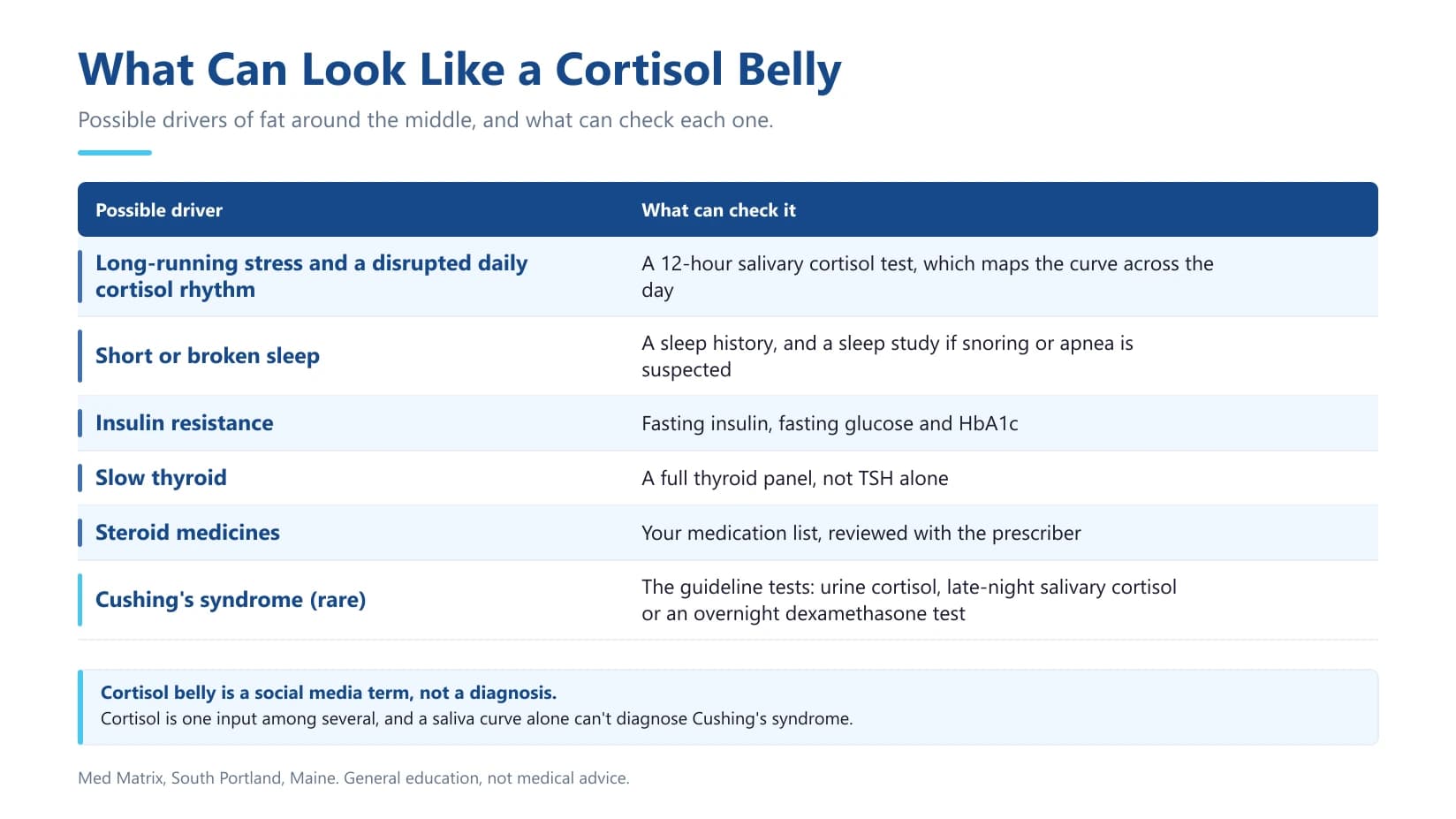
"Cortisol belly" is a social media name for fat around the middle that people blame on cortisol, the body's main stress hormone. It isn't a medical diagnosis. The link behind it is partly real: long-running stress and short sleep raise cortisol, and higher cortisol is associated with more belly fat in large studies. But the effect is small for most people, and a few other causes can look the same and are worth ruling out first.
The American Association of Clinical Endocrinology calls it a popular, nonmedical term used on social media. That's fair. It also doesn't mean the people searching for it are imagining things. A waistline that keeps growing during the most stressful stretch of your life is a real experience, and it deserves a better answer than a 30-second video and a supplement code.
This post covers what the research shows, what it doesn't, the rare condition that a true cortisol problem looks like, and what a cortisol test can and can't tell you. It's general information, and it isn't a substitute for advice from your own provider.
What Is Cortisol Belly?
The phrase usually describes one of two things. Some people mean a firm, rounded stomach that showed up during a hard year. Others mean belly fat that won't move even though they're eating well and exercising.
Both descriptions point at the same fat: visceral fat, the deeper layer packed around the organs inside the abdomen, as opposed to the soft fat you can pinch just under the skin. Visceral fat is the kind that matters for health. It's tied to blood sugar problems, blood pressure and heart disease, which is why a growing waist is worth paying attention to whatever you call it.
What social media adds is a single villain. Cortisol gets the blame, and the fix is sold as lowering it. The real picture is messier.
Does Cortisol Actually Cause Belly Fat?
Cortisol can push fat toward the middle. The clearest proof is Cushing's syndrome, covered below, where the body is flooded with cortisol for months and fat collects in the face, neck and abdomen. Nobody disputes that very high cortisol does this.
The open question is whether everyday stress, at everyday cortisol levels, does the same thing in a smaller way. Three studies carry most of the argument:
- In a 2000 study in Psychosomatic Medicine, 59 healthy women went through repeated lab stress tests over four days. The 30 women who carried more fat around the waist released more cortisol during the first stress session. Among the leaner women, those with more waist fat kept releasing more cortisol on days two and three, even after the tasks were familiar.
- A 2017 study in Obesity measured cortisol in the hair of 2,527 men and women aged 54 to 87. Hair holds a record of cortisol over roughly two months. Higher hair cortisol went with a larger waist and with obesity that persisted over four years.
- A 1997 study in Sleep found that one night of short or no sleep left evening cortisol 37% to 45% higher the next day in healthy young men.
Now the honest part. The first two studies are snapshots, so they show a link without showing which came first. Stress could raise cortisol and add belly fat. Belly fat could also change how the body handles cortisol. And in the hair study the correlation with waist size was weak (r = 0.082), which means cortisol explained a sliver of the difference in waistlines between people.
So cortisol is one input among several. For most people it isn't the main one, and nobody should be promised that lowering it will flatten their stomach.
Signs It May Be More Than Stress
Cushing's syndrome is what a true cortisol problem looks like. The National Institute of Diabetes and Digestive and Kidney Diseases says the kind the body makes on its own is rare, and lists these signs in people with very high cortisol for a long time:
- Weight gain, with thin arms and legs
- A round face
- More fat at the base of the neck, or a fatty hump between the shoulders
- Easy bruising
- Wide purple stretch marks, mainly on the abdomen, breasts, hips and under the arms
- Weak muscles
That combination is the tell. A stressed person with a thicker waist usually has normal arms and legs. Someone with Cushing's often has a heavy middle on thin limbs, along with the skin changes.
The same page says the most common cause of Cushing's syndrome is long-term, high-dose use of glucocorticoid medicines, the steroid family that includes prednisone. If you take one and notice these changes, raise it with the prescriber. Don't stop or cut the dose on your own; when a steroid is the cause, the dose is lowered gradually.
If several of these signs fit, the next step is a medical workup, and it should happen soon.
What Can Look Like a Cortisol Belly
A growing middle has more than one possible driver, and several can be checked. This is the short list we'd want ruled in or out before anyone blames stress alone.
| Possible driver | What often comes with it | What can check it |
|---|---|---|
| Long-running stress and a disrupted daily cortisol rhythm | Poor sleep, feeling wired at night, a hard year you can name | A 12-hour salivary cortisol test, which maps the curve across the day |
| Short or broken sleep | Higher evening cortisol the next day, more hunger | A sleep history, and a sleep study if snoring or apnea is suspected |
| Insulin resistance | Weight settling at the waist, energy crashes after meals | Fasting insulin, fasting glucose and HbA1c |
| Slow thyroid | Tiredness, feeling cold, constipation, weight gain | A full thyroid panel, not TSH alone |
| Steroid medicines | The same signs as Cushing's syndrome | Your medication list, reviewed with the prescriber |
| Cushing's syndrome (rare) | Round face, fatty hump between the shoulders, thin arms and legs, wide purple stretch marks | The guideline tests: urine cortisol, late-night salivary cortisol or an overnight dexamethasone test |
The thyroid row has its own post. If your belly changed alongside fatigue and feeling cold, read thyroid belly shape, which walks through why a single TSH result so often misses the problem.
Can a Test Show Whether Cortisol Is the Problem?
Partly. It depends on which test, and on what question it's asking.
A single blood cortisol taken in the morning gives one number at one moment. Cortisol is supposed to move through the day: highest soon after you wake, falling through the afternoon, lowest at night. One morning value can't show whether that curve is flattened, or whether cortisol is still high at bedtime when it should be falling.
Cortisol is part of the blood work in our initial intake. When the history points toward the stress system, the next step is a 12-hour salivary cortisol test, which you collect at home at set times across the day. It shows the shape of the curve, which is the part a single number misses.
What a saliva curve can't do on its own is diagnose Cushing's syndrome. The Endocrine Society's guideline sets that workup: first rule out steroid medicines, then use one of a urine cortisol collection, late-night salivary cortisol or an overnight dexamethasone suppression test, with repeat or second tests to confirm. That's specialist territory, and it's the right path when the signs in the section above are present.
Testing cortisol by itself also misses the rest of the table. A belly that grew because of insulin resistance or a slow thyroid won't show up on any cortisol test.
What We Mean by HPA Axis Dysfunction
The HPA axis is the signaling loop between the hypothalamus and pituitary in the brain and the adrenal glands above the kidneys. It sets how much cortisol you make and when. Months of stress, short sleep, illness or blood sugar swings can throw its timing off.
Your adrenal glands don't get tired. But HPA axis dysfunction (the technical term) is real, measurable, and well-documented in the research. That's the useful version of the "adrenal fatigue" idea, and our adrenal fatigue post covers it in depth.
For belly fat, the HPA axis matters because it connects the other rows of the table. Short sleep raises evening cortisol. Cortisol raises blood sugar. Higher blood sugar over time pushes insulin up. One bad input feeds the next, which is why fixing a single number rarely fixes the waistline.
How to Get Rid of a Cortisol Belly
There's no cortisol detox, drink or supplement that targets belly fat, whatever the ads say. The things that help are dull and they work slowly. They also work on visceral fat whether or not cortisol was the cause, which is the point.
- Protect your sleep. The CDC advises at least seven hours a night for adults. Given the 1997 sleep study, this is the most direct lever on evening cortisol you have.
- Lift something heavy a few times a week. Strength training builds muscle, and muscle uses blood sugar.
- Stop punishing yourself with cardio. Hours of hard exercise on short sleep is one more stressor. Walking counts, especially after meals.
- Eat regular meals built around protein and fiber, so blood sugar isn't swinging all day.
- Look hard at alcohol. It breaks up sleep, even when it feels like it helps you fall asleep.
- Take the stress itself seriously. A work schedule, a caregiving load, a relationship. No lab value fixes those, and they're often the real driver.
And measure the right thing. The scale can stay flat while visceral fat drops. A tape measure at the navel tells you more, and the NIH's heart and lung institute flags a waist over 35 inches in women or over 40 inches in men as a higher health risk. We measure visceral fat directly with an InBody 770 body composition scan at every visit, so progress shows up even when the scale doesn't move.
Frequently Asked Questions
Is cortisol belly real?
The name is social media slang, not a diagnosis. The idea behind it has some support: higher long-term cortisol is linked to a larger waist in large studies. But the link is weak for most people, and causes like insulin resistance, poor sleep and a slow thyroid often matter more.
What does a cortisol belly look like?
Usually a firm, rounded stomach from deep visceral fat, rather than soft fat you can pinch. A heavy middle on thin arms and legs, with a round face and wide purple stretch marks, is a different picture. That pattern points toward Cushing's syndrome and needs a medical workup.
What are the symptoms of high cortisol?
For the rare condition of very high cortisol (Cushing's syndrome), the NIDDK lists weight gain with thin arms and legs, a round face, a fatty hump between the shoulders, easy bruising, wide purple stretch marks and weak muscles. Everyday stress doesn't produce that full picture.
How long does it take to lose a cortisol belly?
There's no reliable timeline, and anyone who gives you one in days is selling something. Visceral fat responds to sleep, strength training and steadier blood sugar over months. Tracking your waist or a body composition scan shows change sooner than the scale.
Can a blood test show cortisol belly?
A single morning blood cortisol shows one moment, so it can look normal even when the daily rhythm is off. A 12-hour salivary cortisol test shows the curve across the day. Neither one rules in Cushing's syndrome alone; that takes the guideline tests.
Do cortisol supplements work for belly fat?
No supplement has been shown to remove belly fat by lowering cortisol. Sleep, strength training, steady meals and dealing with the source of the stress do more, and they're free.
Start Feeling Like Yourself Again
If your middle has been growing and nobody has looked past "eat less and move more," start with real numbers. It begins with a Free Discovery Call, then an 80+ Biomarker Test & Full Body Scan that includes cortisol, fasting insulin, HbA1c, a full thyroid panel and a visceral fat reading. Our Medical Team Reviews Everything, and a 60-Minute Provider Consultation goes through every result with you and decides whether a 12-hour salivary cortisol test is worth adding. Labs can be drawn in our office, or at a partner lab near you. Our clinical team covers thyroid and adrenal care as part of the same plan.
Get Your Free Guide + $100 Voucher and find out what's actually behind the change.
Med Matrix is a functional medicine clinic in South Portland, Maine, serving patients across Greater Portland and southern New Hampshire.