
Do You Have to Fast for a Thyroid Test? What Changes Your TSH

Forbes Health Advisory Board · Naturopathic Doctor
You don't have to fast for a thyroid blood test that checks TSH on its own. Eating can still nudge the result. A 2026 review in the journal Endocrine pooled studies that tested the same people fasting and after a meal, and TSH read lower after eating, with the biggest drop in people whose thyroid was already underactive.
Free T4 and free T3 showed no significant difference. So the useful habit is consistency: test the same way each time, and mention biotin, sleep, illness and your thyroid medicine before the draw.
If your lab or clinic gave you instructions for this draw, follow them. Other tests ordered on the same draw may need fasting even when TSH doesn't. This is general information, and it isn't a substitute for advice from your own clinician.
Thyroid Blood Test Prep at a Glance
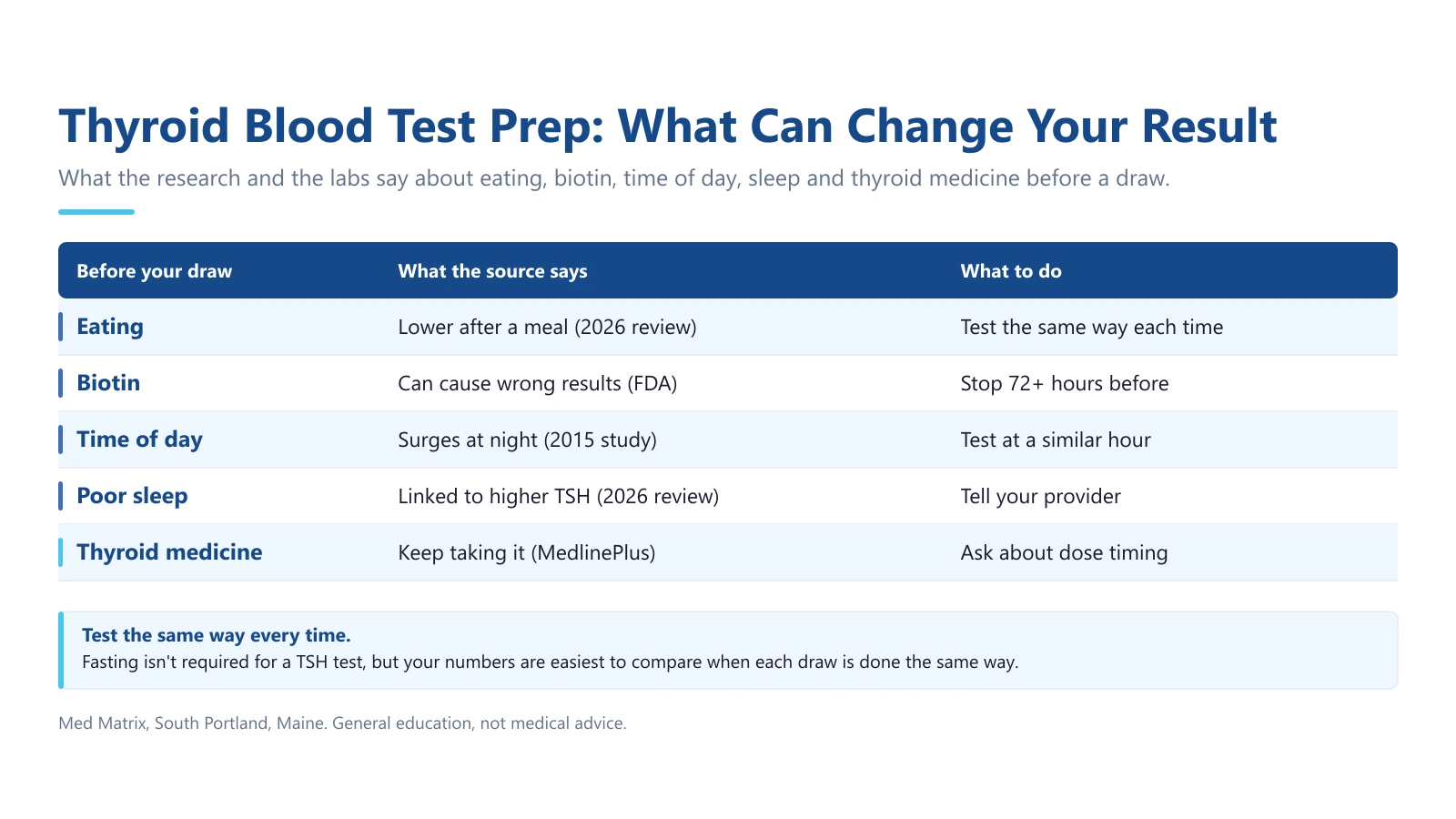
Five things to sort out before your draw. Each row comes from a source named in the sections below.
| Before your draw | What the source says | What to do |
|---|---|---|
| Eating | Lower after a meal (2026 review) | Test the same way each time |
| Biotin | Can cause wrong results (FDA) | Stop 72+ hours before |
| Time of day | Surges at night (2015 study) | Test at a similar hour |
| Poor sleep | Linked to higher TSH (2026 review) | Tell your provider |
| Thyroid medicine | Keep taking it (MedlinePlus) | Ask about dose timing |
Do You Have to Fast for a Thyroid Blood Test?
Not for TSH by itself. The MedlinePlus page on the TSH test lists no fasting rule for TSH. It says that if your provider has ordered other blood tests, "you may need to fast (not eat or drink) for several hours before the test." For thyroid antibodies, Cleveland Clinic says you can eat and drink normally unless your provider tells you otherwise. We cover that test in our guide to thyroid antibodies.
So a full breakfast won't make a thyroid test invalid. It may make the number a little different from the one you'd get fasting. Test the same way every time. Fasting isn't required for a TSH test, but your numbers are easiest to compare when each draw is done the same way.
What Eating Does to TSH
The clearest evidence is a systematic review and meta-analysis published in Endocrine on October 29, 2026 (PubMed 42955544). The authors only included studies that measured the same people twice on the same day, once fasting and once after eating. mIU/L is the unit on your TSH report.
- For TSH, that meant 14 studies and 1,257 people.
- TSH was lower after the meal. On average across the studies, it read 0.802 mIU/L lower.
- The gap was largest in overt hypothyroidism (a clearly underactive thyroid, 2.518 mIU/L lower) and subclinical hypothyroidism (a mildly raised TSH with normal T4, 2.173 mIU/L lower).
- Free T4 and free T3: no significant difference between fasting and after a meal.
Two cautions before you do anything with those figures. The authors rated the certainty of the evidence as low, and the studies disagreed sharply with each other on how big the drop was. Read the result as a direction. TSH tends to come out lower after eating. Nobody should take that average and use it to adjust a number on their own report.
The authors also don't say fasting is better. Their conclusion is that "current evidence does not establish superiority of either sampling condition." An after-meal TSH is still a valid result, taken under different conditions.
When a Meal Before the Test Matters Most
If your TSH sits well inside the lab's range, a drop of that size is unlikely to change how it's read. The authors point to one situation where it can: "borderline thyroid dysfunction, where it may drive misclassification towards euthyroid state." Euthyroid means a normal-functioning thyroid. In plain terms, a TSH sitting just above the line could land just under it after breakfast and be read as normal.
That's why the review says "standardizing and recording fasting status" may help with reading borderline results. People already being treated for an underactive thyroid have more reason to care. The drop was biggest in people with overt or subclinical hypothyroidism. The review doesn't say whether they were on treatment, but if you're having TSH checked to adjust a dose, you want this month's draw to be comparable to the last one.
If your TSH has bounced around between tests and you can't explain why, check whether one draw was fasting and the other wasn't. It's an easy thing to rule out. If your TSH looks fine and you still feel off, read why a normal TSH doesn't always settle it.
Biotin: The Supplement to Pause Before Your Draw
Biotin (vitamin B7) is sold on its own and as an ingredient in other supplements, so check the label of anything you take. It can throw off the lab test itself, so your blood can be fine while the report says otherwise. The FDA warns that biotin "can significantly interfere with certain lab tests and cause incorrect test results which may go undetected."
Thyroid tests are among the affected ones. The American Thyroid Association says biotin "can cause the measurement of several thyroid function tests to appear abnormal, when they are in fact normal in the blood."
How long to stop:
- Labcorp, on its TSH test page and its thyroid antibody test page, says patients should be cautioned to stop biotin at least 72 hours before the sample is collected. Its warning is about supplements with a high dose of biotin, and it recommends asking every patient who may need the test about biotin.
- The American Thyroid Association gives a shorter window, saying biotin should not be taken for 2 days before blood is drawn for thyroid function testing.
- Your own lab may have its own rule. Cleveland Clinic advises asking your provider how long to stop.
- If a clinician prescribed biotin for you, ask them before stopping it, and tell the lab you take it.
Stopping 72 hours ahead meets both the Labcorp and ATA windows. And if you forgot and took biotin the morning of the test, say so before the sample goes off. That's more useful than a puzzling result later.
Does Time of Day or Sleep Change Thyroid Results?
Both can. Neither one is a reason to panic about a single result.
Time of day. TSH has a daily rhythm. A 2015 study in Thyroid looked at 465,593 TSH measurements from people with no thyroid disease (PubMed 26061389). It described a "nocturnal TSH surge" and concluded that the TSH reference interval "varies significantly by age, sex, hour of day, and ethnicity."
There's no single right hour in that study. Because TSH peaks overnight, an early-morning draw and an afternoon draw may not match, so book repeat tests at a similar time of day.
Sleep. A 2026 systematic review in the Journal of Endocrinological Investigation (PubMed 42635905) found that sleep deprivation was associated with a significant increase in TSH. The evidence base is small: 25 studies were included, and only eight could be pooled.
Longer stretches of sleep restriction gave less consistent results, which the authors think may mean the body adapts over time. Their conclusion stresses "the importance of sleep history when interpreting thyroid function tests."
That's an argument for telling whoever reads your labs about a rough week of sleep before the draw. It says nothing about sleep causing thyroid disease.
Your Thyroid Medicine and Other Tests on the Same Draw
Keep taking your thyroid medicine unless your prescriber tells you otherwise. MedlinePlus is direct about this: you may need to stop certain medicines before the test, "but don't stop taking any medicines unless your provider tells you to." Whether to take your dose before or after the draw is a question for the person who prescribes it. Ask once, then do it the same way every time.
Fasting questions usually come from the rest of the order. A thyroid panel is often drawn alongside other blood work, and some of those tests need an empty stomach. If the instructions from your clinic or lab say to fast, fast. If they say nothing and you aren't sure, call and ask before the morning of the draw.
Things worth telling the person drawing or reading your blood:
- Whether you ate, and roughly when
- Any biotin, including biotin inside another supplement
- Your thyroid medicine, your dose and when you last took it
- Every other medicine and supplement you take, since MedlinePlus asks you to tell your provider about everything you take
- Whether you're pregnant or could be
- Short or broken sleep, including a night shift or recent travel
- Any recent illness
MedlinePlus also notes that pregnancy affects TSH, and that some serious illnesses not related to the thyroid may lower TSH for a short time.
Why We Compare You to Your Own Numbers
We retest and compare against your own previous numbers, which is exactly where test-day conditions matter. A trend only means something if the draws behind it are comparable.
The thyroid portion of our 80+ biomarker test includes TSH, Free T3, Free T4, Total T4, T-Uptake, Reverse T3, TPO antibodies and thyroglobulin antibodies. Labs can be drawn in our office, or at a partner lab near you. Our panel includes tests beyond the thyroid, so follow the prep instructions that come with your lab order. Providers review your labs, medical history, and questionnaires, and cross-reference symptoms with biomarker patterns, which is why the details above are worth passing on.
You can read more about our thyroid and adrenal care and our advanced testing, or start with the common signs in our guide to thyroid imbalance.
We have one office, at 198 Maine Mall Road in South Portland, Maine.
Frequently Asked Questions
What happens if I don't fast before a thyroid blood test?
Usually nothing that ruins the test. A 2026 review found TSH tended to read lower after a meal, with no significant difference in free T4 or free T3. The authors said neither fasting nor after-meal testing has been shown to be better, and they said recording fasting status may make borderline results easier to read. If other tests on the same order call for fasting, tell the lab before the draw that you ate.
Should I take my thyroid medication before a thyroid blood test?
Ask the provider who prescribes it, and don't stop it on your own. MedlinePlus says not to stop any medicines before a TSH test unless your provider tells you to. Whatever timing you agree on, keep it the same for each test so results can be compared.
How long before a thyroid test should I stop biotin?
Labcorp says patients should be cautioned to stop biotin at least 72 hours before the sample is collected. The American Thyroid Association says 2 days. Stopping 72 hours ahead covers both, and your lab may have its own instruction. If a clinician prescribed biotin for you, ask them before stopping it.
What can throw off a thyroid blood test?
The sources in this article point to biotin, eating before the draw, the time of day, poor sleep and some serious illnesses unrelated to the thyroid. MedlinePlus adds that pregnancy and age over 80 can affect TSH. Telling whoever reads your result about any of these helps them interpret it.
What is the best time of day for a thyroid blood test?
No single hour has been shown to be best. TSH rises at night, and a 2015 study of 465,593 TSH measurements found the reference interval varies by hour of day. A similar time for each repeat test keeps that rhythm from muddying the comparison.
Do I need to fast for a thyroid antibody test?
No. MedlinePlus says no special preparation is needed, and Cleveland Clinic says you can eat and drink normally unless your provider tells you otherwise. Biotin still matters, so read our guide to thyroid antibodies for the rest.
Track Your Thyroid Against Your Own Numbers
A single TSH tells you less than a series of them taken the same way. Start with a Free Discovery Call, then the 80+ Biomarker Test & Full Body Scan and a 60-Minute Provider Consultation, where you go over every result in detail with your provider. Get Your Free Guide + $100 Voucher to start.
Sources
- K M, K E B, Selvaraj K, et al. Effect of fasting and postprandial states on thyroid function test parameters and diagnostic interpretation: A systematic review and meta-analysis. Endocrine. 2026;91(1):351. PubMed. https://pubmed.ncbi.nlm.nih.gov/42955544/. Accessed November 9, 2026.
- Jain SP, Setia Santoso LFA, Ikkurthy N, et al. Sleep deprivation as a modulator of thyroid function: a systematic review and meta-analysis. J Endocrinol Invest. Published online August 24, 2026. PubMed. https://pubmed.ncbi.nlm.nih.gov/42635905/. Accessed November 9, 2026.
- Ehrenkranz J, Bach PR, Snow GL, et al. Circadian and circannual rhythms in thyroid hormones: determining the TSH and free T4 reference intervals based upon time of day, age, and sex. Thyroid. 2015;25(8):954-961. PubMed. https://pubmed.ncbi.nlm.nih.gov/26061389/. Accessed November 9, 2026.
- TSH (Thyroid-Stimulating Hormone) Test. MedlinePlus, US National Library of Medicine. https://medlineplus.gov/lab-tests/tsh-thyroid-stimulating-hormone-test/. Accessed November 9, 2026.
- Thyroid Antibodies. Cleveland Clinic. https://my.clevelandclinic.org/health/diagnostics/thyroid-antibodies. Accessed November 9, 2026.
- Thyroid Antibodies (test 006684). Labcorp. https://www.labcorp.com/tests/006684/thyroid-antibodies. Accessed November 9, 2026.
- Thyroid-Stimulating Hormone (TSH) (test 004259). Labcorp. https://www.labcorp.com/tests/004259/thyroid-stimulating-hormone-tsh. Accessed November 9, 2026.
- Thyroid Function Tests. American Thyroid Association. https://www.thyroid.org/thyroid-function-tests/. Accessed November 9, 2026.
- Biotin Interference with Troponin Lab Tests - Assays Subject to Biotin Interference. US Food and Drug Administration. https://www.fda.gov/medical-devices/in-vitro-diagnostics/biotin-interference-troponin-lab-tests-assays-subject-biotin-interference. Accessed November 9, 2026.