
Does Thyroid Cause Weight Gain? What an Underactive Thyroid Really Adds

Forbes Health Advisory Board · Naturopathic Doctor · Updated November 7, 2026
Yes, an underactive thyroid can cause weight gain, but usually less than people expect. The American Thyroid Association puts it at about 5 to 10 pounds for most patients, and says most of that is salt and water, not fat. If you've gained more than that, your thyroid may be part of the story, but something else may be behind the rest, and that's worth testing for.
That's a frustrating answer if you've gained 20 or 30 pounds and were hoping one blood test would explain all of it. It's also a useful one. Once you know how much the thyroid can account for, you can go looking for the rest instead of waiting for it to come off on its own.
What Are the Key Takeaways About Thyroid and Weight Gain?
- An underactive thyroid typically accounts for about 5 to 10 pounds, mostly salt and water, according to the American Thyroid Association.
- Nearly 5 out of 100 Americans ages 12 and older have hypothyroidism, according to the National Institute of Diabetes and Digestive and Kidney Diseases (NIDDK).
- An overactive thyroid usually causes weight loss, though some people gain because appetite rises.
- Treating hypothyroidism returns weight to where it was before the hypothyroidism started. Weight from other causes needs its own plan.
- Extra thyroid hormone is not a safe way to lose weight. It raises the risk of serious side effects, and the weight usually comes back.
Does Thyroid Cause Weight Gain?
An underactive thyroid can, and an overactive one usually does the opposite. When the gland makes too little hormone (hypothyroidism), your body burns less energy at rest and holds on to more salt and water. That combination is where thyroid weight comes from.
The fluid part surprises most people. The American Thyroid Association says plainly that "most of the weight gained is actually due to retaining salt and water." So thyroid problems and weight gain do go together, but the thyroid's share is usually modest, and the ATA notes that the more severe the hypothyroidism, the more weight it can add.
Hashimoto's disease, an autoimmune condition, is the most common cause of hypothyroidism according to NIDDK. That's the link between Hashimoto's and weight gain: the weight follows the low thyroid hormone the disease causes.
How Much Weight Can Hypothyroidism Cause?
For most patients, about 5 to 10 pounds, per the American Thyroid Association. Underactive thyroid weight gain in that range is real, and it's worth treating. Gain well beyond that range is less likely to be thyroid alone, especially when the hypothyroidism is mild, though severe cases can add more.
When the gain is bigger than that, other causes can be stacked on top. Months of exhaustion that cut your activity to almost nothing. Sleep that stopped being restful. Blood sugar and insulin drifting up. Lost muscle. Midlife hormone shifts. Other medications. Usually more than one.
If your other symptoms improve with treatment, the ATA says "it is unlikely that the weight gain was only due to the thyroid." Weight that stays after that points to another cause.
Thyroid Weight Change at a Glance
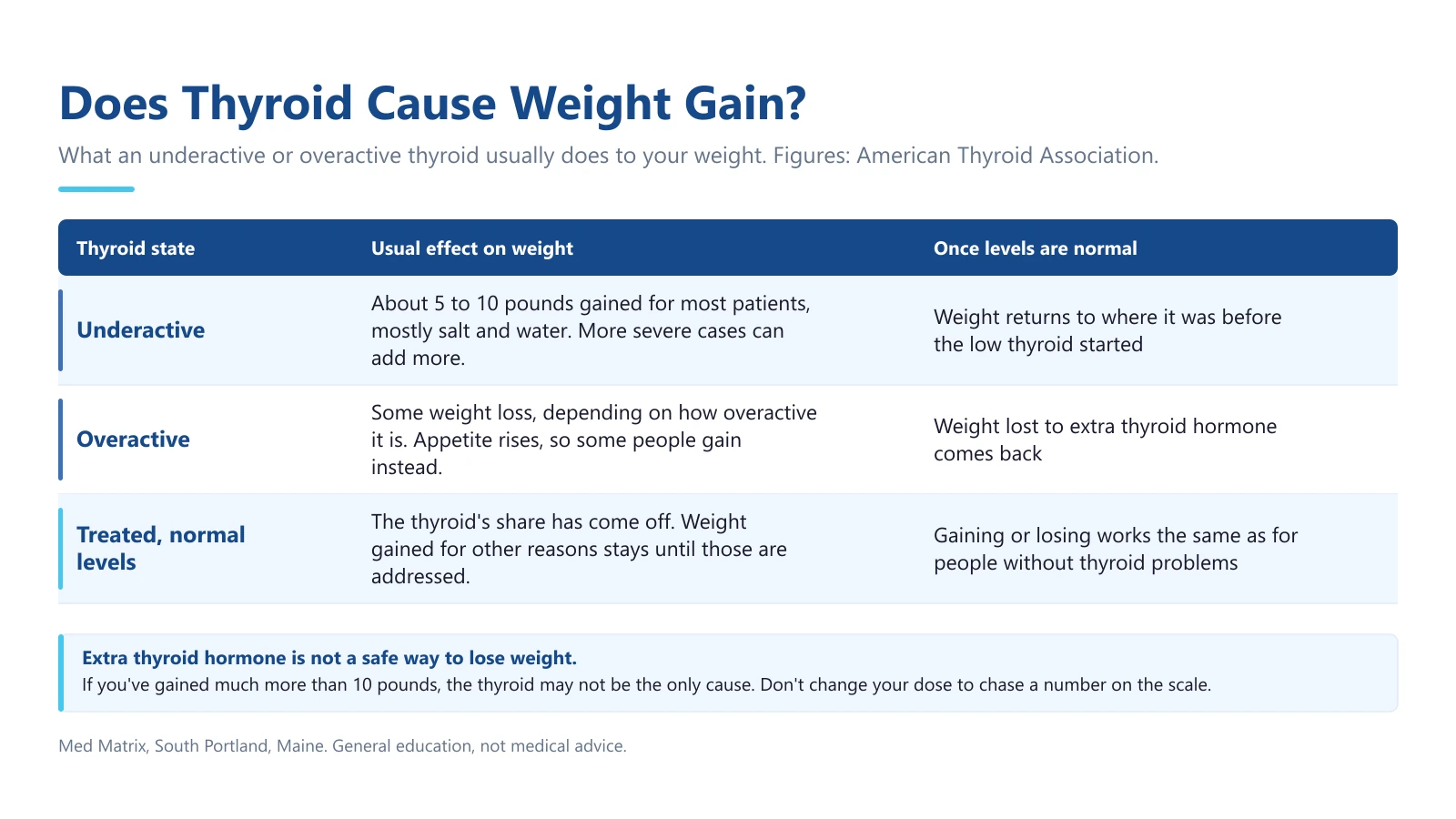
The direction and the size of the change depend on what your thyroid is doing. These figures come from the American Thyroid Association. The bottom row is our reading of what they mean.
| Thyroid state | Usual effect on weight | Once levels are normal |
|---|---|---|
| Underactive | About 5 to 10 pounds gained for most patients, mostly salt and water. More severe cases can add more. | Weight returns to where it was before the low thyroid started |
| Overactive | Some weight loss, depending on how overactive it is. Appetite rises, so some people gain instead. | Weight lost to extra thyroid hormone comes back |
| Treated, normal levels | The thyroid's share has come off. Weight gained for other reasons stays until those are addressed. | Gaining or losing works the same as for people without thyroid problems |
Does Thyroid Increase Belly Fat?
Not directly in the way most people picture. Because most thyroid weight is salt and water, it's more often puffiness than a new layer of fat. The tiredness and lost muscle that can come with low thyroid are part of why the midsection can still change. We've written a full guide to what a thyroid belly looks like and why it happens.
Does Hyperthyroidism Cause Weight Gain?
Usually the opposite. An overactive thyroid speeds up how fast you burn energy, and NIDDK lists "weight loss despite an increased appetite" among its symptoms. Graves' disease, an autoimmune condition, is the most common cause of hyperthyroidism, so the same applies to Graves'.
There are two exceptions worth knowing. The American Thyroid Association notes that some people with hyperthyroidism actually gain weight, depending on how much more they eat. And once treatment brings thyroid levels back to normal, the weight lost to extra thyroid hormone comes back. Some people gain beyond that, because they got used to eating more while the appetite was high.
Fast weight loss can look like good news and hide how serious an overactive thyroid is. Left untreated, it can cause an irregular heartbeat that can lead to blood clots, stroke or heart failure, along with thinning bones and muscle problems, according to NIDDK. If you're losing weight without trying, or can't keep weight on, that's a reason to get tested. It isn't something to self-treat.
What Are the Warning Signs of a Bad Thyroid?
Weight change alone doesn't point to the thyroid. The symptoms that come with it are more useful.
Underactive thyroid. NIDDK lists these as common:
- Fatigue
- Weight gain
- Trouble tolerating cold
- Joint and muscle pain
- Dry skin or dry, thinning hair
- Heavy or irregular periods, or fertility problems
- Slowed heart rate
- Depression
Overactive thyroid. NIDDK lists these:
- Weight loss despite an increased appetite
- Rapid or irregular heartbeat
- Nervousness, irritability, trouble sleeping or fatigue
- Shaky hands or muscle weakness
- Sweating or trouble tolerating heat
- Frequent bowel movements
- An enlargement in the neck, called a goiter
Many of these have other causes too, so symptoms can't confirm a thyroid problem on their own. A blood test can.
How Are Thyroid Problems Diagnosed?
With blood tests. TSH and free T4 are the tests used to diagnose hypothyroidism. Thyroid antibody tests look for autoimmune causes such as Hashimoto's or Graves' disease. TSH alone doesn't show those antibodies. Our guide to thyroid antibodies explains what a positive result does and doesn't tell you.
Does High TSH Cause Weight Gain?
TSH doesn't add the weight itself. It's a signal. According to NIDDK, a high TSH level most often means hypothyroidism, and a low TSH level usually means hyperthyroidism. So a high TSH can go along with thyroid weight gain, and it's the low thyroid hormone that matters. The ATA's estimate of about 5 to 10 pounds is for hypothyroidism, and a single TSH number can't tell you how much weight it caused.
Can Thyroid Weight Gain Be Reversed?
It usually reverses the thyroid part, and not much more. The American Thyroid Association says treating hypothyroidism returns body weight to where it was before the hypothyroidism started, and that once thyroid levels are normal, gaining or losing weight works the same as it does for anyone else. So treatment takes off the thyroid share of the weight, and weight gained for other reasons needs its own plan. What levothyroxine actually does to your weight covers the 2026 evidence.
Does Thyroid Medication Cause Weight Loss?
Only the thyroid share, and it isn't a weight loss drug. The American Thyroid Association notes that thyroid hormone has been used for weight loss in the past, and warns that taking extra raises the risk of insomnia, palpitations, anxiety, loss of muscle and bone, and heart rhythm problems that can raise stroke risk. Any weight lost that way is usually regained once it stops. NIDDK also warns that too much thyroid medicine can cause atrial fibrillation or osteoporosis. Don't change your dose to chase a number on the scale.
How Do You Fix Thyroid Weight Gain?
Start by making sure the thyroid itself is treated and the dose is right. NIDDK says to expect a blood test about 6 to 8 weeks after you start medicine, and again after each dose change. Then treat the rest of the weight as its own project, because it usually is one.
- Get a clear thyroid picture. TSH and free T4 are the tests used to diagnose hypothyroidism, and TSH alone doesn't show thyroid antibodies. More on that in what to do when your TSH is normal but you still have symptoms.
- Split the number into fat, muscle and water. Hypothyroidism adds fluid, so scale weight blurs what's happening. A body composition scan reports all three, so retesting shows how those numbers change. It can't say exactly how many pounds came from your thyroid.
- Test blood sugar alongside the thyroid. Fasting insulin and HbA1c belong on the same draw as your thyroid panel, because insulin trouble and low thyroid are separate problems that can stack.
- Keep your muscle. Muscle helps set how much energy you burn at rest, which matters more when the thyroid has already slowed that down. Our page on muscle loss covers why.
- Check the habits low thyroid wore down. Tiredness cuts activity and sleep quality, and some prescriptions affect weight in their own right.
Some people with a treated thyroid and stubborn extra weight are candidates for a prescription weight loss medication. Some of these medicines aren't an option if you or anyone in your family has had medullary thyroid cancer, or if you have a condition called MEN 2, so tell your provider your full thyroid history. Our medical weight loss program starts from your thyroid labs rather than around them.
Can IV Therapy Help Support Thyroid Function?
Only indirectly, and only when a nutrient deficiency is actually documented. IV therapy does not treat hypothyroidism, and no infusion restores thyroid hormone production. What it can do is replace a measured deficiency when oral supplements aren't being absorbed.
The Iodine Warning
Iodine is the one to be careful with. Iodine is genuinely required to make thyroid hormone, so it sounds like an obvious supplement. But the American Thyroid Association says that, outside of preconception, pregnancy and breastfeeding, the U.S. diet generally contains enough iodine, from iodized salt, dairy, bread and seafood. For those three groups, the ATA recommends a daily multivitamin with 150 mcg of iodine. And if you have Hashimoto's, foods with large amounts of iodine, such as seaweed, and iodine supplements may cause or worsen hypothyroidism, according to NIDDK. Since Hashimoto's is the most common cause of hypothyroidism, pushing iodine at a hypothyroid patient may make the underlying problem worse rather than better. Outside of planning a pregnancy, pregnancy and breastfeeding, we don't recommend iodine supplements.
Nutrients Worth Measuring
- Vitamin D. Involved in immune regulation.
- Ferritin. Iron is needed for thyroid peroxidase, the enzyme that makes thyroid hormone. Ferritin can be low while a routine blood count still reads normal.
- Magnesium. Involved in hundreds of enzyme reactions.
All three are on our panel of 80+ biomarkers, and the point of measuring them is to find out whether anything needs correcting at all. If your levels are fine, an infusion is not going to change how your thyroid works, and we would rather say so. You can read how we handle IV nutrient therapy and what we test before ordering one.
How We Sort Out Thyroid Weight From Everything Else
The question we're answering is whether your thyroid is part of your weight, and what else might be. We work through it in five steps.
- Free Discovery Call. We hear when the weight started, which thyroid symptoms came with it, and whether you've been diagnosed or treated yet.
- 80+ Biomarker Test & Full Body Scan. A full thyroid panel (TSH, free T3, free T4, total T4, T-uptake, reverse T3, TPO and thyroglobulin antibodies), plus the metabolic and nutrient markers that explain weight the thyroid doesn't. The InBody 770 scan reports body water alongside fat and muscle.
- Medical Team Reviews Everything. The team reads your thyroid results alongside your scan to look for other likely causes of the weight.
- 60-Minute Provider Consultation. Your provider walks you through the results and decides what to treat first, the thyroid, the rest, or both together.
- Ongoing Support & Progress. An InBody scan at every visit, with retesting against your own baseline, shows how your fat, muscle and water are changing.
Thyroid treatment can include T4, T3 or natural desiccated thyroid, and correcting nutrient deficiencies the labs actually show. Our thyroid and adrenal program is where that work happens.
Start Feeling Like Yourself Again
Frequently Asked Questions
Does thyroid cause weight gain?
An underactive thyroid can. The American Thyroid Association estimates about 5 to 10 pounds for most patients, and says most of it is salt and water rather than fat. An overactive thyroid usually causes weight loss instead. If you've gained much more than 10 pounds, the thyroid may not be the only cause, especially if the hypothyroidism is mild.
Does hypothyroidism cause weight gain?
Yes. Hypothyroidism slows how fast your body burns energy and makes it hold on to salt and water. The American Thyroid Association puts the thyroid-related gain at about 5 to 10 pounds for most patients, with more possible when the hypothyroidism is severe.
How much weight can you gain with hypothyroidism?
For most patients, about 5 to 10 pounds, according to the American Thyroid Association, and most of that is fluid. Severe hypothyroidism can add more. Gain well beyond that range can also have other causes, such as less activity while you're exhausted, poor sleep, rising insulin, lost muscle, midlife hormone changes or other medications.
Does hyperthyroidism cause weight gain?
Usually not. Hyperthyroidism means the thyroid works too hard and speeds up metabolism, so the body burns more calories, and it usually causes weight loss. The American Thyroid Association notes that some people gain weight anyway, depending on how much more they eat. Left untreated, it can cause an irregular heartbeat that can lead to blood clots, stroke or heart failure, along with thinning bones and muscle problems, according to NIDDK.
Does Graves' disease cause weight gain?
Not usually while it's active. Graves' disease is the most common cause of hyperthyroidism, and NIDDK lists weight loss despite an increased appetite among its symptoms. The American Thyroid Association notes that some people gain weight if they eat a lot more, and that weight lost to extra thyroid hormone comes back once levels return to normal.
Will I lose the weight once my thyroid is treated?
You'll usually lose the part your thyroid caused, and not much more. The American Thyroid Association says treatment returns weight to where it was before the hypothyroidism started. If your other symptoms improve but the scale barely moves, the rest of the weight likely has another cause worth testing for.
Does thyroid make your neck fat?
An enlarged thyroid can change how your neck looks. When the gland gets larger, called a goiter, the front of the neck can look swollen. That swelling is the gland itself, and NIDDK describes it as a possible sign of Hashimoto's disease. New swelling at the front of your neck is worth having checked.
What are the signs that weight gain is caused by a thyroid problem?
Look at what comes with it. NIDDK lists fatigue, trouble tolerating cold, joint and muscle pain, dry skin or thinning hair, heavy or irregular periods, a slowed heart rate and depression as common symptoms of hypothyroidism. These have other causes too, so a blood test is what confirms it.
Does thyroid weight gain affect women differently?
Women are much more likely than men to develop hypothyroidism, according to NIDDK, and it's more common after age 60. The American Thyroid Association's estimate of about 5 to 10 pounds isn't split by sex. Midlife hormone changes can add weight at the same time, which is one reason the thyroid alone may not explain all of it.
Why am I losing weight with hypothyroidism?
Weight loss isn't a typical symptom of hypothyroidism. If you've started treatment, the thyroid share coming off is expected. The American Thyroid Association notes that too much thyroid hormone can also cause weight loss, along with serious side effects. If you're losing weight without trying, tell your provider soon, because it can have causes other than your thyroid dose.
How are thyroid problems diagnosed?
With blood tests. TSH and free T4 are the tests used to diagnose hypothyroidism. A high TSH most often means an underactive thyroid, and a low TSH usually means an overactive one, according to NIDDK. Thyroid antibody tests can identify autoimmune conditions like Hashimoto's or Graves' disease.

From the clinic behind this article
We test first. We do not guess.
Med Matrix is a functional medicine clinic at 198 Maine Mall Road in South Portland, Maine. Everything on this blog is written from how our providers actually work with patients:
- Free Discovery Call. Talk with our patient coordinator about your goals, symptoms, and concerns.
- 80+ Biomarker Test & Full Body Scan. Your labs are drawn in our office, or at a partner lab near you, plus an InBody 770 body composition scan.
- Medical Team Reviews Everything. Providers review your labs, medical history, and questionnaires before recommending anything.
- 60-Minute Provider Consultation. Sit down with your provider for a full hour and go over every result in detail.
- Ongoing Support & Progress. Continued monitoring of your labs and markers, with adjustments as your body responds.
The providers who read your labs
 Dr. Paul Laband, MD
 Sophia Viner, DNP, APRN, FMCP‑M
 Colin Renaud, PA‑C, MS, FAAMFM, ABAAHP
 Gabriel Rocha, PA‑C, MMSc, IFMCP
- Dr. Sasha Rose, ND, LAc, MSOM
See what the panel covers on advanced lab testing, or meet the whole staff.