
Types of Peptides: A Reference List and FDA Status

Forbes Health Advisory Board · Naturopathic Doctor · Updated October 15, 2026
A peptide is a short chain of amino acids. Amino acids are the same building blocks your body uses to make protein, and the only real difference between a peptide and a protein is length. String a few dozen together and you have a peptide. Keep going past roughly fifty and biochemists start calling it a protein. Your body already makes hundreds of them, and it uses them to carry messages: this gland should release something, that tissue should start repairing, you have eaten enough.
That messenger role is why peptides ended up in medicine. If a molecule already tells the body to do something, a lab-made copy can carry the same message. Semaglutide is a peptide. So is insulin, which has been in clinical use since the 1920s.
What follows is a list of the peptide names people actually ask about, from semaglutide and tirzepatide to sermorelin, BPC-157, TB-500, KPV, MOTS-c, Semax, Epitalon and DSIP, grouped by what kind of molecule each one is, with a plain note on where each currently stands with the FDA. That last column is the one most articles get wrong, and in the summer of 2026 it changed in a way that produced a lot of confused headlines.
The five groups peptides fall into
There is no official taxonomy here. Researchers group peptides by what system they signal to, and that is the grouping below, because it is the one that makes the list navigable rather than alphabetical.
1. Incretin peptides, also called GLP-1 medications
These mimic gut hormones that are released after eating. Semaglutide and tirzepatide are the two most people have heard of, and both are approved prescription drugs sold under brand names. Tirzepatide is slightly unusual because it acts on two receptors rather than one, which is covered in semaglutide vs tirzepatide.
This is the only one of the five groups where every medicine named is a fully approved drug with a published label. Liraglutide, an older GLP-1 medication, is approved too, sold as Victoza and Saxenda. If you want the whole class laid out, including the newer oral options, GLP-1 medications covers every one of them, and is tirzepatide a peptide answers the question in the name.
2. Growth hormone secretagogues
Rather than supplying growth hormone, these signal the pituitary to release more of what it already makes. Sermorelin is the one most commonly prescribed in this group, with CJC-1295 and ipamorelin appearing frequently alongside it. What sermorelin is and how it works goes through the mechanism properly.
Tesamorelin belongs in this group as well. It is an approved prescription drug, sold under the brand name Egrifta.
3. Repair and recovery peptides
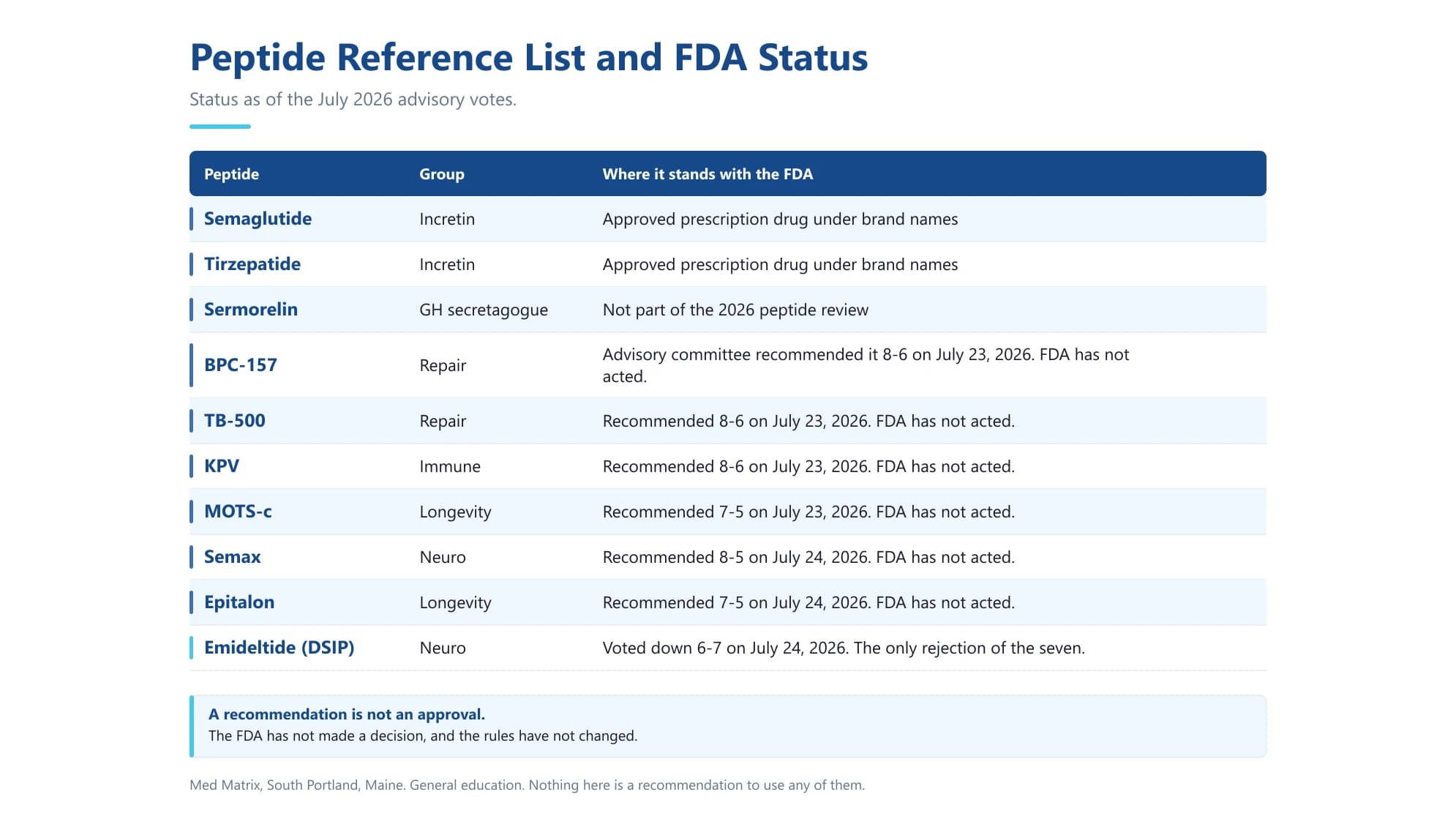
BPC-157 and TB-500 sit here. Both are research peptides, which is a specific regulatory description rather than a marketing one, and it is the reason both showed up at an FDA advisory meeting in 2026. The table below has their current status.
4. Immune-signalling peptides
Thymosin alpha-1 and KPV are in this group. Thymosin alpha-1 is derived from a hormone the thymus produces.
5. Neuro and longevity peptides
Semax, epitalon and MOTS-c. These are the least established of the groups, and they are also the ones where the gap between online claims and regulatory reality is widest.
Peptide list: names, groups and FDA status
The vote results in the FDA column below are from the July 2026 advisory meetings. That column describes regulatory position only. It is not a statement about whether any substance works, and nothing here is a recommendation to use any of them.
| Peptide | Group | Where it stands with the FDA |
|---|---|---|
| Semaglutide | Incretin | Approved prescription drug under brand names |
| Tirzepatide | Incretin | Approved prescription drug under brand names |
| Sermorelin | GH secretagogue | Not part of the 2026 peptide review |
| BPC-157 | Repair | Advisory committee recommended it 8-6 on July 23, 2026. FDA has not acted. |
| TB-500 | Repair | Recommended 8-6 on July 23, 2026. FDA has not acted. |
| KPV | Immune | Recommended 8-6 on July 23, 2026. FDA has not acted. |
| MOTS-c | Longevity | Recommended 7-5 on July 23, 2026. FDA has not acted. |
| Semax | Neuro | Recommended 8-5 on July 24, 2026. FDA has not acted. |
| Epitalon | Longevity | Recommended 7-5 on July 24, 2026. FDA has not acted. |
| Emideltide (DSIP) | Neuro | Voted down 6-7 on July 24, 2026. The only rejection of the seven. |
| Liraglutide | Incretin | Approved prescription drug (Victoza, Saxenda) |
| Tesamorelin | GH secretagogue | Approved prescription drug (Egrifta) |
| Insulin | Metabolic hormone | Approved drug under many brand names, in clinical use since the 1920s |
| Bremelanotide (PT-141) | Melanocortin | Approved prescription drug (Vyleesi) |
| Octreotide | Hormone analogue | Approved prescription drug (Sandostatin) |
Liraglutide, tesamorelin, insulin, bremelanotide and octreotide are approved peptide drugs, shown with their brand names. Three of them, insulin, bremelanotide and octreotide, sit outside the five groups above.
Names on peptide lists that are not peptides
MK-677, also called ibutamoren, turns up on a lot of online peptide lists, but it is a small molecule classed as a non-peptide. It acts on the same growth hormone secretagogue receptor the hormone ghrelin uses. It shares that receptor with ipamorelin, which is why it gets filed next to the growth hormone secretagogues, but chemically it belongs to a different class.
What the July 2026 votes actually changed
Nothing, yet. That is the honest answer, and it is worth reading twice if you saw a headline suggesting otherwise.
The FDA's Pharmacy Compounding Advisory Committee met on July 23 and 24, 2026 to consider seven peptides for the 503A Bulks List, which is the list of bulk substances that traditional compounding pharmacies are permitted to work with. Six of the seven were recommended for inclusion. One, emideltide, was not.
Two details make this more interesting than a routine committee meeting. The panel voted against the FDA's own scientific staff, who had recommended against all seven substances. And the votes are advisory. They carry no legal force on their own. For anything to change, the FDA has to review the recommendations and the public comments, then decide whether to open formal rulemaking.
So a peptide that was not available through a 503A pharmacy on July 22 was still not available on July 25. If you read that the FDA approved BPC-157, that is not what happened. What the FDA's 2026 peptide review means for you walks through the whole proceeding, including what would have to happen next.
Compounded versus approved, and why the difference matters
An approved drug has been through the FDA's review process and carries a label describing what it was approved to treat. A compounded preparation is made by a pharmacy for an individual patient, and it has not been through that process. Both are legal. They are not the same thing, and a page that blurs them is a page to be careful with.
This distinction has driven most of the GLP-1 news of the past two years. The July 30 deadline for compounded semaglutide and what the FDA warning letters mean cover where that landed. Retatrutide vs tirzepatide is a useful comparison precisely because one of the two is approved and one is still in trials.
Where to read more, by question
This page is an index. The detail lives in the articles below.
If you are researching GLP-1 options. Every GLP-1 option explained, pills versus injections, what tirzepatide costs, switching between the two, and what a plateau workup checks. If you have seen patches advertised, do GLP-1 patches work covers what can physically cross skin.
If you are researching growth hormone peptides. What sermorelin is and what the published sermorelin protocols say.
If you are researching safety and regulation. The 2026 peptide review, GLP-1 medications and heart rhythm, and the FDA warning letters.
If you are deciding where to go. What to look for in a peptide clinic is the practical one, and our peptide therapy page explains how we work.
How peptides are actually prescribed here
Peptides are not something you should pick off a list, which is part of why this page does not tell you what any of them will do for you. At Med Matrix the sequence runs the other way around. You start with a free discovery call, then an 80+ biomarker test and full body scan. Our medical team reviews everything, and you sit down with your provider for a full hour to go through what came back.
Whether a peptide belongs in your plan, and which one, is a conversation that happens after the labs, not before. Some people leave that appointment with a peptide protocol. Plenty do not, because their results pointed somewhere else entirely.
Frequently asked questions
What are peptides, in one sentence?
Short chains of amino acids that act as signalling molecules in the body, shorter than proteins, and used in medicine because a lab-made copy can carry the same message a natural one does.
What are the most common peptide names?
Names covered on this page include semaglutide, tirzepatide, sermorelin, BPC-157, TB-500 and MOTS-c, along with older approved peptide drugs like insulin and liraglutide. The table above lists each one by group, with where it stands with the FDA.
Did the FDA approve BPC-157 in 2026?
No. On July 23, 2026 an FDA advisory committee voted 8-6 to recommend BPC-157 for the list of substances compounding pharmacies may use. A recommendation is not an approval, the FDA has not made a decision, and the rules have not changed.
Are peptides the same as steroids?
No. Steroids are built from a cholesterol backbone. Peptides are chains of amino acids, a different class of molecule entirely, and they signal rather than acting directly on the same receptors.
Is tirzepatide a peptide?
Yes. It is a synthetic peptide that acts on two incretin receptors. The longer answer is here.
Which peptide is best?
That question does not have a general answer, and anyone who gives you one without seeing your labs is guessing. What belongs in a plan depends on what your testing shows.
Where to start
If you have been reading about peptides and want to know which parts of it apply to you rather than to somebody on the internet, Start Feeling Like Yourself Again with testing that looks at what is actually happening in your body first.