
Testosterone Levels by Age: A Chart for Men, and What a Normal Number Misses

Forbes Health Advisory Board · Naturopathic Doctor
For healthy nonobese men 19 to 39, the normal range for total testosterone is 264 to 916 ng/dL, according to a 2017 Endocrine Society study that measured 1,185 such men on a CDC-standardized scale. The American Urological Association (AUA) treats a total testosterone below 300 ng/dL as a reasonable cutoff in support of a low testosterone diagnosis, confirmed on two separate early-morning tests and read alongside symptoms and signs.
Med Matrix is a TRT clinic offering testosterone replacement therapy for men in Maine. If you have a lab number in hand, the first question is usually whether it's normal for your age. The chart below answers that from a published study that actually tables age bands, with the source printed under it. Then comes what a chart can't tell you. This is general information, and it isn't a substitute for advice from your own provider.
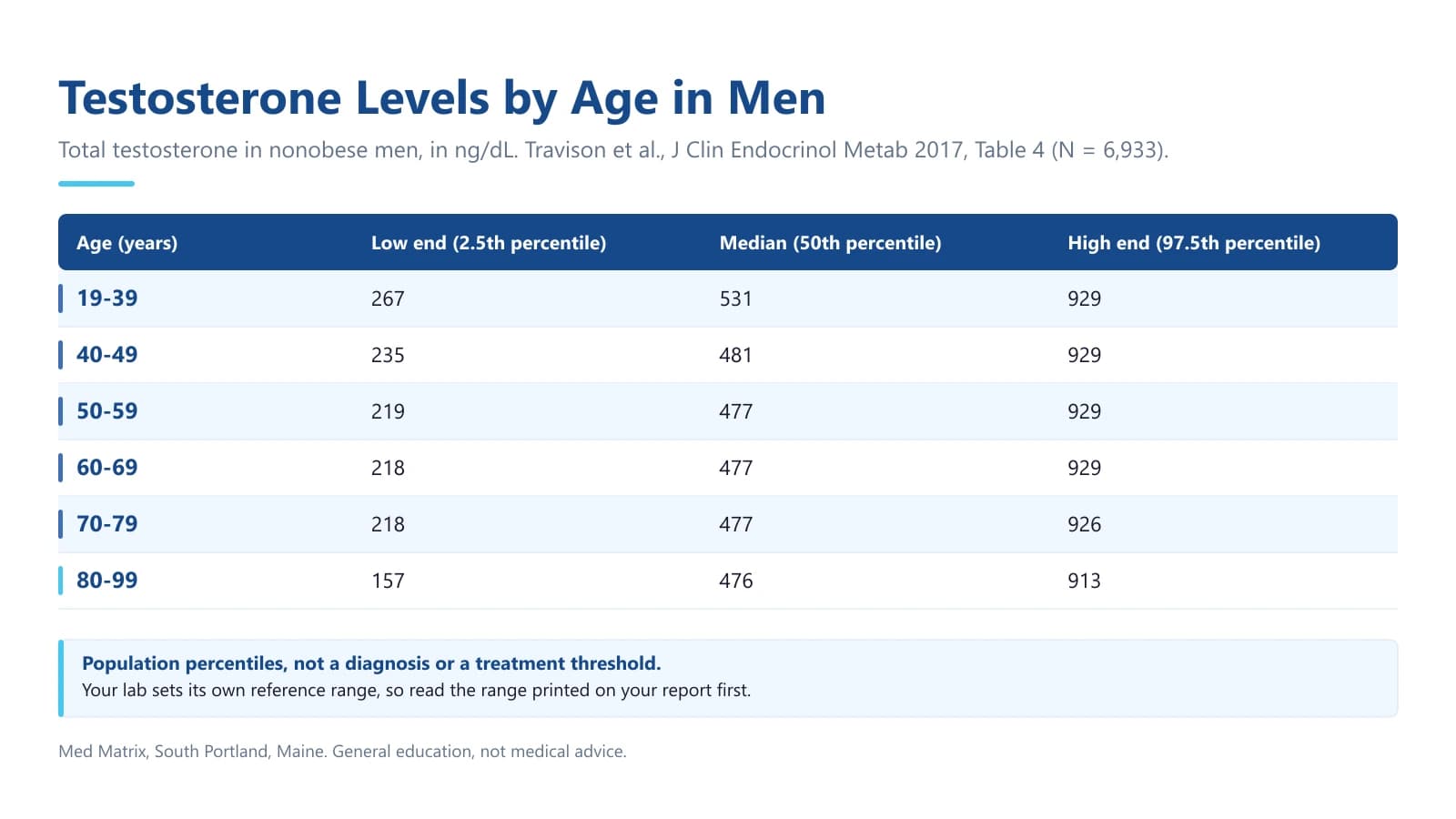
Testosterone Levels by Age: The Chart for Men
In nonobese men, median total testosterone is 531 ng/dL at ages 19 to 39 and about 477 ng/dL from the 50s on, while the low end of the range drops further with age. The figures come from Table 4 of a 2017 study by Travison and colleagues in the Journal of Clinical Endocrinology & Metabolism, built from 6,933 nonobese men (BMI under 30) across four cohorts.
| Age (years) | Low end (2.5th percentile) | Median (50th percentile) | High end (97.5th percentile) |
|---|---|---|---|
| 19-39 | 267 | 531 | 929 |
| 40-49 | 235 | 481 | 929 |
| 50-59 | 219 | 477 | 929 |
| 60-69 | 218 | 477 | 929 |
| 70-79 | 218 | 477 | 926 |
| 80-99 | 157 | 476 | 913 |
Source: Travison TG, et al. Harmonized Reference Ranges for Circulating Testosterone Levels in Men of Four Cohort Studies in the United States and Europe. J Clin Endocrinol Metab. 2017. Table 4, model-based estimates for all nonobese men (N = 6,933). Read the study on PubMed Central.
How to read it: the 2.5th percentile is the level about 1 in 40 men in that age group would fall below, by the study's estimate. The 97.5th percentile is the level about 1 in 40 would sit above. The other 95 in 100 fall in between.
Two patterns stand out. The top barely moves, sitting at 929 ng/dL from 19 through 69. The bottom is what falls, from 267 ng/dL in men 19 to 39 down to 157 ng/dL in men 80 and older. The median flattens after 40: 481, then 477 through the 70s, then 476.
These are population percentiles from research cohorts. They aren't a diagnosis, and they aren't Med Matrix's treatment threshold. Your lab also sets its own reference range, so read the range printed on your report first.
Where These Numbers Come From: Four Cohorts, One CDC Standard
The chart comes from an Endocrine Society initiative that pooled men from four studies and corrected every lab's results to one reference method at the Centers for Disease Control and Prevention (CDC). The cohorts were the Framingham Heart Study, the European Male Aging Study, the Osteoporotic Fractures in Men Study and the Sibling Study of Osteoporosis. About 100 samples from each were re-measured at the CDC's reference laboratory, and equations built from those matched pairs translated every local result onto the CDC scale.
That step matters more than it sounds. Before harmonization, average testosterone for men 70 to 79 measured 397, 470 and 575 ng/dL in three of the cohorts. After it, the same groups came out at 489, 455 and 438 ng/dL. The authors concluded that assay differences, meaning the lab method used, explained a substantial share of the gap between cohorts.
You'll find charts online with five-year bands or a row for teenagers. This study tables decades, starting at 19 to 39, so this chart prints only those six rows.
One more detail. The 264 to 916 ng/dL range in the opening comes from a separate analysis in the same paper: 1,185 healthy nonobese men aged 19 to 39 from the two cohorts that recruited men under 40, measured directly. The chart's 267 to 929 is the model-based estimate from the study's pooled harmonized data. The two land close together.
Is 300 ng/dL Low? The AUA Gives One Cutoff, Not One per Age
A total testosterone below 300 ng/dL is the AUA's reasonable cutoff in support of a low testosterone diagnosis. The AUA statement gives a single cutoff, with no separate number for each age group. The AUA also says the diagnosis should be made only after two total testosterone measurements on separate occasions, both taken in the early morning. One afternoon result doesn't meet that bar.
If you've seen testosterone written in ng/mL, divide the ng/dL figure by 100 to convert, because a deciliter holds 100 milliliters. So 300 ng/dL is 3 ng/mL, and the 19 to 39 range of 264 to 916 ng/dL is 2.64 to 9.16 ng/mL.
Now look back at the chart. For nonobese men 50 to 79, the 2.5th percentile sits at 218 or 219 ng/dL, and at 157 for men 80 and up. All of those are under 300. Even the 5th percentile for men 70 to 79 is 252 ng/dL. So a nonobese 72-year-old can measure under the AUA line while sitting inside his age group's spread.
The chart and the cutoff answer different questions. The chart says where a man falls among men his age. The cutoff marks the point where a low number, confirmed and paired with symptoms, can support a diagnosis. Neither settles a case alone, and we won't invent a number in between. The Endocrine Society's 2018 guideline takes the same line: diagnose low testosterone only in men with symptoms and signs and consistently low levels.
Total vs Free Testosterone: SHBG Can Change the Read
The chart is total testosterone, and total is only part of the picture. According to MedlinePlus, much of the testosterone in the blood is bound to a protein called sex hormone binding globulin (SHBG). A separate blood test can measure the "free" testosterone, though MedlinePlus notes that this kind of test is often not very accurate, so the method matters.
The Endocrine Society's guideline is specific about when free testosterone earns a place. When total testosterone is near the lower limit of normal, or a man has a condition that alters SHBG, it recommends a free testosterone result measured by equilibrium dialysis or estimated with an accurate formula. In plain terms, a total number near the bottom of the range is a reason to look at SHBG and free testosterone before reading much into it.
Our standard panel includes total testosterone, free testosterone and SHBG as part of the 80+ biomarker test. This study doesn't table free testosterone by age, so this page doesn't either.
How to Get a Testosterone Reading You Can Trust
Get the blood drawn early in the morning, repeat it on a second day, and read it against the range your own lab prints. Testosterone moves through the day and across the year. The 2017 study's authors note that their ranges came from single morning samples and set aside pulsatile, daily and seasonal rhythms. A checklist before you trust one number:
- Early morning. The AUA wants both measurements in the early morning, and the Endocrine Society specifies fasting morning tests.
- A second test on a separate day before anyone calls the result low.
- The same lab for the repeat, if you can, since the study found that differences in lab method explained a substantial share of the gap between cohort averages.
- Your lab's own range, printed on the report.
- Free testosterone and SHBG too, when the total lands near the low end.
Ranges really do differ by source. MedlinePlus lists an example range of 249 to 836 ng/dL for men 17 to 50 and 193 to 740 ng/dL for men over 50, and says normal ranges may vary among labs. That's a different split from the study above, which is exactly why the range on your own report comes first.
In Range but Still Symptomatic: Read the Number With the Man
A result inside the range doesn't tell you how a man feels, and a result near the low end deserves a closer look rather than a shrug. The AUA's guideline centers care on total testosterone, symptoms and signs together. That cuts both ways: a number alone doesn't make a diagnosis, and neither do symptoms alone.
A population chart has a second limit. The study's authors note that the drop with age seen across different men is smaller than the drop seen when the same men are followed over time. A chart compares you with other men your age. It can't compare you with yourself ten years ago, which is why older results, if you have them, are worth bringing. Body weight matters here too: testosterone ran higher in nonobese men than in all men. Our post on testosterone and weight gain covers how the two affect each other.
In our clinic, a provider reads testosterone alongside your symptoms and history, and repeat labs are compared against your own earlier numbers. If you're still working out whether your symptoms fit, start with our guides to low testosterone symptoms and the signs of low testosterone most men miss. Colin Renaud, PA-C, MS, FAAMFM, ABAAHP, talks through normal-but-symptomatic results on our podcast episode The Testosterone Crisis. For the wider picture, see our guide to men's health optimization.
What Happens When You Bring Us Your Numbers
It starts with a Free Discovery Call. Next is the 80+ Biomarker Test & Full Body Scan, then the Medical Team Reviews Everything, then a 60-Minute Provider Consultation where we go over every result with you, including where your testosterone, free testosterone and SHBG sit and what your symptoms add. After that comes Ongoing Support & Progress, with follow-up labs compared against your own baseline.
Cost is usually the next question, and we break it down in how much TRT costs. To see how treatment works here, visit our testosterone replacement therapy page, our men's health page, or our page for TRT in South Portland.
Frequently Asked Questions
What is a normal testosterone level for a 24 year old man?
The study behind the chart doesn't give single-year figures. It groups men 19 to 39 together. In that band, the reference range for healthy nonobese men was 264 to 916 ng/dL, and the model-based median was 531 ng/dL. A 24-year-old's own lab range may differ a little, so compare your result with the range printed on your report and with the AUA's 300 ng/dL cutoff.
What is a normal testosterone level in ng/mL?
Divide the ng/dL figure by 100. The 19 to 39 reference range of 264 to 916 ng/dL works out to 2.64 to 9.16 ng/mL, and the AUA's cutoff of 300 ng/dL is 3 ng/mL. If your report uses another unit, such as nmol/L, use the reference range your lab prints next to the result instead of converting by hand.
Is a testosterone level of 300 low?
It sits right at the AUA's line. The guideline uses a total testosterone below 300 ng/dL as a reasonable cutoff in support of a diagnosis, and only after two early-morning tests on separate days. A single result near 300 is a reason to repeat the test and check free testosterone and SHBG, then have a provider weigh it with your symptoms.
Is this chart the level where TRT starts?
No. The chart shows how testosterone was spread across nonobese men in four research cohorts. It's a population reference, and none of its numbers is a point where treatment starts. Whether TRT makes sense is a provider's decision, made from your symptoms, repeat morning labs, free testosterone and SHBG, and a conversation about your goals and risks.
My testosterone is in the low end of normal. Should I still get checked for TRT?
A low-normal result with symptoms is worth a provider review. The Endocrine Society recommends a free testosterone result when total testosterone is near the lower limit of normal, so that's a reasonable next test, along with SHBG. A review doesn't mean you'll qualify for treatment. Guidelines diagnose low testosterone only when symptoms and consistently low levels show up together.
Why does the testosterone test have to be in the morning?
Testosterone levels move through the day, and the guidelines are built on morning draws. The AUA asks for two early-morning tests on separate occasions, and the Endocrine Society specifies fasting morning tests. The reference ranges in the chart also came from morning samples, so an afternoon result isn't being compared like with like.
Where can men in Maine get total testosterone, free testosterone and SHBG read together?
Med Matrix has one office, at 198 Maine Mall Road in South Portland, Maine. Our standard panel includes total testosterone, free testosterone and SHBG as part of the 80+ biomarker test, and a provider goes over every result with you during a 60-minute consultation. The first step is a Free Discovery Call.
Sources
- Travison TG, Vesper HW, Orwoll E, et al. Harmonized Reference Ranges for Circulating Testosterone Levels in Men of Four Cohort Studies in the United States and Europe. J Clin Endocrinol Metab. 2017;102(4):1161-1173. PubMed Central. https://pmc.ncbi.nlm.nih.gov/articles/PMC5460736/. Accessed October 26, 2026.
- Mulhall JP, Trost LW, Brannigan RE, et al. Evaluation and Management of Testosterone Deficiency: AUA Guideline. J Urol. 2018;200(2):423-432. American Urological Association. https://pubmed.ncbi.nlm.nih.gov/29601923/. Accessed October 26, 2026.
- Shin YS, Park JK. The Optimal Indication for Testosterone Replacement Therapy in Late Onset Hypogonadism (a review that reproduces the AUA guideline statements). J Clin Med. 2019;8(2):209. PubMed Central. https://pmc.ncbi.nlm.nih.gov/articles/PMC6406807/. Accessed October 26, 2026.
- Bhasin S, Brito JP, Cunningham GR, et al. Testosterone Therapy in Men With Hypogonadism: An Endocrine Society Clinical Practice Guideline. J Clin Endocrinol Metab. 2018;103(5):1715-1744. Endocrine Society. https://pubmed.ncbi.nlm.nih.gov/29562364/. Accessed October 26, 2026.
- Testosterone (medical encyclopedia). MedlinePlus, US National Library of Medicine. https://medlineplus.gov/ency/article/003707.htm. Accessed October 26, 2026.
Start With Numbers You Can Read
A chart tells you where you stand among other men. It takes a full set of labs, read with your symptoms, to tell you what's going on with you. Start with a Free Discovery Call. We see men from Maine and New Hampshire at our South Portland office.
Get Your Free Guide + $100 Voucher and take the first step.
Med Matrix is a functional medicine clinic in South Portland, Maine, serving patients across Greater Portland and southern New Hampshire.