
Does Creatine Increase Testosterone? What the Trials Show

Forbes Health Advisory Board · Naturopathic Doctor
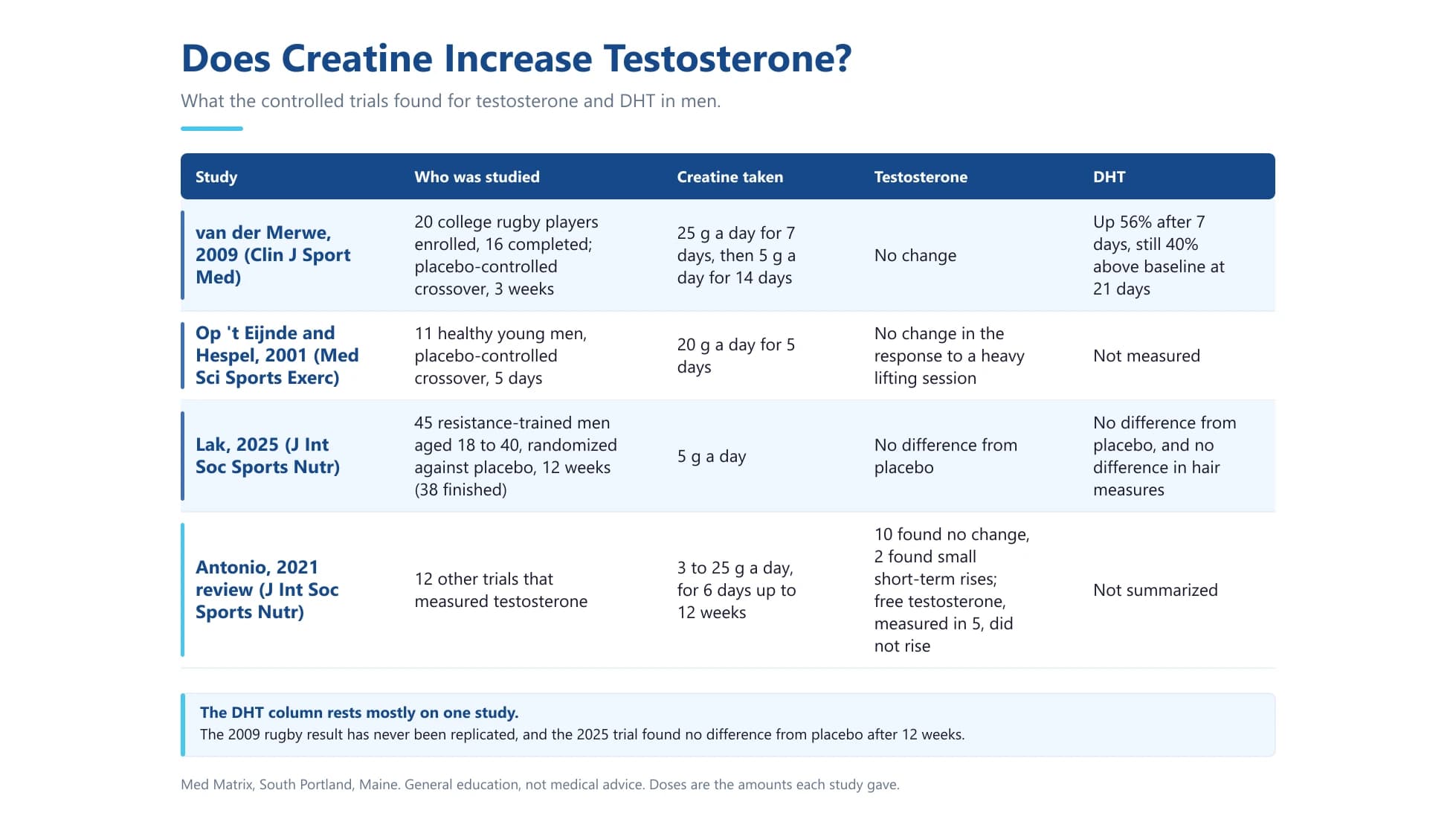
No, creatine doesn't meaningfully increase or lower testosterone in men, based on controlled trials. One small 2009 study of rugby players found that DHT, a stronger hormone made from testosterone, rose during three weeks of creatine. A larger 12-week trial in 2025 found no difference from placebo in testosterone, DHT or hair.
Med Matrix is a TRT clinic offering testosterone replacement therapy for Maine men. Men take creatine for two opposite reasons worth checking: some hope it raises testosterone, and others avoid it because they have heard it causes hair loss.
Both ideas trace back to a handful of studies, and one of them gets quoted far more than it deserves. This post walks through what those trials measured, what they found, and where they fall short. It's general information, and it isn't a substitute for advice from your own provider.
What the Studies Found, Side by Side
The three individual trials below all studied men. The last row is a review that pooled 12 more.
| Study | Who was studied | Creatine taken | Testosterone | DHT |
|---|---|---|---|---|
| van der Merwe, 2009 (Clin J Sport Med) | 20 college rugby players enrolled, 16 completed; placebo-controlled crossover, 3 weeks | 25 g a day for 7 days, then 5 g a day for 14 days | No change | Up 56% after 7 days, still 40% above baseline at 21 days |
| Op 't Eijnde and Hespel, 2001 (Med Sci Sports Exerc) | 11 healthy young men, placebo-controlled crossover, 5 days | 20 g a day for 5 days | No change in the response to a heavy lifting session | Not measured |
| Lak, 2025 (J Int Soc Sports Nutr) | 45 resistance-trained men aged 18 to 40, randomized against placebo, 12 weeks (38 finished) | 5 g a day | No difference from placebo | No difference from placebo, and no difference in hair measures |
| Antonio, 2021 review (J Int Soc Sports Nutr) | 12 other trials that measured testosterone | 3 to 25 g a day, for 6 days up to 12 weeks | 10 found no change, 2 found small short-term rises; free testosterone, measured in 5, did not rise | Not summarized |
Read across the testosterone column and the pattern is plain. Short trials, long trials, big doses, small doses: testosterone barely moves. The DHT column is where the argument lives, and it rests mostly on one study.
What Creatine Actually Does in Muscle
Creatine isn't a hormone, and it doesn't act like one. Your muscles turn it into phosphocreatine, a quick energy reserve used to rebuild ATP during short, hard efforts like a heavy set or a sprint. The 2021 review in the Journal of the International Society of Sports Nutrition spells this out when it answers the question "Is creatine an anabolic steroid?" Its answer is no.
Anabolic steroids work by binding the androgen receptor inside the muscle cell. Creatine works on the energy supply. More energy for hard sets can mean more reps and more training volume, and over months that can add muscle. That's an indirect route, and it runs through the gym.
The International Society of Sports Nutrition's 2017 position stand calls creatine monohydrate the most effective ergogenic nutritional supplement currently available to athletes for raising high-intensity exercise capacity and lean body mass during training. Notice what that claim is about. Performance and muscle. Hormones aren't part of it.
The Rugby Player Study, Read Carefully
Nearly every "creatine raises DHT" article points back to one paper: van der Merwe and colleagues, published in 2009 in the Clinical Journal of Sport Medicine. It's a real study and it deserves a fair reading, which means describing both what it found and what it can't tell you.
What they did. Twenty college-aged rugby players in South Africa took part during their competitive season. Each man took creatine for three weeks and a glucose placebo for three weeks, in random order, with a six-week washout between. The creatine phase started with a loading week of 25 g a day, then dropped to 5 g a day for two weeks. Both phases included glucose.
What they found. Testosterone didn't change. DHT, which the body makes from testosterone using an enzyme called 5-alpha reductase, rose 56% after the loading week and was still 40% above baseline after the maintenance weeks. The ratio of DHT to testosterone rose too. The authors suggested creatine might speed up the conversion of testosterone to DHT, and they called for more research on long-term safety.
The limits. This is where most retellings stop, and where the story gets more interesting.
- It was small. Twenty men enrolled, and the 2021 review notes that 16 completed it.
- The DHT values stayed within normal clinical limits, according to that same review. In the creatine phase, average DHT went from 0.98 to 1.53 nmol/L. The 2025 trial authors put the normal adult male range at roughly 0.8 to 3.5 nmol/L.
- Starting DHT wasn't even. The review points out baseline DHT was 23% lower in the creatine phase than in the placebo phase, and DHT drifted down slightly during placebo. Part of the "significant" gap comes from those two facts.
- Free testosterone wasn't measured.
- Hair wasn't measured. Not a single hair. The study says nothing direct about baldness.
- It has never been replicated.
The study is still a real finding: one early signal from a small group of athletes in season, and a long way from proof that creatine changes male hormones in any lasting way.
The Trial That Tested the Question Directly
The rugby study was never repeated, and it never measured hair. In 2025, a group of researchers ran the trial men had been asking about.Lak and colleagues, published in 2025, randomized 45 resistance-trained men aged 18 to 40 to either 5 g of creatine monohydrate a day or a maltodextrin placebo for 12 weeks. The men kept their usual diet and training.
The team measured total testosterone, free testosterone and DHT at the start and end. They also measured hair directly, using a trichogram and a scalp imaging system to track hair density, follicle counts and hair thickness.
Thirty-eight men finished. The results:
- No difference between creatine and placebo for total testosterone, free testosterone, DHT, or the DHT to testosterone ratio.
- No difference in any hair measure.
- Total testosterone actually went up in both groups over the 12 weeks, by an average of 124 ng/dL with creatine and 216 ng/dL with placebo. Free testosterone fell in both groups, by about 9 pg/mL on average. The researchers found these shifts happened regardless of what the men took, so they reflect something other than creatine.
It has limits too. Twelve weeks is still short. These were young, trained men, so the results may not carry over to a 55-year-old who doesn't lift. There was no loading phase, which is the part of the rugby study where DHT jumped most. And several authors disclosed advisory or consulting ties to supplement companies, which the paper states openly. That doesn't erase a randomized, placebo-controlled result. It's worth knowing when you weigh it.
Even so, its authors describe it as the first trial to measure hair directly after creatine, and it doesn't support the scare.
Does Creatine Lower Testosterone?
No trial we found shows creatine lowering testosterone compared with placebo.
The short-term data point the same way. In a 2001 crossover trial, 11 healthy young men took 20 g of creatine a day for five days, then did a one-hour heavy lifting session. Their testosterone response looked the same as it did on placebo.
Across the 12 other testosterone studies the 2021 review summarized, ten found no change at all and two found small increases after six or seven days that the reviewers described as physiologically insignificant. None showed a drop.
So if a man's testosterone is low, creatine is very unlikely to be the reason. Something else is going on, and that's worth finding.
Why Creatine Won't Fix Low Testosterone
Creatine has earned its place as a training supplement, and the evidence for it is about performance, so men who take it for testosterone usually end up disappointed.
If you're dealing with low energy, a fading sex drive, poor sleep, weight creeping up around the middle, or a mood that feels flat, a scoop of powder won't sort that out. Those can be symptoms of low testosterone, and they can also come from thyroid problems, poor sleep, stress and a long list of other causes. Guessing doesn't help much here. A blood test does.
Our standard panel includes total testosterone, free testosterone, SHBG (the protein that binds testosterone in the blood), estradiol, LH, FSH and PSA. Free testosterone and SHBG matter because a total testosterone number on its own can look fine while the amount your body can actually use is low.
Food and lifestyle are the foundation either way. We cover the evidence on zinc, vitamin D, fats and alcohol in our post on foods that boost testosterone. When the numbers and the symptoms both point to a real deficiency, that's when a conversation about treatment makes sense. You can read about how we approach that on our men's health page.
Creatine and Your Blood Work
This one catches men off guard. Creatine can raise creatinine, a waste product that doctors use as a stand-in for kidney function.
The 2021 review explains it simply. Creatine and phosphocreatine break down into creatinine, so taking creatine can push blood and urine creatinine up. The reviewers say those temporary rises are unlikely to reflect worse kidney function in healthy people. In the 2025 trial, 5 g a day for 12 weeks produced no change in creatinine or eGFR. A number that looks off on a lab report can still worry you, or the person reading it, if nobody knows about the supplement.
The fix is easy. Tell whoever orders your labs that you take creatine, and how much. That one sentence saves a lot of second-guessing.
Taking Creatine and Testosterone Together on TRT
None of the trials above studied men on testosterone therapy. They looked at men making their own testosterone. So there's no trial data on how creatine interacts with a treatment plan, and we won't pretend otherwise.
What we can say is practical. Bring it up at your visit. List every supplement you take, creatine included, so your provider can read your labs in context. If hair is your concern, that's a separate conversation, and we cover it in can TRT cause hair loss.
Frequently Asked Questions
Does creatine increase testosterone?
Not in a meaningful way. A 2021 review of 12 trials found ten with no change and two with small, short-lived increases. A 2025 randomized trial that enrolled 45 men (38 finished) found no difference from placebo after 12 weeks.
Does creatine lower testosterone?
No controlled trial we found shows creatine lowering testosterone compared with placebo. If your testosterone is low, creatine is very unlikely to be the reason, and testing is how you find the real cause.
Does creatine increase DHT?
One 2009 study of rugby players (20 enrolled, 16 finished) found DHT rose during three weeks of creatine, while staying within normal clinical limits. It has never been replicated, and a 2025 trial that measured DHT over 12 weeks found no difference from placebo.
Can creatine accelerate hair loss?
The evidence says no. The 2025 trial measured hair directly, including density, follicle counts and thickness, and found no difference between creatine and placebo. The original rugby study never measured hair at all.
Is creatine a steroid?
No. Creatine fuels the energy system muscles use for short, hard efforts. Steroids act on the androgen receptor. They work in completely different ways.
Can creatine affect my lab results?
Yes. It can raise creatinine, which is often read as a kidney marker. Tell whoever orders your labs that you take it so the result is read correctly.
Can you take creatine and testosterone together?
No trial has studied creatine in men on testosterone therapy, so there's no data on how the two interact. List creatine with your other supplements at your visit so your provider can read your labs in context.
Start With Real Numbers
If you've been reaching for supplements because something feels off, the faster path is to find out what's actually happening. It starts with a Free Discovery Call, then an 80+ Biomarker Test & Full Body Scan. Our Medical Team Reviews Everything, and a 60-Minute Provider Consultation goes over every result with you. We see men from across Maine and New Hampshire at our South Portland office.
Get Your Free Guide + $100 Voucher and start getting answers.
Med Matrix is a functional medicine clinic in South Portland, Maine, serving patients across Greater Portland and southern New Hampshire.