
Does TRT Make You Infertile? What Men Should Know First

Forbes Health Advisory Board · Naturopathic Doctor
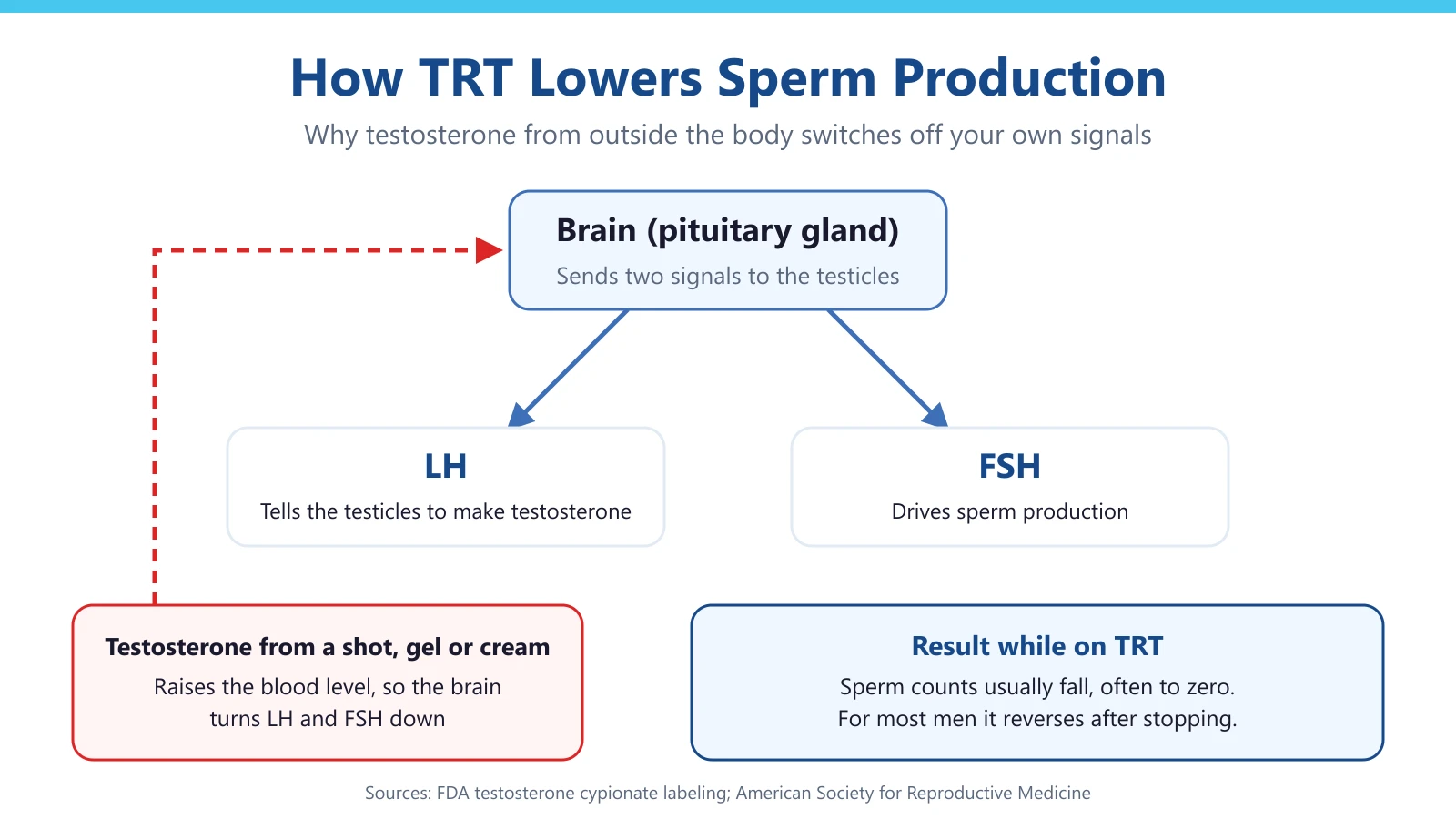
TRT can make you infertile while you're on it. Testosterone from outside the body tells your brain to stop sending the two signals your testicles use to make sperm, so sperm counts usually fall, often to zero. For most men this is reversible after stopping, but recovery takes time, it varies from man to man, and it isn't guaranteed. If you want children now or in the next few years, raise it before your first dose, not after.
Med Matrix is a TRT clinic offering testosterone replacement therapy for South Portland men. Fertility is one of the first things we ask about, because it changes what a good plan looks like.
Most men starting testosterone have one goal on their mind. More energy. A sharper head. A sex drive that shows up again. Kids come up later, sometimes years later, and by then the conversation is harder than it needed to be. This post covers why testosterone lowers sperm, what the professional groups say, what recovery looks like, and the questions worth asking first. It's general information, and it isn't a substitute for advice from your own provider.
Why Testosterone Shuts Down Sperm Production
Your testicles have two jobs. They make testosterone, and they make sperm. Both are run from the brain.
The pituitary gland, at the base of the brain, sends out two hormones. LH (luteinizing hormone) tells the testicles to make testosterone. FSH (follicle-stimulating hormone) drives sperm production. Sperm also needs a very high level of testosterone inside the testicles themselves. The American Society for Reproductive Medicine notes that the level where sperm is made is many times higher than the level in the blood.
Now add testosterone from a shot, gel or cream. The brain reads the higher blood level and decides there's plenty. It turns LH and FSH down. The FDA labeling for testosterone cypionate says it plainly: outside androgens inhibit the body's own testosterone release by suppressing LH, and at large doses sperm production may also be suppressed through FSH.
So your blood testosterone goes up while the testosterone inside the testicles drops. Sperm production slows or stops. Many men notice their testicles get smaller, which is the visible sign of the same shutdown.
It's an odd setup. The treatment raises one number and quietly lowers another one that matters a great deal to a man who wants a family.
How Likely Is It, Really?
Likely enough that you should plan around it. ASRM's patient fact sheet says testosterone treatment "usually leads to either low sperm counts, or no sperm seen whatsoever in the semen."
A review in the January 2019 issue of the World Journal of Men's Health put the point in its title: Testosterone Is a Contraceptive and Should Not Be Used in Men Who Desire Fertility. Testosterone has been studied as male birth control for exactly this reason.
That cuts both ways, and men get it wrong in both directions:
- Some assume a low count means they can't father a child at all. Low isn't always zero, and a count can recover.
- Others treat TRT as birth control. "Usually" is the key word in the ASRM line. Suppression isn't reliable enough to count on, so testosterone isn't a birth control method.
- Gym steroids work through the same feedback loop. Testosterone from outside the body is testosterone from outside the body, whatever the source.
What the Urology Guideline Says
The American Urological Association's guideline on testosterone deficiency sets out how U.S. urologists are expected to diagnose and treat low testosterone. It tells clinicians to discuss the long-term effect of testosterone on sperm production with men who are interested in future fertility, and it gives that recommendation its strongest rating.
Notice the wording. Future fertility. The guideline isn't only about men trying to conceive this month. It's about anyone who might want children down the road, which covers a lot of men in their 20s, 30s and 40s who are starting TRT.
In our clinic that turns into a simple habit. We ask early, and we ask plainly: are kids part of your plans, and when?
Can Fertility Come Back After Stopping TRT?
Usually, yes. ASRM's fact sheet says that once testosterone is stopped, sperm should return to the semen within about 3 months, with no permanent damage seen.
That's the typical case. The edges are messier. A 2017 study in Fertility and Sterility looked at men being treated to restore their sperm counts after testosterone use, and found that older age and longer time on testosterone were both linked to slower recovery. The authors advised caution with long-term testosterone in men who still want children.
Two practical points follow from that:
- Time matters. A man who stops after a few months is in a different spot from one who has been on testosterone for a decade.
- Age matters. Recovery tends to be slower as men get older, which is one more reason to have this conversation early rather than at 45.
Stopping cold has its own cost. Your own production is still switched off when you stop, so many men go through a stretch of low testosterone symptoms before their body restarts. That's uncomfortable, and it's a reason any change should be planned with the provider who prescribes your testosterone instead of done on your own. We cover that side of it in our guide to testosterone cypionate side effects.
Low Testosterone Can Affect Fertility Too
This part gets missed. Testosterone is needed for sperm production, so low testosterone on its own can come with fertility problems before any treatment starts.
That's why the cause matters. Low testosterone can start in the testicles, or it can start with the brain sending weak signals. A blood panel that includes LH and FSH alongside testosterone helps show which one you're dealing with, and that changes the conversation about treatment and about kids.
Our standard panel includes total testosterone, free testosterone, SHBG, estradiol, LH, FSH, prolactin and PSA, as part of the 80+ biomarker test every new patient gets. One honest limit: a blood test measures hormones, not sperm. A semen analysis is the test that actually counts sperm, and a man who is worried about his fertility should have one.
Questions to Ask Before You Start TRT
If any part of you thinks you might want children, bring these to your first appointment, wherever you go:
- Do you ask about fertility plans before prescribing?
- Will you check LH and FSH, not just total testosterone?
- Should I get a semen analysis before starting, so I have a baseline?
- If I want kids in a year or two, is testosterone the right first step for me?
- Who would you send me to if fertility becomes the priority?
That last question deserves a straight answer. Male fertility care is its own specialty, usually handled by a urologist who focuses on reproduction. ASRM notes that fertility specialists prescribe the medications used in this situation, because used the wrong way they can lower sperm counts. A good TRT provider knows where that line is.
A provider who can't answer the first question isn't one to start with. A fifteen-minute visit that ends with a prescription and no talk about your plans is how men end up surprised a few years later.
How We Approach Testosterone and Family Plans
Our process starts with a Free Discovery Call. Next is the 80+ Biomarker Test & Full Body Scan, then the medical team reviews everything, then a 60-Minute Provider Consultation where we go over every result with you. Fertility plans are part of that hour. After that comes Ongoing Support & Progress, with follow-up labs compared against your own baseline.
For a man who wants kids soon, the right answer is sometimes not to start testosterone yet. For a man who is done having children, the fertility question is shorter. Either way, it gets asked. You can read more about how we handle treatment on our testosterone replacement therapy page and our men's health page, or check whether your symptoms fit in our post on the signs of low testosterone.
Frequently Asked Questions
Does TRT make you permanently infertile?
Usually not. ASRM's fact sheet says sperm should return to the semen within about 3 months of stopping, with no permanent damage seen. Recovery can be slower for older men and for men who used testosterone for a long time, so it isn't guaranteed for everyone.
Can you still conceive while on TRT?
It's possible, because suppression doesn't happen to every man to the same degree. It's unlikely to be easy, since testosterone usually drives sperm counts very low or to zero. If you're trying to conceive, talk with your provider before starting or continuing testosterone.
Is TRT a form of birth control?
No. Testosterone has been studied as a male contraceptive, but it doesn't suppress sperm reliably enough to be used that way. If you need birth control, use an actual birth control method.
Do testosterone gels and creams affect fertility too?
Yes. The feedback loop responds to testosterone in the blood, whatever form it arrives in. Shots, gels, creams and pellets all signal the brain to turn down LH and FSH.
How do I know if TRT has affected my sperm count?
A semen analysis. Hormone blood tests can show that LH and FSH are suppressed, which points in that direction, but only a semen analysis measures sperm directly.
Start Your Testosterone Plan With the Right Questions
If low testosterone is wearing you down and kids are still on the table, you don't have to pick one. You need a plan that accounts for both. Start with a Free Discovery Call, and we'll take it from there. We see patients from Maine and New Hampshire at our South Portland office.
Get Your Free Guide + $100 Voucher and take the first step.
Med Matrix is a functional medicine clinic in South Portland, Maine, serving patients across Greater Portland and southern New Hampshire.