
Vitamin ADK: What A, D and K Do and Why D3 Pairs With K2

Forbes Health Advisory Board · Naturopathic Doctor
Vitamin ADK is a supplement pairing of three fat-soluble vitamins. Vitamin A supports vision and the immune system. Vitamin D helps your gut absorb calcium. Vitamin K activates proteins involved in how calcium is handled in bone and blood vessel walls. It's sold for bone and heart health, and the pairing makes sense on paper, but the combined evidence is thin.
The idea behind ADK is real biology. The marketing around it often runs ahead of the research. This guide covers what each vitamin does, why they get bundled, how much the National Institutes of Health says adults need, and who should be careful before taking any of them. It's general information, and it isn't a substitute for advice from your own provider.
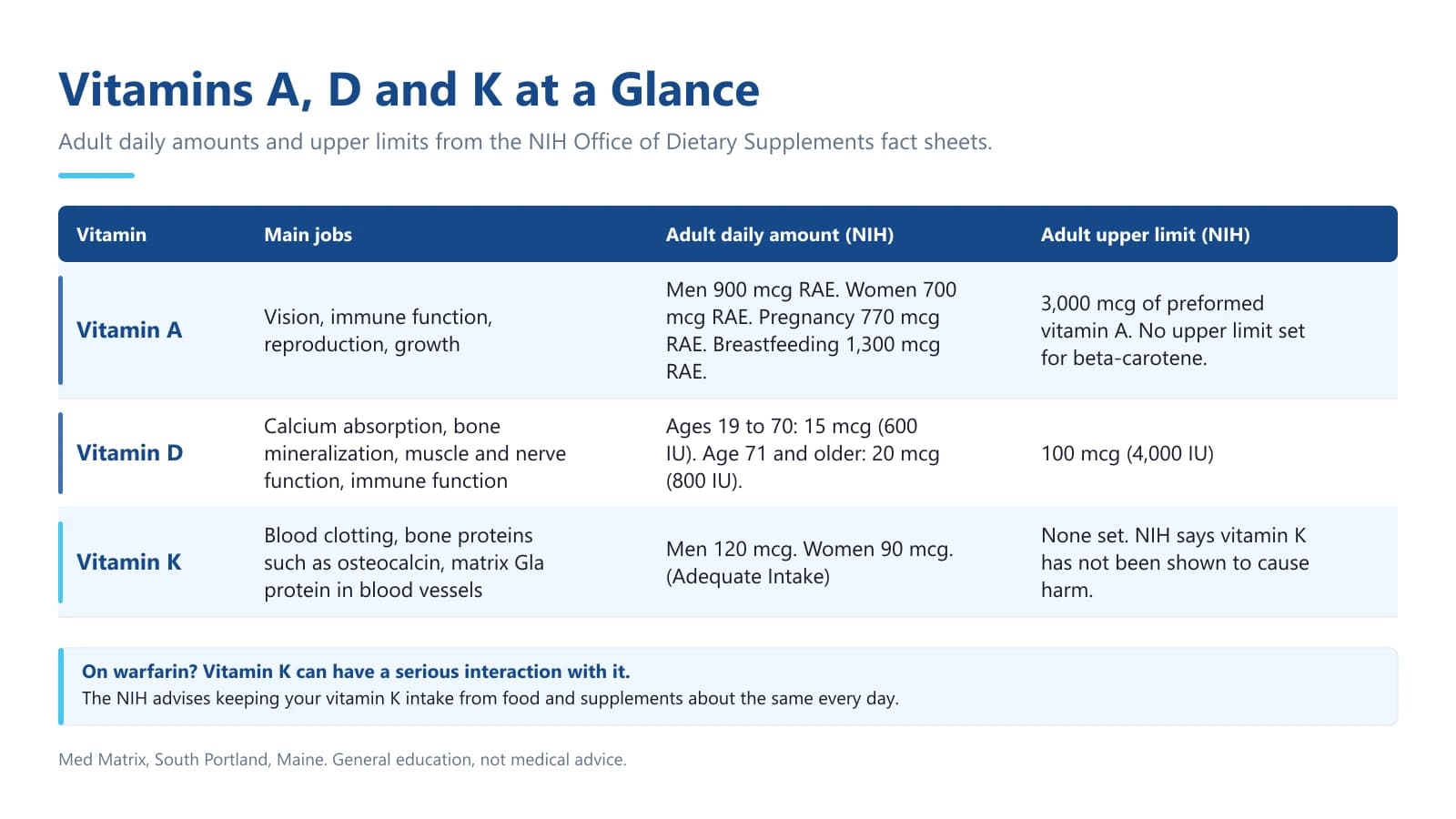
Vitamins A, D and K at a Glance
All three are fat-soluble. That means they're absorbed along with dietary fat and stored in the body instead of being flushed out in urine the way vitamin C or the B vitamins are. Storage is useful when intake is uneven. It's also why too much of some of them can build up over time.
The table below pulls the official adult numbers from the NIH Office of Dietary Supplements fact sheets for vitamin A, vitamin D and vitamin K. The daily amount is what most healthy adults need. The upper limit is the most you can take in each day, from food, drinks and supplements combined, before the risk of harm rises.
| Vitamin | Main jobs | Adult daily amount (NIH) | Adult upper limit (NIH) | Food sources | Be careful if |
|---|---|---|---|---|---|
| Vitamin A | Vision, immune function, reproduction, growth | Men 900 mcg RAE. Women 700 mcg RAE. Pregnancy 770 mcg RAE. Breastfeeding 1,300 mcg RAE. | 3,000 mcg of preformed vitamin A. No upper limit set for beta-carotene. | Liver, fish such as salmon and herring, dairy, eggs, carrots, sweet potatoes, spinach | You're pregnant or could be, you smoke and take beta-carotene, or you take acitretin or bexarotene |
| Vitamin D | Calcium absorption, bone mineralization, muscle and nerve function, immune function | Ages 19 to 70: 15 mcg (600 IU). Age 71 and older: 20 mcg (800 IU). | 100 mcg (4,000 IU) | Fatty fish, fish liver oils, egg yolks, cheese, fortified milk and cereal, sunlight on skin | You take a thiazide diuretic, steroids, a statin or orlistat, or you also take calcium supplements |
| Vitamin K | Blood clotting, bone proteins such as osteocalcin, matrix Gla protein in blood vessels | Men 120 mcg. Women 90 mcg. (Adequate Intake) | None set. NIH says vitamin K has not been shown to cause harm. | Leafy greens, broccoli, vegetable oils, soybeans, fermented foods, cheese, eggs | You take warfarin (Coumadin), long courses of antibiotics, bile acid sequestrants or orlistat |
RAE stands for retinol activity equivalents, a unit that accounts for the fact that your body converts only part of the beta-carotene you eat into vitamin A.
What Vitamin A Does
Vitamin A is the one in the bundle with the least to do with the calcium story. The NIH lists its jobs as normal vision, the immune system, reproduction, and growth and development. It also helps the heart, lungs and other organs work properly.
It comes in two forms, and the difference matters for safety:
- Preformed vitamin A (retinol and retinyl esters). Found in liver, fish, dairy and eggs, and in most vitamin A supplements as retinyl acetate or retinyl palmitate.
- Provitamin A carotenoids, mainly beta-carotene. Found in orange, yellow and dark green produce. Your body converts some of it into vitamin A as needed.
The upper limit of 3,000 mcg a day applies only to preformed vitamin A. There's no upper limit for beta-carotene. Eat a lot of carrots and your skin may turn a little orange, which is harmless and fades when you eat fewer.
What Vitamin D Does
Vitamin D's best-known job is getting calcium out of your food and into your blood. The NIH health professional fact sheet puts it this way: vitamin D promotes calcium absorption in the gut and keeps calcium and phosphate at the levels bones need to mineralize. Without enough of it, bones can become thin and brittle.
It does more than bones. Muscles need it to move. Nerves need it to carry messages. The immune system uses it too.
Supplements come in two forms, D2 (ergocalciferol) and D3 (cholecalciferol). The NIH says both raise vitamin D in the blood, although D3 might raise it higher and keep it there longer. D3 is the form ADK labels usually list.
Very few foods contain much vitamin D naturally. In the U.S., fortified foods such as milk and cereal supply most of it, and skin makes some from sunlight. How much depends on season, time of day, cloud cover and skin pigment, which is a real limitation for anyone living as far north as Maine.
What Vitamin K Does
Vitamin K is a family of compounds, and the two names you'll see on labels are K1 and K2.
- K1 (phylloquinone) comes mostly from green leafy vegetables. It's the main form in the American diet.
- K2 is a group called menaquinones, labeled MK-4 through MK-13 by the length of their side chain. MK-4, MK-7 and MK-9 are the best studied. They show up in modest amounts in animal foods and fermented foods, and bacteria in your gut make some too.
Its job is to act as a helper for an enzyme that activates certain proteins. Without vitamin K, those proteins are made but don't work properly. The best known run blood clotting, which is why vitamin K and the blood thinner warfarin are so closely tied.
Two of those proteins matter for the ADK story. Osteocalcin sits in bone and may be involved in how bone mineralizes and turns over. Matrix Gla protein is found in blood vessel walls, bone and cartilage, and the NIH notes it's the focus of a lot of research because it might help reduce abnormal calcification.
Why Vitamins D and K2 Are Paired
The logic runs like this. Vitamin D raises how much calcium you absorb. It also prompts your body to make more of the vitamin K-dependent proteins. Those proteins then need vitamin K to be activated before they can do their work.
Put simply, vitamin D brings calcium in, and vitamin K activates the proteins thought to help manage where it goes.
A 2017 review in the International Journal of Endocrinology laid out this interplay in detail. The authors described the synergistic interplay between vitamins D and K for bone and heart health, and concluded that animal and human studies suggest adequate levels of both are good for bones and blood vessels.
Then comes the part supplement pages tend to skip. The same review said there isn't enough evidence to recommend combined vitamin D and K supplementation to prevent or treat osteoporosis. Most of the trials it found studied bone in postmenopausal women. Very few tested heart outcomes, and the authors called for more clinical data.
Individual trials have pointed in a hopeful direction. A three-year randomized trial of 244 healthy postmenopausal women found that a low-dose K2 supplement (MK-7) slowed the age-related decline in bone mineral density at the lumbar spine and femoral neck, but not at the total hip. The authors themselves said the results may not carry over to other groups, such as men or children.
The NIH's own summary for consumers lands in the same place. Some research links eating more vitamin K-rich food with stronger bones. A few supplement studies found better bone strength, others didn't, and more research is needed.
So the pairing has a sound mechanism and promising early data. It doesn't yet have the kind of large outcome trials that would let anyone promise fewer fractures or cleaner arteries from a capsule.
Where Vitamin A Fits
The "A" in ADK is mostly about packaging. Vitamin A shares the fat-soluble absorption route with D and K, but it isn't part of the calcium mechanism described above, and the review on D and K doesn't depend on it.
That matters because vitamin A is the one of the three with the clearest risk at high doses. Before taking any product that includes it, add up what you're already getting from a multivitamin, fish liver oil, or any other supplement. We cover how stacked supplements add up in our post on whether you should take a multivitamin every day.
Who Should Be Careful
Fat-soluble vitamins are stored, so the risks are mostly about too much over time and about interactions with medicines. The NIH fact sheets flag several groups.
People taking warfarin
This is the big one. Vitamin K can have a serious interaction with warfarin (Coumadin). The NIH advises keeping your vitamin K intake from food and supplements about the same every day. A sudden drop can raise the risk of bleeding. A sudden rise can raise the risk of clots. Starting or stopping a K2 product without telling the clinician who manages your warfarin is exactly the kind of sudden change to avoid.
Anyone who is or might be pregnant
Too much preformed vitamin A during pregnancy can cause birth defects affecting the eyes, skull, lungs and heart. The NIH says that if you are or might be pregnant or breastfeeding, you shouldn't take high-dose preformed vitamin A supplements. Beta-carotene doesn't carry the same risk.
Smokers, former smokers and people exposed to asbestos
Several studies found that high-dose beta-carotene supplements raised the risk of lung cancer and death in these groups, according to the NIH. That's a reason to check what form of vitamin A a product uses.
People who take high-dose vitamin D for long stretches
Vitamin D toxicity is almost always caused by supplements, not food or sun. That's worth checking on the label, because some ADK products contain 5,000 or 10,000 IU of vitamin D per capsule, above the NIH adult upper limit of 4,000 IU, and some list their vitamin A as retinyl palmitate, which is preformed and counts toward the 3,000 mcg limit. Too much vitamin D can push blood calcium too high, and in extreme cases it can lead to kidney failure, calcification of soft tissues and heart rhythm problems. The NIH also notes that taking calcium supplements alongside vitamin D may increase the risk of some side effects. NIH notes that a health care provider might recommend doses above the upper limit for a period of time to treat a deficiency. That is a supervised decision, made with your lab results in hand.
People on certain medications
- Thiazide diuretics with vitamin D can raise blood calcium too high.
- Steroids such as prednisone can lower vitamin D levels.
- High-dose vitamin D may make some statins work less well.
- Orlistat cuts absorption of all fat-soluble vitamins, A, D and K included.
- Acitretin and bexarotene are made from vitamin A, so adding a vitamin A supplement can push levels dangerously high.
- Long antibiotic courses and bile acid sequestrants can lower vitamin K.
Tell every provider and pharmacist about every supplement you take, so they can check for these interactions.
How to Know Whether You Need Any of This
Most people in the U.S. get enough vitamin K from food, and NIH calls true deficiency very rare. Vitamin D is different. Very few foods contain much of it, sunlight is unreliable this far north, and it's the one a standard blood test answers directly.
That's the problem with buying a three-vitamin bundle on spec. You may be adding vitamin A you don't need to get vitamin D you might need, without knowing where you started.
A standard checkup doesn't always include vitamin D. Our 80+ biomarker panel does, along with B12, folate, ferritin and magnesium, and you can have it drawn in our office or at a partner lab near you. We read your vitamin D next to your symptoms and the rest of your labs, then retest so you can see your own numbers change over time. A number on its own isn't the whole story.
Frequently Asked Questions
What is vitamin ADK good for?
Each vitamin has its own job. A supports vision and immunity, D helps you absorb calcium, and K activates proteins involved in clotting and in how calcium is handled in bone and blood vessels. Whether taking all three together improves bone or heart outcomes hasn't been settled by large trials yet.
Why take vitamin D with K2?
Vitamin D increases calcium absorption and the production of vitamin K-dependent proteins, and those proteins need vitamin K to work. The idea is that K2 helps direct calcium into bone. A 2017 review found the reasoning sound but said there isn't yet enough evidence to recommend the combination for preventing or treating osteoporosis.
Is vitamin D3 with K2 safe to take every day?
For most healthy adults, staying at or under the NIH upper limit for vitamin D (100 mcg, or 4,000 IU, a day from all sources) is considered safe. NIH has set no upper limit for vitamin K. The major exception is anyone on warfarin, who needs a steady vitamin K intake and should talk with their prescriber before starting K2.
Who should not take D3 and K2?
Anyone on warfarin (Coumadin) should not start or stop K2 without their prescriber, because vitamin K changes how warfarin works. People who take a thiazide diuretic or calcium supplements should check with their provider before adding vitamin D. If you're pregnant or could be, avoid any ADK product that contains high-dose preformed vitamin A.
Can you take too much vitamin A?
Yes. Too much preformed vitamin A can cause headaches, blurred vision, nausea, dizziness and muscle aches, and in severe cases worse. The adult upper limit is 3,000 mcg a day. During pregnancy, high-dose preformed vitamin A supplements can cause birth defects and should be avoided.
What is the difference between vitamin K1 and K2?
K1 (phylloquinone) comes mostly from leafy greens and is the main dietary form. K2 (menaquinones such as MK-4 and MK-7) comes from animal and fermented foods and from gut bacteria. Both activate vitamin K-dependent proteins.
Should I get my vitamin D tested before taking ADK?
It's a sensible first step. A blood test shows where your vitamin D actually sits, which tells you and your provider whether supplementing makes sense at all.
Where do you get vitamins A, D and K?
Vitamin A comes from liver, fish, dairy, eggs and orange or dark green vegetables. Vitamin D comes from fatty fish, egg yolks, fortified milk and cereal, and sunlight on skin. Vitamin K comes from leafy greens, broccoli, vegetable oils and fermented foods.
Start With Your Own Numbers
If you're tired, achy, and wondering whether a supplement aisle holds the answer, find out what your body is actually short on first. It starts with a Free Discovery Call, and we see patients from Maine and New Hampshire at our South Portland office.
Get Your Free Guide + $100 Voucher and take the first step.
Med Matrix is a functional medicine clinic in South Portland, Maine, serving patients across Greater Portland and southern New Hampshire.