
DEXA Scan vs InBody in Maine: Which Body Composition Scan?

Forbes Health Advisory Board · Naturopathic Doctor
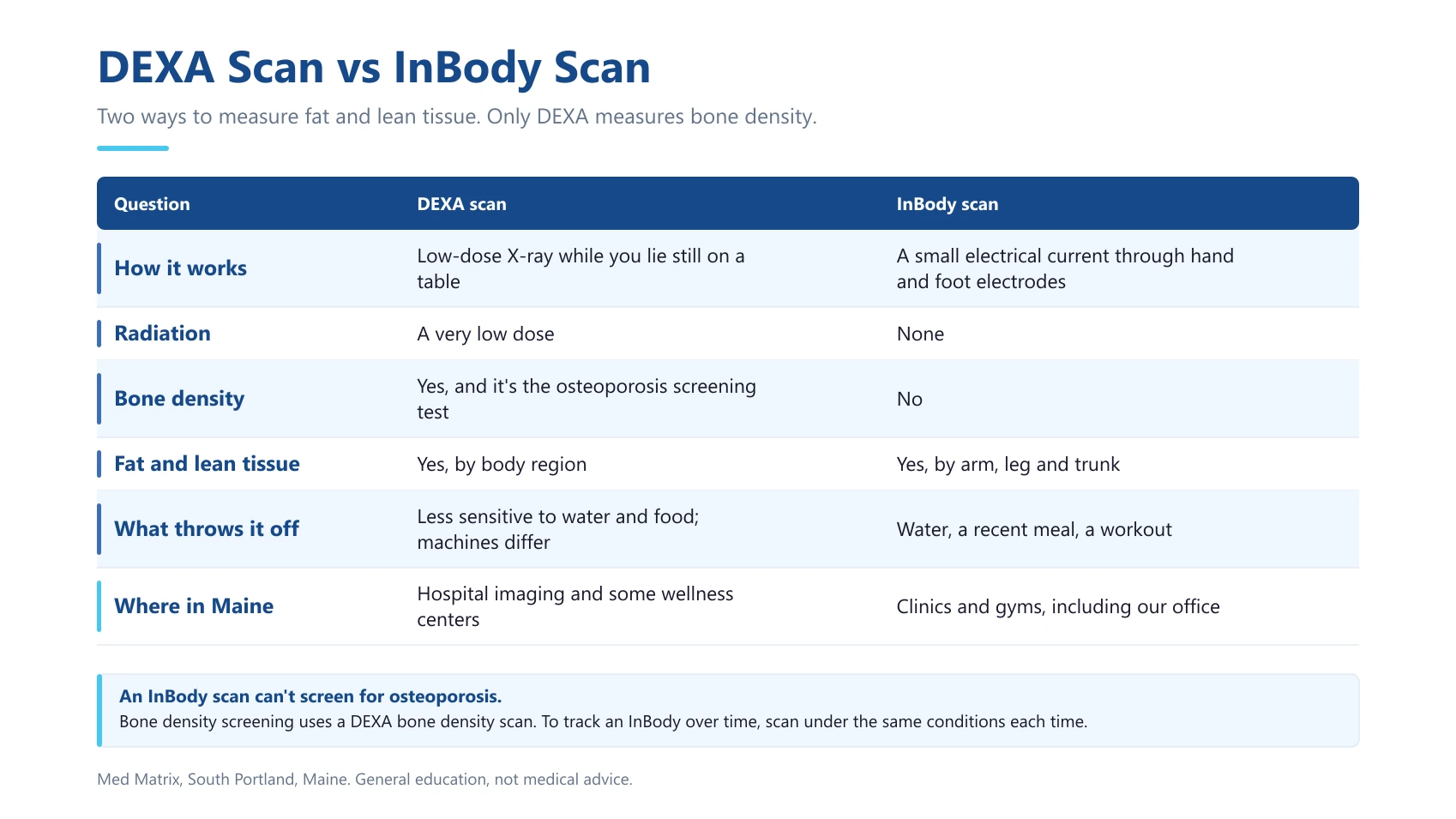
A DEXA scan and an InBody scan both tell you how much of your weight is fat and how much is lean tissue. They get there differently. DEXA uses a very low dose of X-ray, measures bone density as well, and is the test used to screen for osteoporosis. InBody sends a small electrical current through your body, uses no radiation, and doesn't measure bone density at all.
So the choice depends on the question you're asking. If it's about your bones, you want a DEXA bone density scan, which is a medical test. If it's about muscle, fat and how they change while you work on your health, an InBody scan taken the same way every time does that job well. We use an InBody 770 at every visit in our South Portland office, so this is a question patients ask us often.
DEXA vs InBody at a Glance
The short version. Each row is explained in the sections below.
| Question | DEXA scan | InBody scan |
|---|---|---|
| How it works | Low-dose X-ray while you lie still on a table | A small electrical current through hand and foot electrodes |
| Radiation | A very low dose | None |
| Bone density | Yes, and it's the osteoporosis screening test | No |
| Fat and lean tissue | Yes, by body region | Yes, by arm, leg and trunk |
| What throws it off | Less sensitive to water and food; machines differ | Water, a recent meal, a workout |
| Where in Maine | Hospital imaging and some wellness centers | Clinics and gyms, including our office |
What a DEXA Scan Measures
DEXA (also written DXA) stands for dual-energy X-ray absorptiometry. You lie on a padded table while an arm passes over you. The two X-ray energies pass through bone, fat and lean tissue differently, which lets the machine separate the three.
That's why DEXA is the test for bone density. In January 2025 the U.S. Preventive Services Task Force again recommended screening women 65 and older for osteoporosis with a DXA bone density scan, and screening postmenopausal women under 65 who have risk factors. For men, the Task Force found the evidence too thin to recommend for or against routine screening, so that call rests with a clinician.
A whole-body DEXA scan also reports fat mass, lean mass and where your fat sits. Researchers often use it as the reference when they test other body composition methods. The trade-off is practical: it's an X-ray, so it happens in an imaging setting, and it isn't something you'd repeat at every appointment.
In Maine, bone density scans for osteoporosis screening are done in hospital imaging departments. A smaller number of wellness centers offer whole-body DEXA for body composition. Those are two different services, even when they use the same kind of machine.
What an InBody Scan Measures
An InBody is a bioelectrical impedance analyzer. You stand barefoot on the footplates and hold the hand electrodes. A small current passes through you. Water conducts it easily and fat resists it, so the device estimates your body water first and works out lean and fat tissue from there.
The InBody 770 we use reports skeletal muscle mass, body fat mass, body fat percentage, visceral fat, basal metabolic rate, the balance of water inside and outside your cells, lean tissue for each arm, each leg and the trunk, and an overall InBody score. There's no radiation, so it can be repeated as often as it's useful.
It does not measure bone density, and it can't screen for osteoporosis. Anyone with a pacemaker or another implanted electronic device shouldn't be scanned with it.
Reading an InBody Report
The printout is dense the first time. Here's what the main lines mean.
- Skeletal muscle mass is the muscle attached to your bones, the kind you build with strength training. During weight loss, this is the line to protect.
- Body fat mass and body fat percentage show the same fat two ways: as a weight, and as a share of your total weight. The percentage can improve while the scale barely moves if you gain muscle.
- Visceral fat is the fat packed around your organs, as opposed to the fat under your skin. It's the type more closely tied to metabolic health.
- Basal metabolic rate is an estimate of the energy your body uses at rest. It's calculated from your lean mass, so it moves with your muscle.
- The water balance compares water outside your cells with your total body water. A shift here can mean swelling or fluid changes, and it's also a reminder that hydration affects the whole scan.
- Segmental lean analysis splits lean tissue into each arm, each leg and the trunk, which shows whether one side or one region differs from the rest.
A single report is a snapshot. The useful information is in the direction each line moves over time, read next to the rest of your health picture.
Which One Is More Accurate?
For a single reading of fat and lean tissue, DEXA is the more direct measurement. For bone, it's the only one of the two that measures anything.
For tracking change, the bigger question is consistency. Because an InBody reads your body water, a heavy meal, a hard workout or a day of poor hydration can shift the result. The same person scanned under the same conditions gets a far more useful comparison than one scanned after breakfast and again after the gym. A trend across several consistent scans tells you more than any one number.
DEXA has its own version of this problem. Different machines and software can give different numbers for the same body, so if you track with DEXA, use the same facility each time.
How to Prepare for an InBody Scan
Guidance varies a little between facilities. If yours gives you instructions, follow those. These are the common ones:
- Skip a heavy meal for a few hours beforehand.
- Don't exercise right before the scan.
- Drink normally the day before, and avoid a large amount of water just before.
- Use the bathroom first.
- Avoid a sauna or a hot shower right before, and skip lotion on your hands and feet.
- Take off socks, jewelry and anything metal.
Above all, keep your routine the same from scan to scan: similar time of day, similar meals, no workout beforehand. That's what makes two results comparable.
Which Scan Should You Get?
Get a DEXA bone density scan if your question is about your bones: you're in a group the screening guidance covers, you've had a fracture from a minor fall, or a clinician has raised bone loss with you. That's a medical test, usually ordered through your own clinician.
Consider a whole-body DEXA if you want one precise snapshot of fat, lean mass and their distribution, and you're fine with an imaging appointment.
An InBody scan makes sense when you want to follow muscle and fat over months, especially during weight loss, where the scale can't tell you what you're losing. That matters on a GLP-1 medicine. We cover it in body composition vs scale weight, and the bone side of GLP-1 weight loss in does Ozempic cause bone loss.
How We Use Body Composition at Med Matrix
Med Matrix is a functional medicine clinic at 198 Maine Mall Road in South Portland. Every patient gets an InBody 770 scan at every visit. It sits alongside the 80+ biomarker blood panel, drawn in our office or at a partner lab near you, and your provider reads the two together before recommending anything.
That pairing is the point. A scan that shows muscle loss raises a question, and your labs help answer it. In the 60-minute consultation your provider goes through both with you, result by result.
For patients losing weight on semaglutide or another GLP-1, the scan is how we watch skeletal muscle mass while the scale drops. The plan around it includes a protein target, a resistance-training prescription, and peptide or hormone support where it fits. An InBody result isn't a bone density test, and we don't read it as one. See what the panel covers on advanced lab testing.
Frequently Asked Questions
Is a DEXA scan the same as a bone density test?
A bone density test is a DEXA scan of the hip and spine. A whole-body DEXA for body composition uses the same technology to measure fat and lean tissue across your whole body. They're ordered and used for different reasons.
Is an InBody scan accurate?
It's accurate enough to track change when you're scanned under the same conditions each time. It's more sensitive than DEXA to water, food and exercise, so a single reading taken after a big meal or a workout can be off.
Does Med Matrix offer DEXA scans?
No. We use an InBody 770 body composition scan, here in our South Portland office, at every visit. Bone density screening is done in imaging settings such as hospital radiology departments.
Can an InBody scan detect osteoporosis?
No. It doesn't measure bone density. Osteoporosis screening uses a DEXA bone density scan.
What does the InBody scan cost at Med Matrix?
The scan is part of every visit, together with the 80+ biomarker panel and your provider consultation. For current pricing, see the free practice guide.
If you'd like to know what your body is actually made of, and what your labs say about it, start with a free discovery call.
From the clinic behind this article
We test first. We do not guess.
Med Matrix is a functional medicine clinic at 198 Maine Mall Road in South Portland, Maine. Everything on this blog is written from how our providers actually work with patients:
- Free Discovery Call. Talk with our patient coordinator about your goals, symptoms, and concerns.
- 80+ Biomarker Test & Full Body Scan. Your labs are drawn in our office, or at a partner lab near you, plus an InBody 770 body composition scan.
- Medical Team Reviews Everything. Providers review your labs, medical history, and questionnaires before recommending anything.
- 60-Minute Provider Consultation. Sit down with your provider for a full hour and go over every result in detail.
- Ongoing Support & Progress. Continued monitoring of your labs and markers, with adjustments as your body responds.
The providers who read your labs
 Dr. Paul Laband, MD
 Sophia Viner, DNP, APRN, FMCP‑M
 Colin Renaud, PA‑C, MS, FAAMFM, ABAAHP
 Gabriel Rocha, PA‑C, MMSc, IFMCP
- Dr. Sasha Rose, ND, LAc, MSOM
See what the panel covers on advanced lab testing, or meet the whole staff.