
Tirzepatide Dose Chart: What to Expect at Every Dose from 2.5 mg to 15 mg

Forbes Health Advisory Board · Naturopathic Doctor · Updated August 12, 2026
The tirzepatide dosage chart runs six levels: 2.5 mg, 5 mg, 7.5 mg, 10 mg, 12.5 mg, and 15 mg, each taken as a once-weekly injection. The standard schedule steps up about every four weeks, so the full climb from the 2.5 mg starter dose to the 15 mg maximum takes at least 20 weeks. The 2.5 mg dose is a starter, not a therapeutic level, and steady weight loss usually begins at 5 mg, the first therapeutic dose. Most people never need the top of the chart, and the best dose is usually the lowest one that keeps you progressing.
Below is the full chart, followed by a dose-by-dose walkthrough. The numbers only tell half the story. The pace, the holds, and the reasons a good provider slows things down matter just as much as the milligrams.
The Tirzepatide Dose Chart at a Glance
| Dose (once weekly) | Typical timing | What this dose is for |
|---|---|---|
| 2.5 mg | Weeks 1 to 4 | Starter dose. Lets your gut adjust to the medication. Weight loss is minimal by design. |
| 5 mg | Weeks 5 to 8 | First therapeutic dose. Appetite control and steady weight loss usually begin here. |
| 7.5 mg | Weeks 9 to 12 | The step up if progress stalls at 5 mg. A common long-term landing spot. |
| 10 mg | Weeks 13 to 16 | The next level for people who plateau at 7.5 mg and are tolerating the medication well. |
| 12.5 mg | Weeks 17 to 20 | A step toward the maximum for people still making progress on the climb. |
| 15 mg | Week 21 and beyond | Maximum dose. Averaged 22.5 percent body weight loss over 72 weeks in the SURMOUNT trials. |
Read the timing column loosely. Each step assumes at least four weeks at the previous dose with side effects you can live with. Providers often hold a dose longer than four weeks, and that isn't falling behind. It's usually the smarter play.
What Is the Tirzepatide Dosing Schedule by Week?
On the standard tirzepatide dosing schedule, you take 2.5 mg once weekly during weeks 1 to 4, move to 5 mg for weeks 5 to 8, then 7.5 mg for weeks 9 to 12, 10 mg for weeks 13 to 16, 12.5 mg for weeks 17 to 20, and 15 mg from week 21 onward. Read those week ranges loosely. Each step assumes at least four weeks at the previous dose with side effects you can live with, and providers often hold a dose longer than four weeks by design.
How the Tirzepatide Titration Schedule Works
Tirzepatide is titrated, meaning you start low and climb in stages so your body can adjust. The medication slows how quickly your stomach empties and turns down appetite signaling, and those changes feel strongest when they're new. Starting at a therapeutic dose on day one would make most people miserable.
It's a synthetic peptide that works through two gut-hormone pathways at once, GLP-1 and GIP, which is part of why it performs so well. If you're curious about the mechanism, our post on whether tirzepatide is a peptide goes deeper.
Every dose on the chart is a weekly shot. Tirzepatide is injection-only, so if you're weighing a shot against an oral option, our guide to GLP-1 pills versus injections covers the trade-offs. And if you know the medication by its brand names, Zepbound and Mounjaro both contain tirzepatide and follow this exact chart. We break down the brand differences in our Zepbound vs Mounjaro vs Wegovy vs Ozempic comparison.
Most quick-script clinics skip this part: the schedule on the label is a starting framework. It was never meant to be a deadline. You don't earn anything for reaching 15 mg fast, and plenty of people do well at a middle dose for years. The right dose is the lowest one that keeps you moving toward your goals with side effects you barely notice.
2.5 mg: The Starter Dose (Not Therapeutic)
The most misunderstood row on the chart. The 2.5 mg dose exists to introduce the medication, and its job is adjustment, not weight loss. Some people see the scale move a little in the first month. Many see nothing. Both are normal.
Your gut is learning a new signal during these four weeks. Digestion slows, appetite quiets, and the whole system needs time to settle. Starting low is how you avoid the nausea that sends people running after two injections.
If the first month is rough on your stomach, that's useful information, and it usually means holding at 2.5 mg a little longer instead of quitting. This is also where baseline lab work pays off. When we run advanced testing before the first injection, we know exactly what your metabolism looked like going in, which makes every later dosing decision sharper.
5 mg: The First Therapeutic Dose
At 5 mg, things change. This is the first dose considered a true therapeutic level, and it's where most people feel the medication working in earnest. Portions shrink without much willpower. Food noise gets quieter. The scale starts moving with some consistency.
A meaningful number of people find 5 mg is all they ever need. They lose steadily, feel good, and stay put. If that's you, there's no reason to climb just because the chart goes to 15.
Others make early progress at 5 mg and then plateau. Stepping up makes sense at that point, and the decision comes from how you're responding, not the calendar alone. We track that response the same way we run medical weight loss across the board, with scheduled follow-up instead of a refill and a wave goodbye.
7.5 mg and 10 mg: The Middle of the Chart
These two doses are where many people land for the long haul. If 5 mg stops delivering, 7.5 mg is next, usually after about four weeks. Then 10 mg if you need more.
The middle of the chart is a fine-tuning exercise. You and your provider are hunting for the spot where appetite control and results line up with side effects you barely notice. Some people find it at 7.5. Some at 10. There's no prize for any particular number.
The supporting work matters most here. Tirzepatide can blunt appetite so thoroughly that you under-eat protein and lose muscle along with fat, which works against everything you're trying to accomplish. Sophia Viner, DNP, APRN, FMCP-M, who works with weight loss patients in our clinic, builds protein targets and resistance training into tirzepatide plans for exactly this reason, and full body composition scans show whether the weight coming off is fat or lean mass. If you're worried about losing muscle while losing weight, that conversation belongs at every dose.
12.5 mg and 15 mg: The Top of the Chart
The top two doses are the highest approved levels, and they exist for people who tolerated the climb well and still have progress to make. They aren't better by default.
The trial data behind the chart is worth knowing. In the SURMOUNT trials, tirzepatide at 15 mg averaged 22.5 percent body weight loss over 72 weeks, while the 5 mg and 10 mg doses landed roughly in the 15 to 20 percent range. Higher doses produced more average loss, but averages say nothing about what your body needs, and chasing the maximum while your gut protests is how people end up quitting altogether.
Reaching the top should feel deliberate. Tolerating the medication well with goals still ahead of you? Climbing makes sense. Holding steady at 10 mg and feeling good? Staying put is a win. The dose that keeps you healthy and consistent for a year beats the biggest number on the box.
What Is the Tirzepatide Dosage Chart for Weight Loss?
The tirzepatide dosage chart for weight loss is the same six-step climb from 2.5 mg to 15 mg, and steady weight loss usually begins at the 5 mg dose, the first therapeutic level. In the SURMOUNT trials, 15 mg averaged 22.5 percent body weight loss over 72 weeks, while the 5 mg and 10 mg doses landed roughly in the 15 to 20 percent range. Higher doses produced more average loss, but the right dose is the lowest one that keeps you progressing, so many people reach their goals well before the top of the chart. We build that into how we approach weight loss treatment.
When Providers Slow Down or Hold a Dose
A responsible provider doesn't march everyone up the chart on autopilot. There are solid reasons to sit at a dose longer than four weeks or pause the climb entirely, and none of them mean the medication is failing you.
- Side effects. Nausea, vomiting, diarrhea, constipation, and reflux tend to flare right after a dose increase. Holding lets your body catch up before you go higher. Our guide to GLP-1 side effects covers what's normal and what's worth a call.
- Strong response. Losing steadily and feeling well? There's nothing to fix. More medication was never the goal.
- Eating too little. When appetite drops so far that you can't hit basic protein and nutrition targets, a higher dose only digs the hole deeper. Sometimes the right move is holding while you rebuild your eating habits.
- Labs and the bigger picture. Bloodwork, blood pressure, and body composition shifts all factor in. A real workup matters, the kind we build into functional medicine care rather than a five-minute video visit.
Holding a dose is the system working the way it should. The people who succeed long term almost always have a provider who stayed involved past the first prescription.
What Decides Where You Land on the Chart
Two people can start tirzepatide the same week and settle at completely different doses, both doing great. Where you land depends on your biology, your starting weight, your goals, and how your gut handles the medication.
It also depends on what's going on underneath. Thyroid function, insulin resistance, stress hormones, and sleep all shape how your metabolism responds, which is why we look at thyroid and adrenal health and broader hormone balance alongside the injection itself. Weight that won't move on a GLP-1 sometimes has a driver underneath that a higher dose was never going to solve. Our guide to why weight-loss stalls happen and what to check first walks through the usual suspects.
If you've hit a wall, more milligrams isn't always the answer. Finding what's working against you in the background is the core of how we approach weight loss treatment.
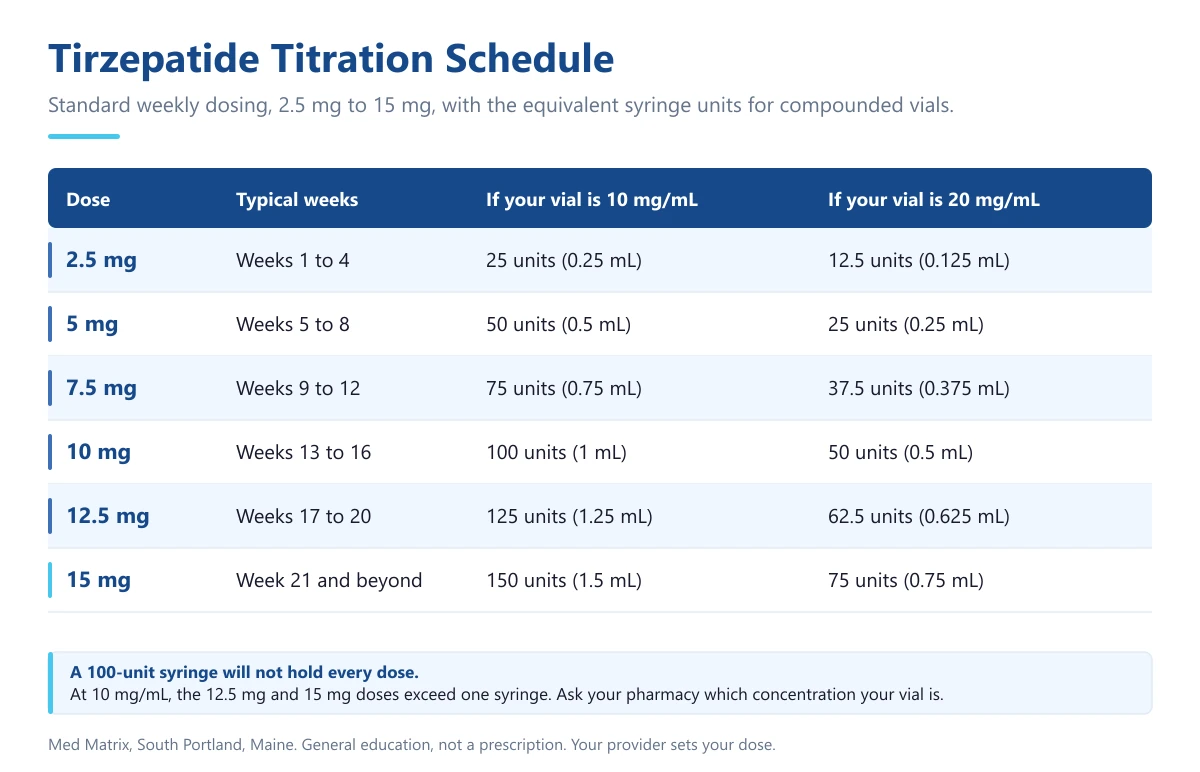
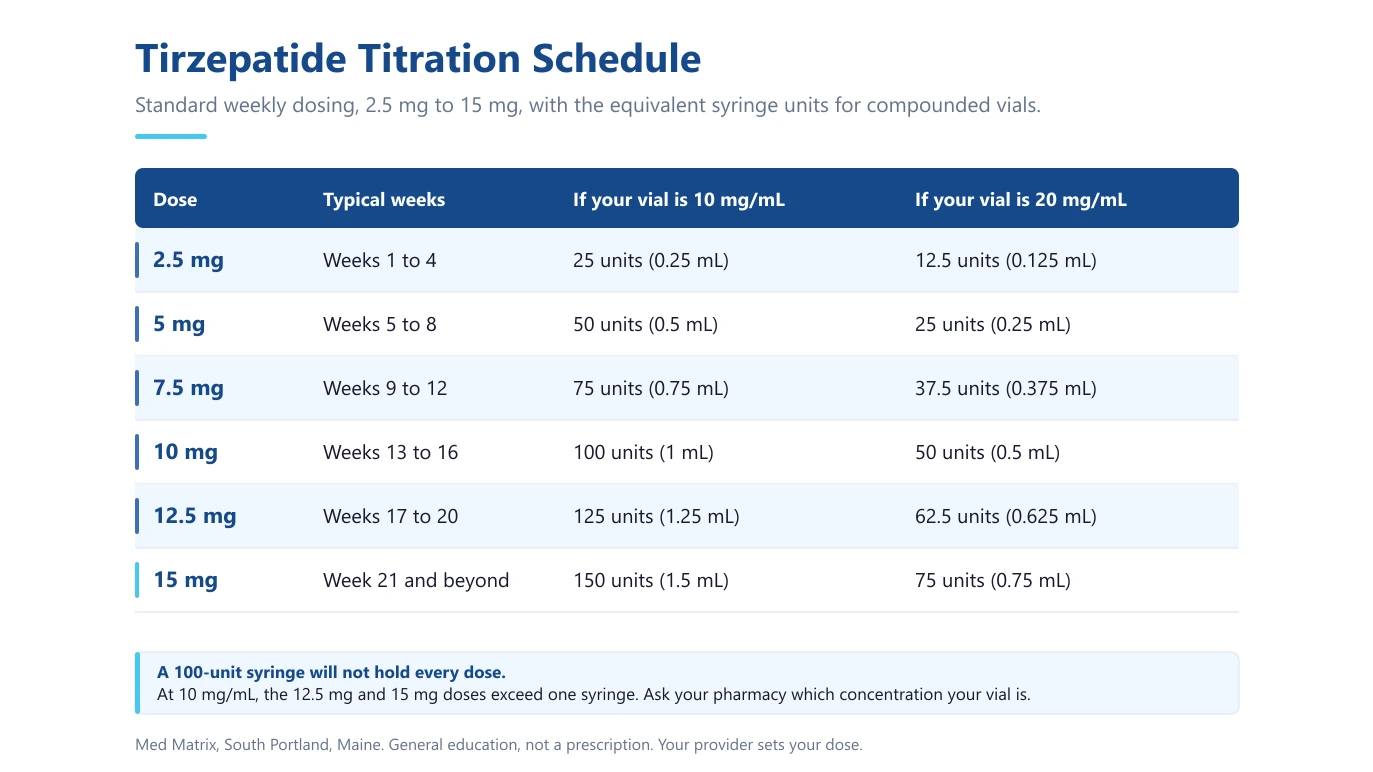
Tirzepatide Dosing Chart in Units (Compounded Vials)
Everything above is in milligrams, which is how the brand-name pens are labeled. If you are on a compounded version you are probably not holding a pen. You are holding a vial and an insulin syringe marked in units, and the chart above does not tell you where to stop drawing.
Units are a measure of volume, not of drug. So the same 5 mg dose is a different number of units depending on how concentrated your vial is, and concentration varies between compounding pharmacies. There is no universal units chart, which is exactly why you should never copy one from someone else's vial.
Read the concentration off your own vial label, then do this:
units = (your dose in mg ÷ the vial's mg per mL) × 100
The 100 is because a standard U-100 insulin syringe holds 100 units in 1 mL. Two worked examples, using the two concentrations we see most often:
| Dose | If your vial is 10 mg/mL | If your vial is 20 mg/mL |
|---|---|---|
| 2.5 mg | 25 units (0.25 mL) | 12.5 units (0.125 mL) |
| 5 mg | 50 units (0.5 mL) | 25 units (0.25 mL) |
| 7.5 mg | 75 units (0.75 mL) | 37.5 units (0.375 mL) |
| 10 mg | 100 units (1 mL) | 50 units (0.5 mL) |
| 12.5 mg | 125 units (1.25 mL) | 62.5 units (0.625 mL) |
| 15 mg | 150 units (1.5 mL) | 75 units (0.75 mL) |
Notice what happens in the 10 mg/mL column at the top of the chart. A 100-unit syringe cannot hold 125 or 150 units, so those doses need either a second draw or a more concentrated vial. If you find yourself planning to inject twice to hit one weekly dose, that is the moment to call your provider rather than improvise.
Two more things worth saying plainly. Half-unit markings do not exist on most 100-unit syringes, so a dose that works out to 12.5 or 37.5 units is being estimated, not measured, and a 30-unit or 50-unit syringe with finer gradations is the better tool. And if your vial lists a total in mg with no mg per mL anywhere on the label, you cannot calculate this safely. Ask the pharmacy for the concentration instead of guessing from the vial size.
None of this is a reason to change your own dose. The arithmetic tells you how to draw the dose you were prescribed. Where you land on the chart is a clinical decision, made against your labs and how you are tolerating the medication.
Compounded Tirzepatide: Where Things Stand in August 2026
A quick, dated note, since plenty of people following this chart are using compounded versions. The FDA has proposed permanently excluding tirzepatide (along with semaglutide and liraglutide) from large-scale 503B compounding. The public comment period on that proposal closed on July 30, 2026, and as of this update the agency has not issued a final determination. What the 503B proposal means if you are on a compounded GLP-1.
Two things follow from that, and they matter in opposite directions. Nothing has changed yet: the proposal is not final, and compounded tirzepatide is not banned today. But the direction has not changed either, and the comment window is now shut, so the next move is the FDA's.
The dose levels work the same no matter the source, but if you're on a compounded version, it's worth talking with a provider now about what your options look like once the rule is finalized. Our tirzepatide cost guide breaks down brand-name and compounded pricing and what a provider-led program actually costs.
Frequently Asked Questions
What is the standard tirzepatide dosing schedule?
You start at 2.5 mg once weekly for four weeks, then move to 5 mg. From there, the dose can increase in 2.5 mg steps (7.5, 10, 12.5, then 15 mg), with at least four weeks at each level. The fastest path to 15 mg takes about 20 weeks, though many people stop climbing well before the maximum.
Why is the 2.5 mg dose not considered therapeutic?
It's a starter dose meant to let your body adjust to the medication. Real appetite control and steady results usually begin at 5 mg, the first therapeutic level. Seeing little change in the first month is expected, and it says nothing about how you'll respond once the dose climbs.
Do I have to reach 15 mg to lose weight?
No. Many people lose well and stay at 5 mg or 10 mg long term. Higher doses produced greater average weight loss in trials, but the right dose for you is the lowest one that keeps you progressing with side effects you can live with. There's no benefit to chasing the top of the chart if a middle dose is working.
What happens if I miss a dose of tirzepatide?
It depends on how close you are to your next scheduled injection, so check with your provider before doubling up or guessing. Missing several weeks in a row can mean stepping back to a lower dose while your body re-adjusts. Your provider will tell you which applies to your situation.
What if I can't tolerate a dose increase?
Tell your provider. The usual move is dropping back to the dose you tolerated, giving your body more time, then trying the increase again later, or simply staying where you are if it's working. Pushing through severe nausea or vomiting helps nobody, and it isn't necessary for success.
Is tirzepatide dosed the same as semaglutide?
No. They're different medications with different dose levels and schedules. Both work through GLP-1, but tirzepatide adds a second pathway. Our semaglutide versus tirzepatide comparison covers the differences, and dosing doesn't transfer one-to-one between them, so read our guide to switching from semaglutide to tirzepatide before you change anything.
Does a higher tirzepatide dose cost more?
Often, yes. Pricing tends to track the dose, which is one more reason to avoid climbing higher than you need. The cost guide linked above covers brand-name pricing, compounded options, and how medication cost sits apart from labs and visits.
How We Handle Tirzepatide Dosing at Med Matrix
The chart from 2.5 mg to 15 mg is a roadmap. Where you land on it should be decided by your labs, your response, your body composition, and how you feel, with a provider who keeps adjusting instead of handing you a vial and disappearing.
Our process is built for that. It starts with a free discovery call, so a patient coordinator can hear what you're dealing with and what you've already tried. Before any prescription, you get an 80+ biomarker lab panel and a full body composition scan, which means we know your thyroid, metabolic, and hormone baseline before the first injection. The medical team reviews everything together, then you sit down with your provider for a full hour to go through the results and build the plan, including whether tirzepatide fits and where your dosing should start. From there, support is ongoing. Doses get adjusted based on your labs, your body composition, and how you actually feel, at every step of the chart.
If you're starting out, stuck on a dose, or tired of being managed by a screen, Start Feeling Like Yourself Again with a plan built around your body instead of a generic schedule.