Deciding on HRT? Explore the Pros and Cons of HRT

Forbes Health Advisory Board · Naturopathic Doctor · Updated October 14, 2026
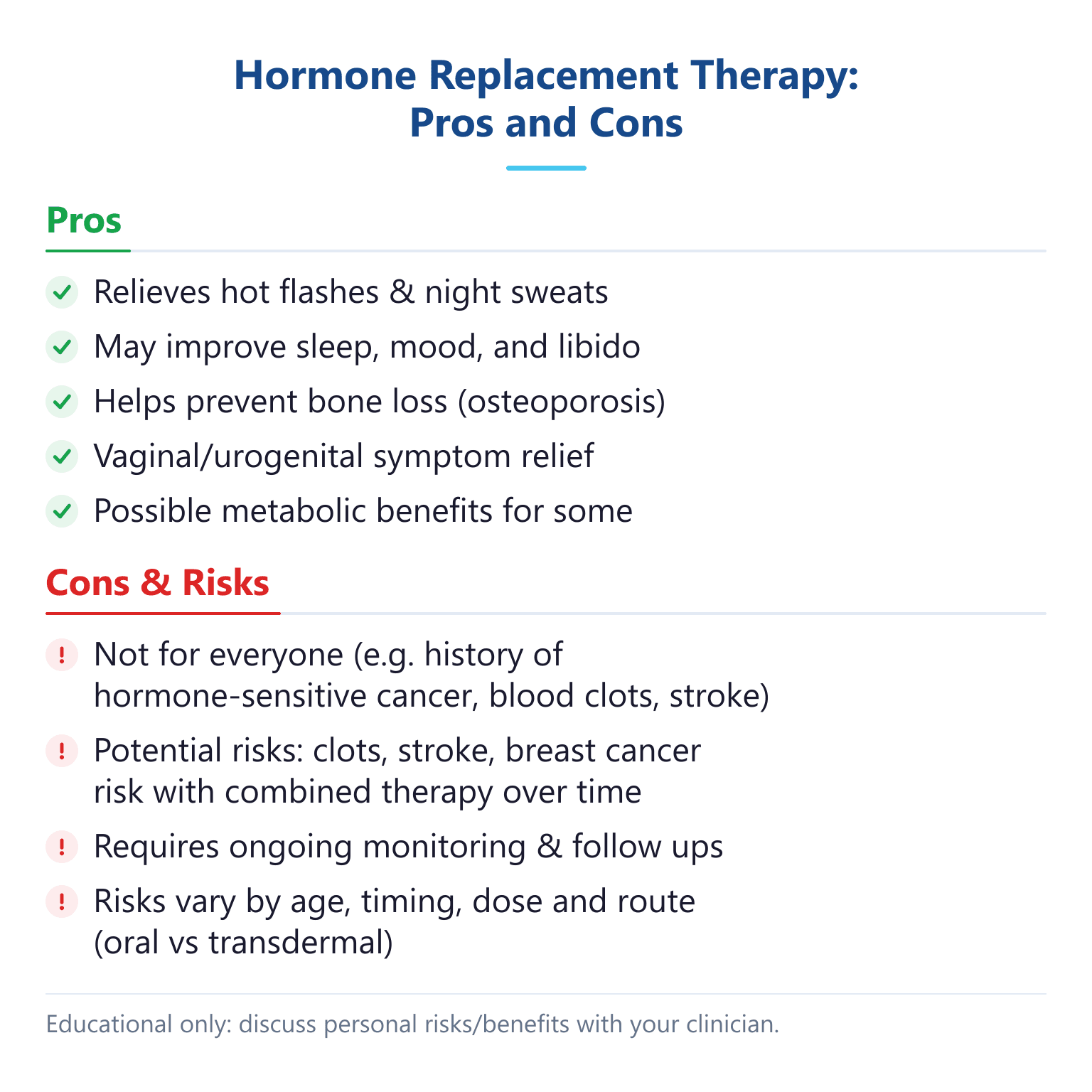
The short answer: The main pros of HRT are relief from hot flashes and night sweats, protection against bone loss and fractures, and relief from vaginal dryness and painful sex. The main cons are a small rise in breast cancer risk with combined estrogen and progestogen (little or none with estrogen alone), and a slightly higher risk of blood clots and stroke with estrogen tablets, which patches, gels and sprays largely avoid. For women under 60 or within 10 years of menopause who have bothersome hot flashes or are at risk of bone loss, and who have no medical reason to avoid it, the Menopause Society (formerly the North American Menopause Society) found the balance of benefit and risk favorable in its 2022 position statement.
Med Matrix is an HRT clinic offering hormone replacement therapy for women in Maine and New Hampshire. The rest of this guide is the longer version of that answer.
You used to feel like yourself. Now you're not sure who that person is anymore.
The brain fog hit first. Then the night sweats. Then the mood swings that came out of nowhere, the kind where you're crying in your car at 2pm and can't explain why. Your energy crashed. Your sleep fell apart. Intimacy started feeling like a chore (or just painful). And when you brought all of this to your doctor, they said your labs looked fine.
Fine.
You don't feel fine. You feel like your body turned on you, and no one is taking it seriously.
If you've been through that cycle of frustration, you're not imagining things. These are real symptoms of real hormonal changes that happen during perimenopause and menopause. And Hormone Replacement Therapy (HRT) might be worth considering as part of your care plan.
But HRT isn't a simple yes-or-no decision. There are genuine benefits, real risks, and a lot of nuance in between. The risk conversation shifted in November 2025, when the FDA announced it would remove the broad boxed warning from hormone therapy. This article walks through both sides honestly so you can make an informed choice for your body.
HRT Pros and Cons at a Glance
Here is the short version before the detail. The right call always depends on your age, your history, and your labs, decided with your provider.
Potential benefits:
- Relief from hot flashes, night sweats, and broken sleep
- Better mood, focus, and energy for many women
- Support for bone density and protection against fractures
- Help with vaginal dryness, comfort, and libido
Potential risks and trade-offs:
- A small increase in certain risks that varies with the type, dose, and timing
- A risk profile that shifts with your age and how long since menopause
- It is not right for every woman, which is why individual evaluation matters
- It needs monitoring and the right delivery method (oral versus transdermal)
What HRT Actually Is (and Isn't)
Hormone Replacement Therapy replaces hormones your body has stopped making in the amounts it used to. We're mainly talking about estrogen, progesterone, and sometimes testosterone.
During perimenopause, your ovaries slow their production of these hormones. For some women it's gradual. For others, it feels like the floor dropped out. Either way, that decline affects your brain, bones, mood, metabolism, sleep, heart, and sex drive. Not just hot flashes.
HRT gives your body back what it's lost. It's not about overriding your system or forcing something artificial. When done thoughtfully, it's about restoring balance your body already knows how to use.
Bioidentical vs. Synthetic
Bioidentical hormones are structurally identical to the hormones your body naturally produces. They're usually plant-derived and compounded to match your specific levels. Your body tends to recognize and process them more smoothly.
Synthetic hormones have a different chemical structure. They can work, but some women metabolize them harder, and the side effect profile can differ.
In functional medicine, bioidentical hormones are often the preferred starting point because the goal is to mimic your body's own rhythm, not override it.
How HRT Gets Into Your Body
There are several delivery methods, and each one matters more than people think:
- Patches, gels, and creams: Go through your skin and bypass the liver. Steady absorption, lower clotting risk for most women.
- Oral pills: Familiar and easy, but they pass through your liver first, which can affect metabolism and clotting factors.
- Vaginal creams, rings, or tablets: Target local symptoms like dryness or discomfort without much systemic effect.
- Injections: Provide longer-lasting levels but need careful dose management.
- Pellets: Implanted under the skin for slow release, though they're less flexible if adjustments are needed.
The delivery method isn't just a preference. It changes how your body absorbs the hormone, how stable your levels stay, and what side effects you might experience. This is why a cookie-cutter prescription from a 10-minute appointment doesn't cut it.
The Pros of Hormone Replacement Therapy: What HRT Can Actually Do for You
When HRT is part of a personalized, well-monitored plan, the benefits go far beyond stopping hot flashes.
Relief from Vasomotor Symptoms
Hot flashes, night sweats, the drenched-pillow-at-3am experience. For many women, HRT dramatically reduces or eliminates these. That alone can give you back your sleep, your confidence at work, and your willingness to leave the house without packing an extra shirt.
Bone Protection
Estrogen tells your body to keep building bone. When estrogen drops, bone density drops with it. HRT slows that loss. For women concerned about osteoporosis or who already have thinning bones, this is a significant benefit. Stronger bones also mean fewer fractures, better balance, and more confidence in daily movement.
Brain Function and Mental Clarity
That word-on-the-tip-of-your-tongue feeling. The fog that makes you lose your train of thought mid-sentence. Estrogen supports blood flow to the brain and protects neurons. Starting HRT during perimenopause (rather than years after menopause) may help preserve cognitive sharpness and reduce that foggy, disconnected feeling.
Heart Health Support
Estrogen helps keep blood vessels flexible and supports healthy cholesterol balance. After menopause, cardiovascular risk rises for women. When started within the first 10 years of menopause, HRT may offer protective benefits for the heart. The timing matters here, which is one more reason personalized assessment is important.
Mood Stability
Estrogen boosts serotonin. Progesterone calms the nervous system. When both drop, anxiety spikes, irritability flares, and emotional resilience shrinks. Many women on well-dosed HRT describe feeling "steadier." Not numb. Just grounded. The rage settles. The random tears slow down. You start to feel like a version of yourself you recognize.
Better Sleep
Night sweats wreck sleep. But even without them, hormone shifts disrupt the brain chemicals that regulate your sleep-wake cycle. HRT can help restore those signals so you actually wake up rested instead of just surviving another night.
Vaginal and Sexual Health
Vaginal dryness, pain during sex, urinary discomfort. These are common and deeply personal symptoms that most women don't bring up with their doctors. Estrogen therapy (even localized) can restore tissue health and make intimacy comfortable again.
What Are the Risks and Cons of Hormone Replacement Therapy?
HRT has real risks. Pretending otherwise would be dishonest. But the risks aren't the same for every woman, and understanding the details matters more than a blanket warning.
Blood Clots
Oral estrogen (pills) can increase the risk of blood clots, including deep vein thrombosis. This risk is higher in women who smoke, are significantly overweight, or have a personal or family history of clotting disorders. Transdermal methods (patches, gels) largely avoid this risk because they bypass the liver.
Breast Cancer
This is the concern that scares most women away from HRT. And it deserves a straight answer.
Combined HRT (estrogen plus synthetic progestin) used for more than five years has been associated with a small increase in breast cancer risk. How this differs between estrogen-only and combined HRT is covered below. Bioidentical progesterone may carry a different risk than synthetic progestins, though research is still evolving.
Your personal risk depends on family history, breast density, duration of use, and the specific hormones involved. This is exactly why blanket advice fails. You need someone who will actually review your full picture.
Stroke
Oral estrogen has been linked to a slight increase in stroke risk, particularly in older women or those who start HRT well after menopause. Again, transdermal delivery and earlier initiation reduce this concern for most women.
Side Effects in the Adjustment Period
Even when HRT is the right choice, the first few weeks can feel bumpy. Common early side effects include:
- Breast tenderness
- Headaches
- Bloating or nausea (especially with oral forms)
- Spotting or irregular bleeding
- Mood shifts as levels stabilize
These usually settle within one to three months. If they don't, it's a sign that dosing or delivery method needs adjusting, not that HRT "doesn't work for you."
It's Not Right for Everyone
Women with a history of certain cancers, active liver disease, unexplained vaginal bleeding, or a history of blood clots may not be good candidates for HRT. That doesn't mean they have no options. It means they need a provider who knows how to navigate the alternatives.
Estrogen-Only vs Combined HRT: How the Pros and Cons Differ
In both estrogen-only and combined HRT, estrogen is the hormone that relieves the symptoms. What changes the risk side is whether a progestogen comes with it.
If you still have your uterus, you need a progestogen alongside estrogen. Taking estrogen on its own raises the risk of uterine (endometrial) cancer, and the progestogen protects against it. That pairing is combined HRT. If you've had a hysterectomy, estrogen-only HRT is the usual choice.
The breast cancer signal sits mainly with combined HRT. The NHS puts it at around 5 extra cases of breast cancer for every 1,000 women who take combined HRT for 5 years, and describes little or no increase with estrogen-only HRT. With either type, the risk grows the longer you take it and the older you are.
Low-dose vaginal estrogen is its own case. It treats dryness, burning and painful sex where they happen, and the NHS notes it can be used without a progestogen even if you still have a uterus.
For how each delivery method changes absorption and clot risk, see How HRT Gets Into Your Body above.
Pros and Cons of HRT for Perimenopause
In perimenopause, the pros of HRT are relief from hot flashes, night sweats and broken sleep, plus bone protection, often arriving right when symptoms are hardest to live with. The cons are the same small breast cancer risk with combined HRT and clot and stroke risk with estrogen tablets, plus a cyclical regimen with a monthly withdrawal bleed and the need for separate contraception.
HRT can start before your periods stop.
A few things work differently while you're still cycling:
- The regimen. The NHS recommends sequential (cyclical) combined HRT if you're still having periods: estrogen every day, with a progestogen added for the last 10 to 14 days of each cycle.
- A monthly bleed. On a sequential regimen you'll normally have a withdrawal bleed at the end of each progestogen course. That's expected.
- Birth control. HRT is not a contraceptive, and pregnancy is still possible. The NHS advises using contraception until 2 years after your last period if you're under 50, or 1 year if you're over 50.
- Timing works in your favor. Starting before menopause puts you inside the window where guidelines judge the benefit-risk balance favorable.
Not sure where you are in the transition? Start with am I in perimenopause? or the full list of perimenopause symptoms.
When Is the Best Time to Start HRT?
When you start HRT matters as much as whether you start it.
Research consistently shows that women who begin HRT during perimenopause or within 10 years of menopause tend to see greater benefits and fewer risks than women who start later. Your body still recognizes hormone signaling during this window. Lower doses are often effective. The response is smoother.
Pros and Cons of Starting HRT After Menopause
After menopause, the balance shifts, and closer monitoring becomes more important. The Menopause Society's 2022 position statement finds the benefit-risk ratio favorable for women under 60 or within 10 years of menopause onset, and less favorable for women who start more than 10 years out or after 60, because the absolute risks of heart disease, stroke, blood clots and dementia are higher. The FDA has asked manufacturers to update systemic HRT labels to suggest starting treatment for moderate to severe hot flashes before age 60 or within 10 years of menopause onset.
Starting later puts more weight on your own heart, clotting and breast history, and on the route. Estrogen tablets carry a clot and stroke risk that patches, gels and sprays largely avoid at standard doses, according to the NHS. And if dryness or painful sex is the main problem, the Menopause Society recommends low-dose vaginal estrogen (once over-the-counter options haven't helped) for women who don't otherwise need systemic HRT.
What Changed About HRT Risks in 2025 and 2026?
On November 10, 2025, the FDA announced it would remove the broad boxed warning about cardiovascular disease, breast cancer and probable dementia from menopausal hormone therapy labels, and on February 12, 2026 it approved the first six updated labels. The boxed warning for endometrial cancer stays on systemic estrogen-alone products. The label wording changed, but the risk data in this guide still applies, so the pros and cons still get weighed one woman at a time. Here's what the FDA change means for you.
What a Functional Medicine Approach Looks Like
The biggest problem with how HRT is typically prescribed? A 15-minute visit, a standard prescription, and a "come back in six months." No testing. No follow-up. No personalization.
In a functional medicine setting, HRT is one tool inside a larger plan. Before anything is prescribed, you get thorough lab work, not just total hormone levels but free hormones, thyroid markers, inflammation markers, and metabolic indicators. Your symptoms, health history, family risk factors, and goals all factor in.
Then the plan gets built around you. The hormone type, delivery method, and dosage are chosen based on your data. Follow-up labs track how your body is responding. Adjustments happen based on results, not guesswork.
Our team works with women across Maine and New Hampshire. We run an 80+ biomarker panel and spend a full 60 minutes with you during your provider consultation. Because figuring out whether HRT is right for you shouldn't be rushed.
What Questions Should You Bring to Your Provider About HRT?
If you're weighing HRT, here are questions worth asking (whether you come to us or go somewhere else):
- What specific hormones do my labs show are low or imbalanced?
- Am I in perimenopause, menopause, or postmenopause based on my levels?
- What delivery method makes the most sense given my health history?
- Are bioidentical hormones an option for me?
- How will we monitor my levels and adjust over time?
- What are my specific risk factors for blood clots, breast cancer, or stroke?
- What lifestyle changes should I pair with HRT for the best results?
A good provider won't rush through these. If yours does, that tells you something.
How Do You Decide Whether HRT Is Right for You?
There's no universal answer to "should I do HRT?" The right answer depends on your symptoms, your labs, your risk profile, your values, and what you're willing to commit to in terms of monitoring and follow-up.
What we can say is this: you don't have to white-knuckle your way through perimenopause or menopause. You don't have to accept "this is just aging" as a final answer. And you don't have to make this decision alone or based on fear.
Get the data. Understand your options. Work with someone who will take the time to explain them.
Frequently Asked Questions
What are the main pros and cons of HRT?
The pros include relief from hot flashes and night sweats, bone protection, better sleep, and support for brain and heart health when started early. The cons include a small increase in breast cancer risk with long-term combined therapy, and clot or stroke risk that is mostly tied to oral estrogen pills. Your personal balance of benefit and risk depends on your labs, your age, and your health history.
Is HRT safe?
For many women in perimenopause or early menopause, the benefits outweigh the risks when HRT is personalized and monitored. Transdermal estrogen (patches, gels, and creams) bypasses the liver and avoids most of the clotting risk linked to pills. Safety comes down to your history and ongoing follow-up, not a blanket yes or no.
What is the difference between bioidentical and synthetic hormones?
Bioidentical hormones match the structure of the hormones your body already makes, so your body tends to process them more smoothly. Synthetic hormones have a different chemical structure, and some women metabolize them harder. In functional medicine, bioidentical hormones are often the preferred starting point.
When is the best time to start HRT?
Women who begin during perimenopause or within 10 years of menopause tend to see greater benefits and fewer risks. Starting later is still possible, but the risk and benefit conversation changes and closer monitoring becomes more important.
What are the disadvantages of HRT?
The main disadvantages are a small increase in breast cancer risk with combined HRT, which grows with longer use and older age, and a slightly higher risk of blood clots and stroke with estrogen tablets. Early side effects like breast tenderness, headaches and spotting are common while doses settle. HRT also needs ongoing monitoring, and it isn't a fit for women with certain cancers, a history of blood clots, or unexplained vaginal bleeding.
What are the pros and cons of HRT for perimenopause?
The pros are the same symptom relief and bone protection, started at the point symptoms are often worst and well inside the window where guidelines favor treatment. The trade-offs specific to perimenopause are practical: you'll usually take a cyclical regimen with a monthly withdrawal bleed, and you still need contraception, because HRT doesn't prevent pregnancy.
What are the pros and cons of taking estrogen?
Estrogen is the part of HRT that relieves hot flashes and night sweats, protects bone, and eases vaginal dryness. On its own it's for women without a uterus, and the NHS describes little or no increase in breast cancer risk with estrogen-only HRT. If you have a uterus, estrogen alone raises the risk of uterine cancer, so you need a progestogen with it. In tablet form, estrogen slightly raises clot and stroke risk, which patches, gels and sprays largely avoid.
Is it too late to start HRT after menopause?
You can still start after menopause. The benefit-risk balance is most favorable before 60 or within 10 years of menopause onset, and less favorable after that because heart, stroke, clot and dementia risks are higher. Starting later is a more careful, individual decision, and the delivery route matters more.
Does HRT work as birth control?
No. HRT is not a contraceptive, and you can still get pregnant while taking it. The NHS advises using contraception until 2 years after your last period if you're under 50, or 1 year if you're over 50.
Why do some doctors not like hormone replacement therapy?
Much of the caution traces back to early readings of the Women's Health Initiative study in the early 2000s, which linked hormone therapy to breast cancer, heart disease and stroke and led to a broad boxed warning on the label. Later research showed the risks depend heavily on age, timing and the type of HRT, and in November 2025 the FDA moved to remove that broad warning. Some doctors still practice from the older guidance, so it's fair to ask how current your provider's view is.
Is HRT worth it, or should I say no?
For many women it's a yes and for some it's a no, and a pros and cons list can't settle it alone. If you're under 60 or within 10 years of menopause, have symptoms that bother you, and have no reason to avoid it, published guidance leans toward yes. Past 60, the risks weigh more and the decision gets more individual. With a history of breast cancer or blood clots, systemic HRT is usually not recommended, and non-hormonal options come first. Your symptoms, your labs and your history decide it.
If you want to start that conversation, Med Matrix offers a free discovery call where you can talk through your symptoms and learn what testing would look like. No pressure, no sales pitch. Just a real conversation about what's going on and what might help.